Solar Power isn't Feasible!

Solar Power isn't Feasible!
This cartoon was on the cover of the book "SolarGas" by David Hoye. It echoes the Sharp Solar slogan "Last time I checked nobody owned the sun!"

Sunday, July 13, 2008

How Solar CITIES began... A story of Thanksgiving

(Our colleague and African development/Shea Butter cooperative specialist Marlene Elias demonstrates the Native American-designed "poor-man's solar hot water system" on the roof of the Los Angeles Eco-village. A 30 watt BP Solarex PV panel runs the 12v circulation pump since copper coils don't thermosiphon well, and the tank is a recycled 40 gallon gas-fired water heating tank donated by another Eco-villager).


Around the turn of the century our good friends Colin and Ronna Filkow invited educational reformer Dr. Sherry Kerr, her daughter Emily, and me to their home in Palm Springs California for Thanksgiving.

Colin was the general manager of Priority Records but had been an inventor who holds patents on Leather Glove making machines in Canada and he shares my enthusiasm for innovations and do-it-yourself technology. He knew I had recently moved into the Los Angeles Eco-Village and wanted to experiment with solar energy systems and he had kindly torn a page out of a recent Popular Science magazine he had been reading that had a cross sectional diagram of a solar hot water system and a paragraph about people building their own heaters.

He presented it to me at the breakfast table Thanksgiving day and said something to the effect of "you know, it doesn't look all that hard to build".

"Why don't we try and make one this weekend?" I asked.

"That could be fun. I have the tools in the garage, we would just need to buy the materials."

That afternoon, since Ronna and the others were busy preparing the turkey, I took it upon myself to borrow the car and drive over to the nearest Loewe's hardware superstore, a massive but isolated building surrounded by a huge parking lot in the middle of the desert.

Because it was Thanksgiving the store was as deserted as the landscape around it.

Clueless about solar construction, being more of an academic armchair inventor than a hands-on engineer, and being completely unfamiliar with hardware super-stores, I slowly made my way down the long aisles with the torn page from Popular Science in my hand, trying to figure out what I would need and where I would find it. There were no helpers on the floor.

I thought I would start with copper pipes since they were the obvious and most visible part of the system needed for carrying and heating the water, so I made my way over to the plumbing section and started laying out different lengths and thicknesses of pipe on the floor, trying to match them to the diagram.

"God help me" I thought, "I really don't have a clue what I am doing. This may be harder than I thought".

As if in answer to my silent prayer a sudden voice behind me said in a distinctive but hard to place accent, "looks like you're trying to build a solar hot water system".

Startled, I turned around to face the only other customer in the cavernous store - a dark copper-tan skinned man with jet black hair wearing denim.

"Actually, yes I am." I held out the torn magazine page for him to see, "but I only have this to go on. How did you know?"

"I build solar hot water systems. On the Native American reservation nearby, where I live. So I could tell -- only somebody trying to build a solar hot water system would lay out copper pipe in that pattern."

He smiled at my startled look.

"Do you know how to braze?" he asked gently.

I smiled self-consciously. "To tell you the truth, I don't even know what the word means!"

"So you are a total beginner. That's what I thought." He laughed, gesturing at the way I had been building my jigsaw puzzle on the floor.

" Brazing is torch-welding. To make those pipes water tight you will have to braze them and do a good job of it. Here in Southern California a solar hot water system can get so hot it will produce steam that will have to be vented with an over-pressure relief valve. I've had systems get so hot they cracked the welds. There is a lot of pressure in that steam. These things really work. But you have to do a decent job of brazing."

"Is it hard?" I asked

"No, but it takes a little practice. You have to buy an oxy-acetylene torch system and brazing rods and practice a bit."

"Hmm".

I studied the diagram as he pulled out a pen and tore a flap off of a cardboard box.

"Here's what I recommend," he said, sketching a system on the cardboard."What I've drawn here is the simplest of solar hot water systems..."

He placed the sketch in my hands and ran down the aisles, pulling parts from various bins. Then he grabbed a 60 foot coil of copper pipe and threw it down on the ground amidst the pile of parts.

"Build a box that fits this coil, about 1 yard by 1 yard, insulate it with styrofoam and place a sheet of aluminum, also about 1 yard by 1 yard, on the styrofoam in the box. Paint the aluminum sheet matte black, lay this copper coil on the aluminum sheet and fasten it in various places to the aluminum sheet with these clamps so as much of the copper touches the metal as possible and it is held down.

"Drill two holes in the box, one for the cold water coming in, one for the hot water pipe coming out. Paint the coil black too, and slap a sheet of glass or plexiglass on the box. Seal it with silicone.

" Now all you gotta braze is one connector to the in pipe and one to the hot pipe. You don't have to worry about braze joints cracking or leaks.

"The rest is just standard plumbing. A coil won't thermosiphon all that well, so you have to use a small circulation pump. Connect the pump between the bottom of your water tank and the cold connector and connect the hot connector to the top of your tank.

"If you can afford to buy a solar electric panel -- around 30 watts will do -- to run a 12 volt DC circulation pump it will turn on when the sun rises and off when it sets. It will cost you 150 or 200 bucks. But that's a luxury. Any cheap circ pump on a timer will work.

" Voila, you've got an automatic solar hot water system! On the Indian reservation people call these "the poor man's solar collector" because they are inexpensive and easy to build. Anybody can do it. But they are more than that - they are a way out of poverty and misery, a way toward comfort and dignity. A way of getting in harmony with nature so we can take care of our needs ourselves. The sun can do a lot for us once you know how to use her..."

He smiled and patted me on the shoulder. "Good luck!"

"Thank you" I said, deeply impressed. "Thanks a lot. I don't know what I would have done if you hadn't appeared."

"Sure." he replied with a wink, "It's Thanksgiving".

With that he turned and disappeared down another aisle. When I had gathered up the supplies he had brought me and returned the other copper pipes to their racks I tried to find him to get his name and contact information. But he was gone. The vast hardware store was empty.

When I got back to Colin and Ronna's everybody was worried.

"You were gone so long!" they exclaimed. "We were afraid we would have to eat the turkey without you."

"I feel like one of the first pilgrims, one of the pioneers on the first Thanksgiving" I told them as I poured the contents of my shopping bag on the living room floor.

I told the story of my mysterious encounter with the Native American solar engineer.

"What are the odds?!" I asked incredulously.

Emily said, "Sounds like he was an angel."

That night we sat down to our Thanksgiving meal and said a heartfelt prayer of thanks to the Native Americans of the past whose wisdom and kindness saved the European pilgrims from starvation that first cold winter, and to the modern Native American from the deserts of Palm Springs who shared his wisdom so that a new Eco-villager could start his pilgrimage toward using the power of the sun to help save the descendants of those Europeans -- and all those whose lives they have adversely impacted over the centuries -- from the growing nightmares and threats that have come from foolishly using fossil fuels and atomic fission to heat up water.

The next day Colin and I built our first solar hot water system from the design our mysterious Indian friend had sketched on the cardboard box, and that system became my first water heater on my apartment at the eco-village.

When I moved to Egypt in 2003 and began living and working with the urban poor, wondering how I could contribute to the development effort in the land of my cousins Naveen and Hisham, I remembered the Native American angel's advice: solar energy is a way out of poverty, a way to get into harmony with nature and find our comfort and dignity by being able to take care of our own needs.

I realized that teaching people the simple task of building a solar hot water, as our Native American friend did for me, could be the first step in building capacity and confidence in thinking creatively on how to work with what God has provided us. As the simplest of renewable energy projects, learning to build a do-it-yourself solar hot water heater puts us on a path that leads to ever more sophisticated projects as our understanding of the laws of physics and nature grows. From an understanding of how to work with local materials to provide domestic solar hot water we more easily scale up to understanding all forms of self-provisioning, from household level solar, wind, and micro-hydro electricity production, to solar adsorption chilling and solar air conditioning, to an understanding of ground-source heat pump technology, to home biogas production from urban wastes, to home hydrogen production and water purification, to rooftop gardening, composting and all other forms of ecologically sensible self-provisioning. They all flow from that first small step of learning how to harness the starlight that started all life on earth.

At any rate, it is how I started this journey on one special Thanksgiving, thanks to one mysterious Native American angel, and it showed me, as one who is descended from Irish and French Europeans and Iraqi and Lebanese Arabs yet calls himself by birth and passport "American", how we could, in turn, also act as true American angels in the lives of others when we go around the world purporting to give development help and U.S. AID.

And thus, inspired by those thoughts, a with the fortune of obtaining a grant from the American People that we wrote through the U.S. Agency for International Development, the Solar CITIES project was born...

(A song and slide-show I wrote about the experience, called The Thanksgiving Song (As We Sow so Shall We Reap), can be accessed below:)


Saturday, July 5, 2008

Let them eat cake: Food vs. Fuel as a red herring

I'm a new father with a one-week old baby so you will have to excuse me if I take the newspaper headlines a little too seriously these days.

They will affect my son's future.

And your children's.

But for some reason we don't spend a lot of time connecting the dots, putting the puzzle together, trying, as parents, to figure out how current events are going to play out as our little one's come of age.

Today's headline, "Biosprit macht Nahrung teurer" infuriates me because of what the ensuing article doesn't say. The english translation of the headline is "Biofuels make food more expensive" and the article goes on to tell us that biofuel production is being charged guilty for raising food prices by up to 75%. The figure comes to the German WAZ from the British newspaper "The Guardian" and all I can help thinking is that all of these newsrags are acting as the guardians of the status quo -- a status quo that puts my newborn son in mortal danger.

The irony is that this headline, from July 5th, comes one day after Americans had their yearly "get drunk on biofuels (primarily beer) and gorge yourself on the barbecued flesh of dead animals fed on soybean from destroyed Brazilian rainforests" party, celebrating their independence from the British. Independence day. Hooray, we're still independent from the British! Not from oil, though! Not from radioactive rocks! Not from foreign dictators! No, we wouldn't want to celebrate that, now would we? Maybe in 200 years?!?

Another irony is that the headline appears a mere 4 days after Germany finally decided to (loosely) enforce the "you can't poison other people's air with your smoke" law that was supposed to go into effect last year (they wanted to give people time to adjust to the idea that pregant women and babies like mine might want to sit in a restaurant and not be asphyxiated).

How do all these events link together?

For one thing, with all these articles indicting biofuels as the culprit in the rising food price drama, development experts wagging their fingers and saying "shame shame for trying to use corn or rapeseed or grains for fuel when they could be used to feed the hungry" NOBODY is saying "shame on the tobacco farmers for using land that could be used to grow food for the hungry to grow a toxic weed that kills millions".

Not one word is mentioned about competing land uses that are vastly more profitable than food or fuel crop growing that are taking arable soil out of production for nutritious products.

Nobody talks about how the growing of non-nutritive cash crops causes food prices to rise.

The public is being fooled into thinking that there are fields that grow corn and fields that grow tobacco and that corn should be used for food and tobacco should be used for cigarettes, and you violate some sacrosanct principle by using some corn for ethanol. The critics of biofuels never mention that for every acre of corn you plant for fuel you could simultaneously take an acre of tobacco out of production and grow food corn there.

To make it worse, Presidential candidate John McCain talks about the Brazilian success in using sugar cane for ethanol fuel production, criticizing Barack Obama's support for the midwestern farmers who are experimenting with corn fed ethanol but nobody mentions that sugar is also a non-nutritional cash crop that does more damage than good for society, or questions why we allowed so many millions of hectares of fertile rain-forest to be destroyed just so that people could sweeten their coffee and eat candy bars. Last time I visited sugar can plantations in Venezuela, Hawaii and upper Egypt I noticed there was nothing for the peasants who grow the sugar cane to eat for miles around. In the book "Death Without Weeping" Nancy Scheper Hughes documents how the sugar cane industry caused misery and starvation. But nobody said, "hey, stop! Growing sugar cane on this land drives the price of real food up by 75% -- you can't grow this garbage here!"

Likewise, nobody talks about how much corn goes into making "corn syrup sweetener" -- America's challenge to the sugar cane industries of the south. Did you notice when coca-cola and other soda pop companies switched from using sugar to corn syrup sweeteners? The fact is that we don't grow corn only for food in America or anywhere else in the world -- we grow it for sweeteners. Sweeteners that destroy people's nutrition, wreck their teeth and make them fat. All while raising the price of real food.

Oh yeah, and we grow it to feed factory-grown animals that we can barbecue on "Independence day" -- animals that could be wandering around the plains happily munching on cellulosic feedstocks like grass and other weeds that we can't eat and that happily grow on land that won't produce food crops for us.

But all the corn used for corn syrup and all the corn used to fatten animals for slaughter never makes it into the headlines as an "evil" or "bad" or even "competitive" use of our crop land.

What is more, corn fed ethanol is made from -- guess what? Corn syrup! The stuff that is in the candy and sodas and other junk food crap that makes kids hyper in school, makes cavities grow to the size of craters, makes Fat Albert fat, and causes the twinkie murderer to go on a killing spree. Some sacrifice if we have to use that garbage for fuel instead!

In California we had a visitor to the school I taught in (Jefferson High School in South Central L.A.) from a representative of the California Energy Commission who drove an ethanol fueled car. The ethanol came from the recycled waste of a local soda pop factory -- the liquid effluent waste from the corn syrup used in the soda that would otherwise have been dumped in the local rivers or sewer systems (to end up in the ocean). So it wasn't even a competitive use of the corn syrup -- it was just what was left over. Other ethanol came from a cheese factory, after they had made the cheese, taking the sugars in the whey they had to separate out. That would have been dumped down the drain too.

The fact is that an enormous amount of the sugar content from our corn production and other agricultural industries is being flushed down drains every day. But that doesn't get talked about in the alarmist articles criticizing biofuel production.

I am NOT a fan of food for fuel, and I certainly was disturbed when I visited Malaysian and Guatemalan rainforests that were being burned down to make way for vast oil palm plantations, some of which is now going for the production of biodiesel. But oil palm isn't food either -- the oil palm plantation boom began before the biofuel boom (I saw it with my own eyes as a rain forest researcher from 1985 when I was with a Harvard team in Borneo to 2003 when I was working in Central America with the L.A. Zoo) and most oil palm products ended up in cosmetics, as lubricants, in soaps, and in desserts. Desserts are not food. They are luxuries that make us fat and give us heart attacks. Sure they are fun to eat, but don't tell me you are outraged because fats and oils that would have ended up in your arteries are now being converted to run through your car engine!

Naturally I favor switch grass and other cellulosic feedstock for my biofuels. I have long been a critic of using food crops for fuel, but I have also long been a critic of using land that could be used to grow food in order to grow non-nutritional cash crops for cigarettes, coffee, tea, snacks and sweets. There is an obesity epidemic going on around the world because we don't eat right and their is a cancer epidemic going on because we let people poison our air and water with the polonium 210 and tar and nicotine that tobacco plants produce. This is hardly the time to be bickering when farmers look into ways of using their land that can help us kick our addiction to fossil fuels. It isn't as if we are going to stop growing food to get our fuel. First we would convert the land that we are using to grow tobacco and sugar cane and all that corn and wheat and rice that goes not into food for the hungry millions but into snacks and cookies and cakes that are killing us, and use that non-food crap to drive our cars right? Wouldn't we? We would use this time in history to end our addictions to not only OIL but to drugs like cigarettes and coffee and tea and other stimulants and junk food, right?


No, no. I get it. We aren't going to do either. We are beholden to our addictions. The articles waging war on biofuels are really an attempt by the party of the rich to knock the good Senator from Illinois out of the race. Because Obama is a smart man and gets it, and McCain is a panderer to the oligopolists who just wants to make sure they stay in power. McCain, a man who thinks war is a joke and sings "Bomb Bomb Bomb, Bomb Bomb Iran", makes offers of prizes for battery makers for electric cars, but his real agenda is to get us hooked on massive quantities of electricity that he will argue can only be provided by nuclear power plants. Since domestic energy can so easily be provided by wind and solar and other renewables at a much lower cost than building and maintaining and securing nuclear power plants, the nuclear lobby needs a massive turn-over from oil fueled cars to electric cars to make the argument for their latest centralized energy distribution scheme. And biofuels threaten that.

I see this as a bid to keep centralized power in the energy industry -- the same fight that Henry Ford had to wage with his chemurgists against John D. Rockefeller and William Randolph Hearst when he launched his Model A alcohol powered cars and proposed that every farmer could be both an energy and a food provider. Ford lost his battle when the oil lobby got desperate enough to force congress to enact prohibition. That killed the alcohol car. The resurrection of the electric car (which both Ford and Edison worked on and drove together in the late 1800s), while admirable if fueled by electricity produced by renewables, is, in the Republican's hands, merely an attempt to monopolize electricity through their ownership of uranium mines and nuclear power plants.

Heaven forbid we should use real plants, which are powered by the sun, to power our cars.

Smart do-it-yourselfers know that when push comes to shove we can distill our own ethanol fuel or cook up biodiesel or make biogas in the backyard using garbage and animal plant food waste. We know there is no competition between food and fuel. We know that making fuel is not going to drive up the cost of real food.

What the scaremongers would have you believe is that people are going hungry because we are turning away from oil and exploring different sources of solar powered energy, some of which involve using biomass. But if you let a poor farming family decide how to use their land they will wisely grow enough food for themselves and enough cash crops for the market. It usually matters little to them whether that cash crop is ending up being burned with a match to provide the cough in someone's lungs or burned as calories providing the sugar high in somebody's dessert or candy bar or bringing the buzz into somebody's beverage cup. Or putting the "vroom" into somebody's gas tank. That isn't what determines whether they a farming family goes hungry or not, and it isn't what is driving up food prices for the non-farmers.

If it were then there would be a simple answer for people worried about the food vs. energy debate, given how much land on this planet is devoted to non-nutritional cash crops:

Let them eat cake.


Sunday, June 22, 2008

Give us this day our daily bread, and deliver us hot water from sunshine, amen.

Last night I watched a prize winning film entitled "Unser täglich Brot", a.k.a. "Our Daily Bread". It is a brilliant and moving documentary by Nikolaus Geyrhalter that shows industrial food production in all its mechanised glory.

It made me think of The Meatrix, the disturbing spoof of the Matrix films that uses animation to show the horrors of the way we get our food, and of Erwin Wagenhofer's We Feed the World, another depressing look at agro-industry that I watched a few weeks ago.

Indeed, like the other films, it made me depressed. The scale of the problems we have created with our capital intensive systems of farming dwarf even the giant scale of the industries themselves. Agroindustry is a juggernaut, consuming behemoth proportions of water and energy and poisonous chemicals. It operates with an appetite so voracious that when you actually confront the mess we are in, you feel paralyzed into inaction. How can we even begin to talk about reducing resource consumption as citizens when the food industries that sustain us use quantities of the same materials we are trying to conserve that make our efforts look like those of valiant ants? I get the same feeling watching documentaries on the scale of our energy operations, but in that sector I feel much more confident in my ability to fight back and make a difference-- in our home we have solar hot water and photovoltaics and even a small wind generator. I've lived off the grid for several years and know I don't depend on the energy companies for my light, heat or electricity. I've ridden a bicycle as my main means of transportation (and otherwise taken public transit) so I don't feel helpless in the face of so called "oil shocks" -- go ahead and raise the price of a gallon of gasoline another 4 dollars -- won't bother me a bit! And I can do without a lot of cheap consumer goods -- my wife and I buy our clothes and books and CDs used when we want to own things, and meet friends in the public library where they have more "food for thought" than we could possibly consume in a lifetime. But when it comes to the price and availability of food for eating, when it comes down to giving us "our daily bread"... well, this one bothers me alot.

I've tried to grow my own food as an urban resident. Very, very difficult.

My fondest bittersweet memory is when the garden snails ate all the soybeans I planted. I turned around and made escargot. Such sweet revenge! But then I found out that the snail populations couldn't keep up with my predation! It takes more than a suburban stamp sized lawn to support a top predator! Yeah, we had tomatoes and hydroponic lettuce and strawberries and whatnot. But getting protein is tough for a city slicker.

Thus, when I think global crisis, I don't think about energy prices -- I think we've got that one solved when it comes to domestic consumption. My computer, my electric guitar and even my Sony Playstation all run off of photovoltaics just fine. No, domestic energy isn't the problem. You can raise the prices or cut off the supply, and we will hardly notice here at home. Make a sunk investment in household level renewable energy and you can weather a lot of storms, environmental and financial. So it seems to me that the biggest threat of the current recession is what it is doing to food production and food prices, and until we find a way beyond "business as usual" in the wasteful and resource intensive food sector, we had better consider finding ways to ration as much of the rest of the "cheap" fossil fuel supplies we have as is possible and devote them to investments in better food production techniques.

We simply can't be consuming oil and gas (and oil and gas fired electricity) to do simple things, like keeping our lights on and heating our food and water, for which we already have simple non-fossil fuel substitutes. We, as citizens, have got to help redirect energy supplies to the food industry, instead of asking them to provide us with even more fuel (we are wasting resources during this debate about "food for fuel", with corn being wasted on ethanol production when we should be using switchgrass and other cellulosic waste feedstock, while making biodiesel and biogas from animal wastes, crop residues, and city garbage). Meanwhile, we need to be sending strong market signals to our food producers that we prefer healthy local, organic, pesticide free products, and encourage a redesign of the way food is made and distributed.

What was most disturbing about watching "Our Daily Bread" for me was the conflicting memories it conjured up of my years in Cairo, Egypt, working with the "Valley Foods Corporation". Living with the family that runs the company on their plantation, adjacent to their factories, I saw first-hand how they, like all big food companies, feel trapped into a protocol for how they must treat their workers, their animals and plants, and their plantation environments in order to remain competitive and profitable. Don't get me wrong -- "Valley Foods" is a model of a good company with good practices, especially relative to other big agroindustrial corporations; they follow international ISO and HACCP standards, have great leadership, are run by a caring family. They put a lot of money and time into environmental improvements and into health and safety and dignity improvements for their workers. They even run an Educational Environmental Science Center, on whose board of directors I once sat. Among companies I've seen they are the best. It isn't the family or staff that runs the corporation I fault for what will ultimately prove to be socially and environmentally unsustainable practices -- I have great affection and respect for them and know they are trying harder than most other corporations to do the right thing. No, it is the nature of the beast - the logic of capital accumulation when it meets industrial scale operations and the constraints of the market. To be competitive they have to engage in practices that, when viewed even dispassionately can turn your stomach (and you can't get much more dispassionate than Nikolaus Geyrhalter's "Unser täglich Brot", which shows the same practices all over Europe, and does so with a complete absence of music or narration or any other biasing production techniques.) The mass production and commodification of life forms (including laborers) and the monocultural landscape required to keep prices low and increase profit margins, feels as wrong at the gut level as it is ecologically and socially unsustainable. James C. Scott labeled such practices in his book Seeing Like a State: How Certain Schemes to Improve the Human Condition Have Failed as part of "the dummification" of people and landscape.

But though well-intentioned corporations try to make marginal improvements in the way they do business (because their leaders have families and care about the future too) they are trapped in an endless merry-go-round of bad practices that feed on one another. Here is just one example I witnessed of the catch-22 corporations get themselves into: in the industrial chicken industry baby chicks need to have their anal pores closed to prevent salmonella. The cheapest way to disinfect and close the anal pore of thousands of chicks hatching every day is to bathe the chicks in mists of carcinogenic formaldehyde. The formaldehyde makes the chicks turn bright yellow as a side effect and farmers who go on to produce "broilers" who must buy the chicks from a wholesale supplier have come to use the artificial bright yellow feather color of the chicks as an indicator of health. Thus they will only buy yellow chicks. Now, if an Egyptian company decides to invest in changing their operations to be more worker and environment friendly, and switch to non-carcinogenic iodine based treatments (which is mandatory in California and the EU to protect workers health) their now not-so-yellow chicks will no longer be competitive on the market. Since the costs of switching away from formaldehyde are not offset by a reduced need for protective gear for the workers (because low wage Egyptian workers are provided with little or no protective gear to begin with, which helps keeps labor costs down) there is no cost advantage to changing this terrible practice. In fact the company could lose market share in the competitive chicken market. So people running companies feel forced to hang on to such terrible practices to stay in the game. The logic applies not only to deadly chemicals (biocides) used by agro- industry, but to the fuel-use practices fueling their competitive success. While it is easy for us to preach that agrobusiness should return to being completely solar powered (remember that agriculture is, essentially, a photosynthetic solar powered enterprise!) there is not a modern farming enterprise in the world that is going to abandon industrial scale practices and the fossil fuel dependency that it entails. That much is evident in all the documentaries on how we get our daily bread. Fossil fuels will probably be needed by most large scale agriculture firms for a long time to come.

So who will be the game changers? And if we find a few companies led by visionaries who decide to take the risk, will they be able to change things quickly enough to create a band-wagon for everybody else to jump on? What about the energy industry? Can we look to the energy sector itself to be able to provide agro-industry with safe, clean, inflation resistant fuels? We know that in the case of U.S. Coal burning utility plants for example , according to a recent Herald Tribune article entitled "Carbon-capturing technology is stalled by a Catch-22", nobody in that industry is apparently ready to take the lead and be the first to invest in carbon sequestration technology that could reduce the ecological footprint and CO2 burden of coal fired electricity or coal liquification. Meanwhile, Shell Energy, actually one of the largest of the oil companies investing in renewable energy, is investing billions more in exploiting the "trillions" of barrels of oil found in the tar sands of Alberta, Canada. Their contribution to renewable energy, while substantial by the standards of their own industry, is negligible compared to what Shell is doing to exploit even more dirty fossil fuels. BP, calling itself "Beyond Petroleum", is also a player in the RE field but is now shedding most of its investment in favor of tar sands; Exxon, despite the exhortations of the Rockefellers themselves, has yet to even turn their corporate heads in a sustainable direction, and is banking on more fossil extractions to please their shareholders. The real money is going into "business as usual", and worse, into building nuclear power plants to provide the energy needed to get energy from the tar sands that is supposed to provide us with energy!.

When it comes to wholesale investment in renewable energy and eco-friendly practices, we are still at the "prototype stage". When it comes to large-scale substitution of climate and civilization friendly fuels, everybody is waiting for the other guy to prove long term sustainability investments have enough of a short term advantage that those who use them will be able to remain profitable. But by then it will be too late for many many people suffering the effects of climate change and environmental degradation, and certainly for much of the biodiversity that keeps our unique planet magical and healthy for humans -- go to Mars if you want to picnic in a world without an ecosystem -- no ants to bother you -- and make sure you bring a six-pack for a cool one, I hear they have ice... But if you want to keep up the picnic here on earth...

Chillingly, there is today an even closer link between agro-industry and the fossil fuel industry than ever before. Not only is the former completely dependent on the latter (for everything from the fuel for its tractors, its machinery, and its transport, and for the raw materials for its fertilizers and pesticides) but both are now the major part of stock market speculators' profiles (driving up prices in both sectors in a dangerous self-reinforcing spiral). And given that our industrially produced food is so intimately dependent on fossil fuels, and that food price hikes and energy price hikes will continue to cause immiseration and social unrest (witness the recent food riots in Cairo) we have to do everything we can immediately to decrease fuel consumption elsewhere in the commodity chain; if we reduce fuel demand in one sector, we increase supply for the other.

For this reason, Solar CITIES has been vitally concerned with finding ways to reduce domestic demand for fossil fuels (and fossil fuel derived electricity) in Cairo. We would like to see our friends and the families we know there have the same advantages we have in our solar powered apartment here in Germany. Fuel and food prices will continue to rise, and with them immiseration and social unrest. We can mitigate a lot of these problems by ensuring that urban Egyptians can utilize the abundant sunshine and city garbage to provide for all their lighting, electricity, cooking and air and water heating needs.

Egypt needs to be able to export its oil and gas for hard currency at market rate so it can invest in its infrastructure and its peoples' education. It needs to supply its agro-industries with fairly priced fuel so that food prices can stay low. Thus it needs desparately to remove its fuel subsidies for domestic consumers.

But once the price of a tank of cooking gas and heating gas and electricity go up to market rates (about 5 times what people are paying today) the data from our surveys indicate that most of the urban poor (who make up the majority of Cairo's 20 million) will be forced to do two very unpalatable and unfair things -- 1) our surveys indicate that they will be forced to radically reduce consumption (which is something we wish bourgeois consumers would do, but do not wish on the Urban Poor who are at subsistence to begin with, for example using as little as 10 liters of water per capita per day) 2) our surveys show that they will go back to using the cheapest fuels available for their heating and cooking -- using kerosene in dangerous and smoky pump stoves (baburs) and burning garbage in Kanouns -- practices that drastically reduce indoor air quality and cause many health and safety hazards. They will do this so that they can devote what little money they have to buying ever dwindling quantities of ever-more-unhealthy cheap food.

The nature and scale of agro-industry and the energy industry and the current fever of speculation that is driving prices in both industries up and up is having devastating effects on the poor. Helping provide safe, clean, affordable and inflation resistent heating and cooking alternatives for the poor (such as "city solar rooftops" and "city garbage-fed biogas" ) are two of the simplest things we can do to help households weather this storm of price surges with security and dignity, so they can devote their scarce household resources to the actual and ever more expensive food and water that feeds and cleans their families, instead of paying through the nose for the means to heat these ever more precious basic commodities.

We may not be able to quickly change the nature of the game of how we get our daily bread and our daily bath. But we can immediately change the way we heat them.

Saturday, June 7, 2008

Economic Growth that recognizes the Limits to Growth

I'm enamored with youtube as a medium for professional exchange.

That little video I made for the Environment and the Psychology of Behavior class I taught for Mercy College's On-Line Education Department-- the one showing environmental engineer Les Hamasaki talking about his Solar Air Conditioning System at the Debs Park Audubon Center in L.A., has now gotten 53,801 views, and despite a few new comments from those whom I laughingly "suspect to be nuclear lobby shills" insulting me, it has, on the balance, led to very uplifting conversations with people around the world about how we can work together to reduce our fossil fuel consumption through a sharing of technical expertise. Who would have thought it!?

I would like here to publish a couple of the exchanges in the hope that they will spark furthur dialog with our Solar CITIES associates:

First the bad news:

From a guy named dannyp1974:

"How ignorant are these guys?, the drunk that fatso al gore coolaid. until people like you start realizing that nuclear energy is the most efficient and cheap , we will all suffer high price of fuel, which if the wackos environtmentalist will allow us to drill out more of it will be as cheap as in venezuel , where it cost $1.00 (one) dollar to fill out a gas tank of a car
Go nuclear , like france and don't listen to propaganda that wants us to go back to be cave men.
Realista dude"

We don't take comments like this to heart on a personal level, but they disturb us in light of the nuclear accident at the Krsko power plant in Slovenia that occured the day before yesterday. We are lucky that no radiation was released (as far as they tell us). It is unthinkable to us that ill-informed people continue to spread the myth that without nuclear power we will somehow enjoy a reduced standard of living or that anybody wants us to go back to being cave men, when in fact it is a nuclear catastrophe that will plunge us into a new dark age. Those of us who have lived like kings living off solar and wind energy, those of who are part of a high-tech culture of advanced science and materials, and have never had to worry about our energy systems hurting anybody and have never had to worry about any accidents, ever, wonder how we get cast as the recidivist villains in this power play. As though we (and our rocket scientist friends who power space stations and robots on Mars with solar energy) were the troglodytes!

Anyway, you can read the comments thread at http://www.youtube.com/watch?v=AtMC2MXc_n8 if you want to see the long answer I left for this self-embarrassing fellow, patiently addressing each of his accusations and insults (because unlike John McCain, I support Barack Obama's idea of engaging with people who think differently than we do and trying to understand and address their concerns, even when they position themselves as "the enemy" -- Jesus Christ gave us the model and the mandate to love our enemies:

"Ye have heard that it hath been said, An eye for an eye, and a tooth for a tooth: But I say unto you, That ye resist not evil: but whosoever shall smite thee on thy right cheek, turn to him the other also." (Matthew 5:38-39)...Ye have heard that it hath been said, Thou shalt love thy neighbour, and hate thine enemy. But I say unto you, Love your enemies, bless them that curse you, do good to them that hate you, and pray for them which despitefully use you, and persecute you. (Matthew 5:38-44)"

But this blog entry is not about how I deal with people who "despitefully use us or persecute us"; I'll leave that for the comments section of my youtube channel.

So here is the good news:

This blog entry is a celebration of a conversation that is evolving between us at Solar CITIES and a cool Australian guy named John who has a background in electrical chemistry and building science and wants to help developing household level solar cooling. John apparently believes (like us) that it is time we developed more "micro systems" to bring sensible energy solutions to the household level so that we aren't always dependent on massive infrastructural investments that are controlled by oligarchs and can be threatened by special interests or by terrorists (those of you who lived through the rolling blackouts during the Enron scandal that hurt California know very well what I'm talking about!).

This domestic-sized technology mission is what Solar CITIES is all about: Connecting Community Catalysts Integrating Technologies for Industrial Ecology Systems -- AT THE HOUSEHOLD LEVEL. (We left that part out because it doesn't fit the acronym "C3ITIES". It would make it C3ITIESATHL, and that is just wahnsinn! So we hope people will understand that that is what we mean by "communities"; we are intensely local, working down to the level of an individual family or group of families, as opposed to working at the city, state or federal level) Anyway, back to the latest community catalyst connection:

In the sunny land down-under, John has been building hybrid photovoltaic systems that are both grid intertied and grid-independent, his latest installations having 2 Kw of PV backup with 400 amp hour of storage, and apparently lit by 3000K warm glow LEDs (the same kind that we are installing in our apartment here in Germany -- no more harsh blue-white light, these LED lamps look and function just like halogens. They are a bit pricey just now -- 30 Euros a bulb, so we are only putting in three for the time being -- but that will change...).

Recently John and I have been dialouging about both the technical and the socio-political barriers to implementation of household size solar air conditioning , because any effort to implement a feasible technical solution must be packaged with a proper political understanding.

Let's face it - as Buckminster Fuller said back in the 1970s and is all the more true today, we really have all the technology we need to immediately move off of fossil fuels and nuclear power, we just lack the political will and we focus far too much on "centralized" "big solutions", ostensibly for economies of scale, but I suspect more for economies of the controlling interests.

So, here are some excerpts from our youtube dialouge about whether or not we can innovent a domestic Solar AC system by hunting around the internet and pooling expertise. Others of you might also find the exchange useful and might want to add your two bits to it:


"RE: SOLAR AIR CONDITIONING

"I wonder some times who runs the government.
With such big issues ahead why have we such small thinkers running the show? Oil companies hiding in the bush?
("Sorry that was a mistake" we had our own Howard (how hard) here in AU.)
As for the nuts and bolts if I can see its design /layout, yes I have access to the fitters/ artists that can make and improve it.

The installations I have put in over the years have one draw back,
they require little repeat work, so much so I have had only one call back for repairs to a system that went through a cyclone and thats in 20 years.

Have you any drawings to this heat exchanger to look at?

Hope to hear from you again Mr T.
John"


"Hi John,

I think you hit the nail on the head when you talked about the "draw back" of good engineering.

It seems our society is afraid of durable consumer durables.

In America I think we invented the institutional practice of "planned obsolescence" when our consumer durables really began to live up to their name.

I took a grad school class at UCLA where the professor basically blamed the "great depression" on the industrial revolution being too successful for the capitalist model -- he said we ended up with surpluses of everything and this destroyed the ability to get huge windfall profits from manufacturing. The laws of supply and demand stated that with an oversupply the bottom falls out of prices and the need for full employment vanishes.

So to "correct things" we had to create a policy of "planned obsolescence".

We had to create huge incentives for raising the population at home, making individuals superfluous and labor cheap. Give me your weak, your poor, your hard working immigrants, but let us keep them illegal so they can be worked to the bone without complaining (lest they be tossed out). We had to accelerate globalization and seek markets overseas . We had to make foreign populations increase exponentially, so we could increase the size of those new markets and the size of their labor pool.

Then we had to deliberately manufacture things that would break easily, that were inherently inefficient and that required constant inputs of fuel.

When all else failed, to keep a "balance" in supply and demand, we decided we had to destroy or sequester a lot of what our massively increased productivity was churning out. We had to encourage a "throw-away society" and burn agricultural surplus. And we had to wage ever more destructive wars (which rapidly deplete stocks and raise demand for goods. That is one reason that war is often a "good cure for a recession").

It's the economy stupid.

Right now in Germany the government is allowing the farmers to spray milk all over their fields to take it off the market. Every day on television we see them destroy surplus that could be used to feed the hungry while at the market they are raising the price by 10 cents a liter. Apparently with fuel prices going up the farmers are mad that they must sell their abundance of milk at last months market price when they can't afford next months fuel expenses. So they get to destroy food to bring the price up.

Of course one real good answer to that problem would be to give our surplus away to the poor and needy in other countries (which is what US AID is supposedly all about). Redistribution of wealth through redistribution of agricultural and manufactured goods overseas does help reduce domestic supply gluts.

However, while this seems logical and laudable, the greedy rich are terrified of letting such equalizing generosity go too far: since we depend on poor people to keep our labor costs down, the fear is that if they get too comfortable through our largesse they won't work as hard and for so little. We say it is for their own good -- as if people get dependent on basics like food and water and machinery the same way they get hooked on drugs. As though third world people who were healthy and had a chance to raise their productivity would lose all incentive to grow.

No, it is more likely that we fear that if "the poor" had free reliable food and water and clothing and machines they would not just have a comparitive advantage, but an absolute advantage that would erase the profits to be made from exploiting them.

Nancy Scheper-Hughes in Death Without Weeping tells the story of how the sugar plantation owners in North East Brazil used to destroy the workers home gardens and forbid self-provisioning. The argument behind this barbaric practice was that if they couldn't feed themselves they would have to accept working for miserable wages on the plantation and then buy food from the company store.

Yale professor James C. Scott makes similar observations in "Seeing Like A State" in which he talks about governments' need to "dummify" their peasants and proletariat so that they needed to work for the land and factory owners and could not take care of themselves.


Keep 'em dumb and hungry, right?

Why is the idea of well-fed, materially satisfied individuals willingly engaging in free trade for mutual advantage so frightening to people? What is wrong with the idea of an economy that grows in productivity without growing in sheer volume of output, an economy that can give everybody what he or she needs to be happy and fulfilled at low cost, and that grows not in physical size but in efficiency and expertise?

The rich (and those who are not rich but who have the ambition to be rich) seem to be threatened by the concept of a steady-state economy, even though great economists like John Stuart Mill and Herman Daly have argued for its net benefits.

But as you note, John, when you do too good a job there is little repeat work; and I think people are scared that unless the population is actively growing and creating new demand producers run the risk of driving themselves out of the market. At the same time, growing populations mean growing problems in dealing with scarcity in land and other non-renewable factor inputs.

That is the fear.

I think the long term solutions are evident though:


1) help families voluntarily limit population growth by giving them great education and health care and access to credit.

2) continually improve products and offer them in ever "sexier" packaging so that consumers want to "replace and upgrade" even when they don't have to (the "fashion" solution which also drives demand for new computer hardware and software) and most importantly

3) put our energy into expanding ecologically sensible civilizations underground, underwater and into space, striving to create sustainable biospheres that add value to their environments rather than destroy them (when life expanded from the sea to the land millions of years ago it was at no cost to the sea, but rather enriched the sea. William McDonough talks about this "Industrial Ecology" Model)

As for Solar Air Conditioning , whch is one component of this "eutopian" dream, the diagrams and explanations that I find easiest to understand are here:

http://www.yazakienergy.com/waterfired.htm


Here is a reproduction of the explanation from their website:

Yazaki - Water Fired Chiller/Chiller-Heater

How They Work


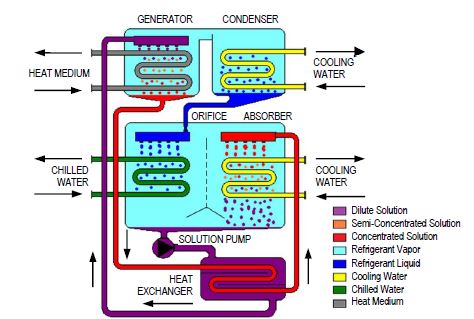
Yazaki water fired SINGLE-EFFECT chillers or chiller-heaters have cooling capacities of 10, 20 and 30 tons of refrigeration and produce chilled water for cooling or hot water for heating in comfort air conditioning applications. The absorption cycle is energized by a heat medium (hot water) at 158°F to 203°F from an industrial process, cogeneration system, solar energy or other heat source and the condenser is water cooled through a cooling tower.

Absorption Principle


The Yazaki absorption chiller or chiller-heater uses a solution of lithium bromide and water, under a vacuum, as the working fluid. Water is the refrigerant and lithium bromide, a nontoxic salt, is the absorbent. Refrigerant, liberated by heat from the solution, produces a refrigerating effect in the evaporator when cooling water is circulated through the condenser and absorber.

Cooling Cycle

Condenser

In the condenser, refrigerant vapor is condensed on the surface of the cooling coil and latent heat, removed by the cooling water, is rejected to a cooling tower. Refrigerant liquid accumulates in the condenser and then passes through an orifice into the evaporator.


Evaporator


In the evaporator, the refrigerant liquid is exposed to a substantially deeper vacuum than in the condenser due to the influence of the absorber. As refrigerant liquid flows over the surface of the evaporator coil it boils and removes heat, equivalent to the latent heat of the refrigerant, from the chilled water circuit. The recirculating chilled water is cooled to 44.6°F and the refrigerant vapor is attracted to the absorber.


Absorber

A deep vacuum in the absorber is maintained by the affinity of the concentrated solution from the generator with the refrigerant vapor formed in the evaporator. The refrigerant vapor is absorbed by the concentrated lithium bromide solution flowing across the surface of the absorber coil. Heat of condensation and dilution are removed by the cooling water and rejected to a cooling tower. The resulting dilute solution is preheated in a heat exchanger before returning to the generator where the cycle is repeated.

Heating Cycle
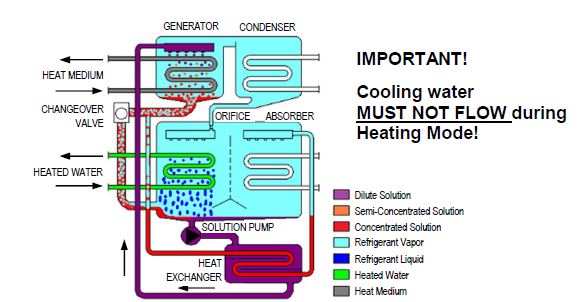


When the heat medium inlet temperature exceeds 154.4°F, the solution pump forces dilute lithium bromide solution into the generator. The solution boils vigorously under a vacuum to generate refrigerant vapor and droplets of concentrated solution. Since the changeover valve is open during heating operation, the mixture of refrigerant vapor and concentrated solution flows directly into the evaporator. Some refrigerant vapor flows through the condenser before reaching the evaporator.


Evaporator

Hot refrigerant vapor condenses on the surface of the evaporator coil and heat, equivalent to the latent heat of the refrigerant, is transferred to the hot water circuit. The recirculating water is heated to 131°F. Refrigerant liquid mixes with concentrated lithium bromide solution and the resulting dilute solution returns to the generator where the cycle is repeated.


Looking forward to hearing whether you think it is feasible to do this on a small scale -- I don't know how big a "cooling tower" the Yazaki systems require.

T"

These are the kind of dialouges, replete with audio-visual material, that are emerging in spaces like youtube, facebook and blogs. Former strangers who are part of the extended family of humanity, are connecting across the globe and tackling the big issues.

Even the hecklers out there are contributing something by directly engaging with the issues and going public with their ideas. Everybody has something to say, and we can't get it all on the table soon enough. We need to answer the question of how to acheive continued economic growth without continuing to grow our human population, our consumption of finite resources and our quantity of waste products.

We know we can't keep the terrestrial population growing and that we must recognize the "Limits to Growth" in terms of per capita consumption of non-renewable resources. Is this so hard to balance with our desire for prosperity?

Even the most elementary Economics textbook points out that economic growth is not the same as population growth -- in fact a growing economy can occur within a steady state frame. As Krugman, Wells and Graddy point out,

"The production possibility frontier helps us understand what it means to talk about economic growth. [We defined it as] the growing ability of the economy to produce goods and services... but are we really justified in saying that the economy has grown? Afer all, although countries produce more of many things than they did a century ago, they produce less of other things -- for example, horse-drawn carriages. Production of many goods, in other words, is actually down. So how can we say for sure that an economy as a whole has grown?
" The answer is that economic growth means an expansion of the economy's production possibilities: the economy can produce more of everything... what the economy actually produces depends on the choices that people make."

Economic growth is thus about POSSIBILITIES. Not production quantitites. Not consumption quantities. About Production Possibilities.

Paraphrasing the textbook's example (which talks about the tradeoffs in production of coconuts or fish on a tropical island by a character based on Tom Hanks in the movie Castaway) I will substitute solar air conditioners and Hummers in the appropriate places:

"After his production possibilities expand, Tom might not actually choose to produce both more solar air conditioners and more Hummers -- he might choose to increase production of only one good, or he might even choose to produce less of one good. But even if, for some reason, he chooses to produce either fewer solar air conditioners or fewer Hummers than before, we would still say that his economy has grown -- because he could have produced more of everything."

Krugman tells us that though this is a simplified model of an economy "it teaches us important lessons about real-life economics. It gives us our first clear sense of a key element of economic efficiency, it illustrates the concept of opportunity cost and it makes clear what economic growth is all about." (p. 25)

Economic growth is all about what you COULD HAVE done. Not what you actually DO.

So even the most basic economics text gives us the answer to the ridiculous fear-based question "how are we supposed to keep the economy growing if we don't churn out more and more and more automobiles, and burn more and more and more fuel, and put more and more and more people to work in factories"? Growth is here defined as "a growing ability, a greater efficiency, the ability to do more with less."

For example, my computer's power has grown even as it has gotten smaller. I can now play Crysis or Turok or Assasin's Creed or simulate my perfect city in CityLife 2008 on my MacBook Pro laptop computer. Its dual core processor uses much less energy than the larger older processors that could only handle a tenth of the power crunching. Similarly, we just installed a highly efficient and compact Brotje Eco-Therm Plus gas heater to replace the old Vaillant VRC C88 we had in the basement. It hangs neatly on the wall, takes up a third of the space of the bulky old one (leaving plenty of room for the solar hot water tank it connects to) and uses only 40% of the natural gas. Our home economy has grown, while the amount of fuel and space the thing uses has shrunk.

Of course, the new Brotje is so efficient and so well built that it requires less maintenance. Does that concern our installer or the company? Not in the least.

Will they soon be out of a job?

As far as our installer is concerned he has plenty of work to do upgrading every home in the city. That will last him a long while and there is still room for plenty of other people to enter the market. We can't replace inefficient burners fast enough -- especially not with Russia threatening to cut off our largest source of CNG.

What about after that, when the market is saturated?

By then, he says, this forward thinking company, which reinvests its profits in Research and Development, will have a heater that uses half the energy that this one does, one that is smaller, more attractive, enables more features (our new one lets us turn on and off the heat in our house in Germany from our laptop while on vacation in Spain!) , and one that will probably talk to you (and the other appliances in the basement, chatting away self-contentedly about Carnot Limits while their human friends are at the beach!).

But what happens when we do reach the theoretical Carnot Limit and when Moore's Law has run its course, and we can't make anything smaller or more efficient? What happens when we have tried out every color combination and design, and there is no way to improve anything on earth?

Will the economy have to stop growing?

No, of course not. But that is when we need to seriously start expanding our economy into space. Infinite and infinitely challenging space.

The final frontier that knows no finality.

Tuesday, June 3, 2008

Conversations with God: A Solar Parable

And the Lord did put a nuclear reactor in the Heavens, and He did place it a safe distance from His beloved Creation, so that it might power and sustain them.

And He called it "Shamesh" -- the Sun -- and it was GOOD.

And lo, he did put the Earth on a Timer, each Cubit facing the heavenly radiation for a measured time only, and He did make the timer so reliable that the stupidist of his Creation could predict the rising of the radiant reactor, to unfurl their leaves and bask or crow their morning satisfaction, and so that Men could set their watches thereby.

And he called the received radiant dose "a Day".

And it was really GOOD.

And lo, the Lord did say unto Mankind: "Go forth and use of this nuclear reactor that I hath created unto you, that you may be fruitful, and grow fruit, and multiply, and do long division and subtract. For this guiding star sends it's sacred particle-wave emissions toward you at the constant speed of 299,792,458 metres per second, which We shall call "c". And it will create and sustain all life.

"But when thou dost multiply, do be fruitful, and prudent, and do not make use of the equation that multiplies c by m after squaring c to produce E on earth (except in research universities), for this equation belongs in the Heavens, and not on the earth where it will do much mischief.

"And that would be BAD. "

And Man did ask, "But why then, heavenly Father, hast thou buried in our Earth and given unto us the heaviest elements, likened unto Uranium, where from we might obtain E through squaring c and multiplying m? And while we're at it, Lord, what about those dinosaur bones?"

And did the Lord say, "I did indeed give unto you the unstable elements that thou might labor in laboratories and assemble teams of rocket scientists who would understand how to apply the sacred equation when such time came as you would grow up and leave your earthly womb and travel through the spaces where I placed no nuclear reactors.

To cross these voids you will need to make your own small stars until you are safe once again in my heavenly cradles of creation.

But THOU SHALT NOT create suns where I have created suns, for they belong a safe distance from my sons and daughters and the others of my Creation, and their life giving rays are to be received in such measured doses that the mutation rate conforms to my rate of creation through evolution.

As for the dinosaurs, I placed them there to test the faith of people who are too blind to understand that God created Evolution. Deal with it."

And Man did say, "but Lord how are we to make use of a nuclear reactor that WE cannot control whose instantaneous output can be reduced by floating water vapor, just when the superbowl is on, and whose radiance falls on the land of other tribes when we are most in need of a cappuccino and power for our surround sound home theater systems?"

And the Lord did speak thus:

"If your best and brightest minds (particularly those of your small children, if you would let them think and express themselves instead of sending them to your penitentiary-like schools) cannot figure out how to make use of the radiation from a relatively safe nuclear reactor in the heavens of a planet that has already been engineered to capture all of its output in the form of light, heat, wind, biomass, thermal mass, ocean currents and falling water, what hope have ye to make proper use of a reactor in your back yard that emits merely foolish quantities of heat along with persistent and deadly toxins while making the very matter that contains it unstable? You toy around with the dangerous and complex for simple purposes when you could more easily be using the safe and simple for complex purposes. You are certainly not ready to play God if you can't even make proper use of what God has put in play. Thus Spake Zarathustra!"

And the skies did tremble.

But Man, motivated by Nuclear Industry Shills with snake-skin briefcases did ask the Lord, in naivete: "But how Lord, if nuclear energy is 'not for commercial use', to make huge profits to satisfy our friend Mammon, with his giant Invisible Hand; how if we do not centralize power sources where we can control the supply to always be somewhat less than demand? Dids't Thou not create the laws of Economics, with all due respect. Sir. Hmm?"

To which the Lord did ponder why he made Man in the first place, a creature who believes more in snake-oil salesmen than their own Creator. And so He went off to one of his other Goldilocks "just-right" planets near Betelgeuse in the constellation Orion where people took him, and His Laws, more seriously and understood that God is always Just and Right.

Monday, June 2, 2008

Chip Ward's Catalyst Magazine Article on "Why Nuclear Power Is Not an Energy Solution for Global Warming"


Chip Ward wrote such a good piece on the Nuclear Issue that I thought it is worth reproducing here.

I'm still looking for evidence that, in an atmosphere saturated with greenhouse gases, the last thing we should be doing is building a fleet of reactors that add more heat, but the jury is still out on this one...

Lots of people say that given how much solar energy hits the earth every day the impact of the exothermia of nuclear fission is miniscule, a drop in the bucket (if you believe Yahoo Answers when they say "resolved question")

They "resolvers of the question" in this non-peer reviewed forum make the somewhat convincing argument that it is the sun that is the real culprit in Global Warming . By which they mean: when its rays are transformed into heat and that heat can't escape back into space because of "greenhouse" gases in the atmosphere that trap it and keep it there.

They make resonable arguments that the reason Venus, which is roughly the same distance from the sun as we are, is hot enough to melt lead (and apparently the few Soviet Robots that visited the planet in the 1970s) while Mars is frigid cold and we are just right (The Goldlilocks Hypothesis) , is because of the different composition and densities of our atmospheres. Venus' thick cloud shroud simply won't let the heat back out. Mars is 95% CO2, but the atmosphere is so thin it can't keep the sun's heat in. Ours was "just right". Fine.

Only two things still trouble me.

1) If the problem with global warming is having an atmosphere that traps heat, and ours is no longer "just right" and we aren't going to (or can't) do anything soon to change that atmosphere back to the right amount of heat transparency -- even if we were to soon stop adding carbon dioxide and methane (i.e. stop all fossil fuel use, stop deforestation, reforest everywhere, and ensure the health of the plankton in our oceans) , doesn't that still imply that we have to stop adding more anthropogenic heat, given that the sun is pouring so much in?

Is the amount of heat we are adding really such a drop in the bucket?

People said our anthropogenic contributions of CO2 and methane, from our industries' and homes' and offices' and automobiles' and trucks and ships and planes and plantations and farms were just a "drop in the bucket" and were "dwarfed by the amount of CO2 released by volcanoes and other "natural processes" so we shouldn't worry. Wasn't that Michael Chrichton's main argument in "State of Fear"? Turned out Jurassic Park was more a more scientifically reasonable fiction than that one.

Now we are hearing that the exothermic reactions we employ, releasing the stored energy in chemical bonds (fossil fuels) and atomic bonds (nuclear fuels) is "a drop in the bucket" compared to what "nature" ( the sun and the inside of the earth) contribute, so we don't have to worry about anthropogenic heat contributions, even though our atmosphere is getting more Venusian every day.

Could they be wrong about that too?

That's the first thing that troubles me. Here's the second:

2) If the sun is so powerful that it's energy contribution to the earth dwarfs all of our anthropogenic contributions to the point where people tell me it is "ridiculous" to worry about the miniscule amount of energy and heat our power plants put out (and I'm quite happy to believe this is true) then why would the same people believe we can't power our entire planet with this same massive amount of solar energy?

Do you see the disconnect here? If anthropogenic contributions of thermal energy are so miniscule and unimportant, and aren't making any impact when exhausted into our greenhouse gas laden atmosphere, and the sun's contribution of light energy is so enormous that when the tiny portion of it that is absorbed by the earth and the water and the atmospheric vapors and then reradiated as heat can lead to catastrophic global warming (which it apparently does), then why are we not bowing down in awe to that overwhelming energy supply in the sky and saying, "let's harness this magnificent source of energy NOW!"?

With such an intense nuclear fusion reactor (that's what the sun is, a nuclear reactor!) safely (perhaps not safely enough!) situated 93 million miles away, why are we even considering replicating nuclear processes here on earth?

Boggles the mind.

Well, I'll keep hunting for answers. In the meantime, Chip Ward does a beautiful job of explaining why nukes won't help stop global warming, even if it turns out their contribution to it is nominal, a "mere drop in the bucket":


Why Nuclear Power Is Not an Energy Solution for Global Warming

Written by Chip Ward

Reproduced from Catalyst Magazine


If you’ve seen those television commercials for Energy Solutions (they were Envirocare before the extreme makeover) that show endangered tree frogs crawling across the corporate logo, you may have already guessed that Energy Solutions is to tree frogs what Donald Trump is to salamanders —that is, there is no relationship beyond the contrived imaginings of the advertising agency that Energy Solutions pays to come up with such nonsense.

Nevertheless, the claim that nuclear power is an “energy solution” for the global climate crisis we are now experiencing is worth examining because it is being made by the nuclear industry’s political lobbyists and PR operatives across the nation and is now being echoed by the politicians who are in the industry’s pocket. Even clueless car dealers who own unpronounceable arenas, basketball teams, racetracks, and faux-Mayan restaurants are joining the chorus calling for more nukes to combat global warming.

So let’s look at the facts. The industry’s reps are right on one point: nuclear reactors themselves do not directly emit greenhouse gasses that contribute to global climate change. That good news should be tempered by the fact that the “emissions” from those reactors take the form of extremely radioactive waste that is dangerous for tens of thousands of years, is also dangerous to transport, is an obvious target for terrorists, can be used to make “dirty bombs,” and is endlessly expensive to endlessly manage. In Utah, we are very familiar with the intractable problems from nuclear power’s waste stream and the troubling politics of ‘pass the radioactive hot potato’ that go with it. But let’s be generous and concede that although small amounts of radiation are emitted from nuclear reactors, no greenhouse gasses are emitted.

Nuclear power generation, however, requires so much more than just what happens in the reactor alone. The raw material for nuclear power is uranium. Uranium must be located and mined, transported and milled, and then further processed into useable fuel. At every step along the way, energy is consumed and emissions that are indeed greenhouse gases are released. At one time, for example, four dirty coal-fired power plants were operated exclusively to electrify the uranium enrichment plants at Paducah, Kentucky, and Portsmouth, Ohio.

Nuclear power is infrastructure intensive. Nuke power plants come in one size—extra large—and massive construction projects also burn up fossil fuel and spew CO2 as trucks, bulldozers and cranes do their thing. Nuclear power plants require massive amounts of materials, of course, and the steel comes from smoky steel furnaces and iron ore that is also mined by pollution-belching machinery. Cement, lead, and other reactor materials also result in CO2 emissions as they are produced. Then there is building an infrastructure for the waste—the Yucca Mountain repository in Nevada, which is looking very doubtful these days, was slated to be the largest single construction project in history and the machinery and materials used to build it also contribute to global warming.

Recent research highlighted in the prestigious British journal, The Ecologist, estimates that when the entire production cycle is accounted for, nuclear power emits less greenhouse gas than burning coal but far more than alternatives such as wind, solar, and conservation. For every unit of uranium recovered, the study concluded, 20 units of CO2 are produced. So much for saving the planet from greenhouse gasses. Suggesting, as the industry does, that we assess the global warming impact of nuclear power based on reactor emissions alone, then, is profoundly misleading. This comes as no surprise—the industry has a long history of misrepresenting its dangers, its costs, and its potential. This was the energy solution that we were told in the 1950s would be so cheap it wouldn’t be worth metering.

What about reprocessing the high-level radioactive waste into fresh fuel and skipping that dirty uranium mining and milling cycle altogether? That, after all, is what Energy Solutions would like to be all about. And that is how nuclear power was supposed to work when it was sold to us the first time back in the ’50s and ’60s. But the one commercial attempt at reprocessing was a financial and environmental disaster that went belly up after just six years, leaving U.S. taxpayers with a whopping $5 billion clean-up that has yet to be completed. Reprocessing facilities in France and England are responsible for about 90% of “routine radiation emissions” for their entire nuclear fuel chain—by far the dirtiest component of nuclear power generation. As a result of reprocessing in England, about 1,000 pounds of plutonium was discharged into the Irish Sea, making it one of the most radioactive bodies of water on Earth. Plutonium from reprocessing facilities has been detected in the teeth of children hundreds of miles away and has spread as far as the Canadian Arctic.

So-called “breeder reactors” were supposed to produce plutonium that could be used for fuel in other non-breeder reactors, thus making nuclear power self-sustaining. Aside from three breeder reactors built abroad, two of which are no longer active and one of which never “bred,” and a breeder reactor built in Michigan that experienced a partial meltdown in 1966, breeder reactors were not constructed because they are potentially more catastrophic than your run-of-the-mill Three Mile Island or Chernobyl reactors. They are also much more expensive to build. A new generation of breeder reactors and new “light-water” nuclear reactors are imagined but could be 20 years or more in development if they are ever perfectible and affordable at all—too late to make a difference in global warming.

When America walked away from breeders and reprocessing in the ’70s, too many workers involved in reprocessing the fuel had become sick. Unfortunately for the proponents of nuclear power, the technical problems involved in “recycling” nuclear fuel are too complex, too expensive, and too dangerous. Energy Solutions boasts it is the leader in a new quest to successfully reprocess nuclear waste. Given the thoroughly disappointing and wishful history of reprocessing so far, this is a bit like being on the cutting edge of alchemy during the Middle Ages. Or maybe there is just money to be made selling wishful thinking to those who are desperate for a solution and in denial about the unlikelihood of ever realizing one. Energy Solutions or energy delusions?

When President Carter, a former nuclear submarine commander, ruled out reprocessing for America, he cited the danger that the by-products of reprocessing could be used to fashion nuclear warheads. In fact, every new nation that has recently acquired nuclear weaponry or is about to do so, including North Korea, Iran, India, and Pakistan, have relied on the by-products of nuclear power generation to produce nuclear weaponry. The danger of terrorists using nuclear power by-products is also very real. Although the problem of nuclear proliferation and terrorism can be regarded separately from the question of whether nuclear power can ease global warming, a world that is experiencing climate chaos and the ensuing displacement of refugees and competition for viable habitat should not also be awash in nuclear weapons. A nuclear exchange will not be an “energy solution” to global warming. Reprocessing nuclear fuel is the pipe dream Energy Solutions is smoking—saner minds just say no.

Uranium is finite and world supplies are decreasing while prices and competition for access increase, especially for high-grade ore that does not require more in expenditures of energy than the energy it contains. Without reprocessing as a realistic option, dwindling supplies of uranium could raise the same tragic dynamic that is fueling war for access to oil at the end of the fossil fuel epoch. The inevitable scarcity of uranium would be accelerated if the world decided to build the thousands of nuclear power plants that would have to be built to make a dent in global warming. Do we want to burn all that fossil fuel as described above to build an energy production system that is likely to become as vulnerable and unreliable as an oil pipeline through the Middle East is today?

Nuclear power plants would be vulnerable not only to fuel scarcity and disruption, but to terrorism and to global warming itself. Severe weather would make nuclear power plants too dangerous to operate and reactors would be shut down in the face of hurricanes, floods, and even droughts and heat waves.

Nuclear energy is terribly expensive. To make a difference in global climate change, we would have to immediately build as many nuclear power plants as we already have in the U.S. (about 100) and at least as many as 2,000 worldwide. A massive investment would have to be made immediately. Wall Street won’t invest in nuclear power because it is too risky, even though the industry is shielded from liability by the Price Anderson Act (yep, you guessed it—if a reactor melts down, taxpayers have to cover most of the costs). The partial meltdown at Three Mile Island taught investment bankers how a $2 billion investment can turn into a $1 billion clean-up in under two hours. Since the private sector cannot and will not generate the capital for such an expensive undertaking and will not tolerate the risks, the taxpayer would have to foot the bill. Gosh, do you think there might be cost overruns? Do you think this could be done on schedule (so far, the Yucca nuclear waste repository is 20 years behind schedule)?

Then there is the time factor. Even under the most ideal scenario, a doubled nuclear power infrastructure would take decades to build—too late to make a difference in climate change. Globally, to build the 2000 nuclear reactors that expert studies say would make a difference in climate change, four reactors would have to be built per month between 2010 and 2050. Also, a Yucca-sized dump would be needed every three to four years. Is this reasonable and realistic? In the time it would take to build enough reactors and dumps, we could cover the globe with windmills and solar panels, put everyone in China in a Prius, and find scores of new ways to conserve or create energy. And the money we spend to build new nukes would mean less money to develop wind and solar or to conserve the energy that we now waste—solutions to our energy woes that would make a difference much sooner than later. (To learn how we could cut global warming emissions in half through efficiency and clean energy, check out the executive summary of the National Resources Defense Council’s “Responsible Energy Plan for America” at www. nrdc.org/air/energy /rep/execsum.asp.)

Where would all those new reactors go and how would they get there? Communities are not lining up to have nuclear power plants built in their neighborhoods. Building so many new reactors would require a widespread suspension of civil rights and democratic practices. Communities and citizens would have to get out of the way —they couldn’t be allowed to resist or sue if they believed their health or property interests were endangered. That pesky, if anemic, public participation process for locating new nukes would have to be scrapped altogether. Unelected, inaccessible, and distant bureaucrats would have to be given the power to overrule the locals and fast-track the construction of new plants. Nuclear power is a technology better suited to authoritarian regimes than democratic cultures, which is why you can build a reactor in North Korea or Iran more easily than you can put one up in California. We shouldn’t have to burn up the Constitution to get clean energy.

Nuclear power is an energy solution only if the problem you are solving is how to make big profits from the potentially catastrophic global crisis we find ourselves in. Billions of federal tax dollars for research into reprocessing added to billions to bury the waste in environmental sacrifice zones like Utah’s West Desert will solve the problem of Energy Solutions’ investors—how to cash in on the public’s fear of global climate change and their willingness to invest in solutions. But if you are looking to actually alleviate global warming, nuclear power is no solution at all. It is a shill, snake oil, a cruel joke with unwanted consequences—and those Energy Solutions advertisements are as shameless as they are baseless. And, fortunately, most of us sense that. The only person buying the Energy Solutions pitch, it seems, is Larry Miller, a used-car salesman who should recognize a lemon when he sees one.

“Activist, urban librarian and environmental writer as well as the author of ‘Hope's Horizon: Three Visions for Healing the American Land,’ Chip Ward (as the title of his fascinating book suggests) likes to focus on the sparks amid the global gloom,” writes Tom Engelhardt of The Nation Institute.

Hands-on Climate Change Mitigation: Future Possibilities of "Climate Consultant"

My Urban Planning Quantitative Analysis Professor Robin Liggett and her colleagues Murray Milne and Rashed Al-Shaali at the UCLA Department of Architecture and Urban Design have come up with a neat software application called "CLIMATE CONSULTANT 3.0 A Tool for Visualizing Building Energy Implications of Climates".

This newly revised design tool "will display dozens of different graphic images of various weather variables for all 8760 hours per year in EPW (EnergyPlus Weather) format files which are available for over a thousand stations around the world. It will also suggest building design strategies appropriate for the unique characteristics of that climate. "

They presented this great data visualization tool, which can be generously downloaded at no cost from www.aud.ucla.edu/energy-design-tools , at the Solar 2007 conference in Cleveland, Ohio last year. There they showed how easy it was with this tool to view and understand complex parameters such as "Tables of Mean Climate Data", "Set Criteria", "Temperature Range Bar Charts", "Radiation Range Bar Charts", "Sky Cover Range Bar Charts", "Wind Speed Bar Charts", "Dry Bulb vs. Relative Humidity Charts, "Dry Bulb vs. Dew Point Charts", "Sun Shading Charts", "Sun Charts", "Time Table Plots", "3D Charts", "Psychrometric Charts", and "Wind Wheels".

In their summary they stated "The beauty and power of these graphic approaches to climate data analysis is that they communicate in a way that allows users to see extremely subtle distinctions that would otherwise be lost in a page full of numbers.
If ‘information’ is defined as the recognition of small differences that make a difference, then these techniques make it possible to recognize some very subtle differences, indeed"

We've long known the adages "knowledge is power" and "forewarned is forearmed" but until data visualization tools like this (and the computer power to use them) became available to the average planner (or citizen -- we are all planners, really, and should think of ourselves as such!) it was hard for us to get involved in planning for climate change. How would we ever know the overall trends in our local climate and see how things were changing, so we could better plan to deal with "the vagaries of the weather" and optimize our utilization of the climatic resources around us? Consult the Farmer's Almanac?

Now we can "Consult the Climate" with Climate Consultant.

The implications are far reaching, especially in an age when we can control our home, office and industry HVAC systems in Germany or Los Angeles from our Blackberry Wireless while on the beach in the Canary Islands.

I learned that when I was working with Utility Consultant Frank DiMassa on a powerpoint presentation about CMS Energy System's "Utility Vision" software program for energy consumption monitoring and data analysis.


We were told at the time that the logical corrolary to be able to do real time monitoring and visualization of the data was the ability to control the energy systems in the building remotely. Now that is standard practice in many places, where energy managers can turn lights and chillers and other appliances and utilities on and off from remote locations.

This promise actually formed the sinister premise of the 1998 German thriller "23" in which a group of computer hackers in a German University (based on real-life hacker Karl Koch, the "hagbard") inadvertantly get involved with a Russian mafia group that forces them to hack into the control systems of a nuclear reactor to shut down its control systems and cause a meltdown. The film-makers suggest that Chernobyl like events could be under such nefarious control.

Whether such nightmare scenarios are plausible or not (and let us hope the worst hackers can do is turn out the lights in a building and make it uncomfortably hot or cold) we planners now have the tools and the opportunity to deal with spot climate changes, seasonal climate changes and long-term climate changes with a sophisticated bevy of tools and control sets that can let us optimize our planning and response.

The Climate Consultant tool puts in our hands the ability to plan better buildings, knowing how much sun and shade they receive, what the relative humidity trends are, what the local wind speeds are etc. We can thus decide not only if it is worth deploying PV and Solar Thermal and small wind generator systems on our roofs, but how to manage their contributions to a decentralized energy grid for 24/7 power.

The beauty of integrated renewable energy systems is that they are based on differences in temperature -- when it is sunny and hot in one area, warm air is rising. When it is cloudy or cool in another area, cold air is falling. This is creating solar radiation patterns, wind patterns and rainfall patterns which, once we can visualize them and understand them, can help us make optimal integrated use out of them.

Germany is already pioneering such work, as I found out this weekend at the Renewable Energy Job Fair at the Solar Center in Gilsenkirchen. Germany is using data management and visualization and computer numeric control software and hardware to link together heliostats on solar fields, wind turbine nacelles and biogas production facilities to provide a steady stream of electrons to the grid so that there is never an interruption in service. When the wind stops blowing, the sun power kicks in, when the sun goes down the biogas facilities kick in, when the rains come and the rivers and mountain streams swell, the micro-hydro generators kick in.

Such abilities to consult the climate and use whatever it throws at us defy the critics of renewable energy who whine "but it is intermittent -- waaaah! What do we do when it rains? Waaaah!" As if Russia threatening to cut off our gas supplies at any moment doesn't qualify for "intermittence"! (The same argument applies to our "constant" supply of oil from the Middle East and Nigeria and Venezuela and the other Petro-tyrant states, and to the output of French nuclear reactors, which presumably can be either hacked into by malicious people like the Hagbard, or shut off in some political power play by some CEO using his blackberry on the beaches of the Canary Islands....)

What we could evolve, if we are wont to, is a decentralized energy wiki, or an energy E-BAY -- yeah, that's more like it -- a spot energy market through P2P (Peer to Peer) file and power sharing. P2P would be redefined as "Power-to-Power".

I have some early experience in this "E-mule Energy concept" -- Before California's Rolling Blackouts (caused by Dick Cheney's Enron corporation -- who did have the power to make electricity "intermittent" or unvailable to California Citizens) when I installed my 1.2 KW photovoltaic system at the Los Angeles Eco-Village, my friend and UCLA colleague Angel Orozco also installed his "$1500 energy solution" a few light wells down on the roof of the same building (two all silicon solar PV panels, a charge controller, a deep-cycle battery and a small inverter on a sesame seed bun). It was obvious to us that whenever I went down to Guatemala and he stayed home (or vice-versa) each of our systems were continuing to put out surplus electricity that was doing us no good at all, but that could benefit our neighbor. You don't shut off the sun when you go on vacation!

So we talked about connecting our two systems so we could share the surplus. Later California's feed-in tarrif system with grid intertied home PV systems enabled all the homeowners out there to contribute green electrons to the common electron pool, but for renters like us, who were forced to install our own systems, learning how by reading "Home Power Magazine" and practicing "guerilla solar" that wasn't a legal option. Still, like students using napster, we could share electricity under the radar and "off the grid".

Now this "energy bartering" system could easily become a reality, and areas with local -- not even international but LOCAL -- comparative advantages can raise the production possibility frontier for all.

I envision a day very soon when folks across town who are experiencing shading from a bank of clouds, while my roof is under full sun, make up for their shortfall by using my surplus electricity, and vice a versa as the clouds move across the sky. I envision a day when we welcome wind and rain storms because, like Benjamin Franklin waiting for thunderclouds to send up his kite, we can use our real time climate data to predict when we should "raise the windmills" (the way mariners of old shouted "raise the sails"), or "connect to the stream generator", with the ability to instantaneously manage both our energy production and consumption.

The consequences of this ability to meaningfully use our information to make a difference are even farther reaching.

In my last post I talked about the dream of being able to use our renewable energy powered homes not only to reduce the amount of CO2 emitted into the atmosphere, but to reduce the amount of heat we contribute to global warming.

My idea came from reading the Ph.D proposal of one of Robin Ligett's students, Pablo LaRoche, who is now Associate Professor of Architecture in the College of Environmental Design and adjunct professor in the Masters of Science program in the Lyle Center for Regenerative Studies in Cal Poly Pomona University. When Pablo was Professor Ligett's student, he designed and published a concept with Baruch Givoni (presented at the Solar 2000 conference in Wisconson) called "Indirect evaporative cooling with an outdoor pond". What I remember from the Ph.D proposal I read in the library at UCLA was that they built a system on a roof at UCLA that used a roof pond to trap solar heat and convected room heat to keep the spaces below cool. With an ingenious system of louvers they were able to control the transfer and storage of heat so that, at night, they could vent the heat captured in the day into the "infinite heat sink" of the cold night sky.

From this I got the idea of "heat pumping and heat dumping" that I talked about in my last post.

The concept isn't trivial if it is correct. It could help us shed heat that is exacerbating global warming.

I've been thinking more and more about this since a person wrote a hostile comment to my "Solar Air Conditioning" video on my youtube channel (probably one of my hypothetical nuclear lobby shills!). The man claimed that the use of solar energy systems would increase global warming because we were "painting roof tops black, or covering them with black or dark colored panels, and black absorbs heat at a time when we should be reflecting sunlight back into space".

In my response I tried to point out that while he was correct that surface albedo is very important in controlling the greenhouse effect, solar energy systems should not be expected to have any impact. I told him he was correct that as the arctic and antarctic glaciers melt, the loss of huge areas of white reflective ice and snow, replaced by energy absorbing dark waters and rocks, is expected to exacerbate our runaway greenhouse effect. I said, however, that I thought that huge fields of solar panels would behave more like the leaves of trees -- surfaces that take the energy from solar radiation and store it by transforming it into another form from whence its re-radiation is considerably slowed. Rate is the problem with global warming (as with most pollution). I claimed that solar thermal panels, like we build in Cairo, and the PV panels we have on our roofs, take the sun's light during the day and instead of turning it directly into heat that reradiates into a moist atmosphere, is sequestered for a time as potential energy, either in the hot water system, or the electric energy storage system.

All of the sun's energy that is not reflected (and indeed all forms of energy produced on the earth) will end up as radiant heat. The question is when and how and how much of that heat goes where.

It is similar to the situation with carbon dioxide -- are you adding more carbon to the atmosphere than the system can assimilate and at a higher rate than the system can recycle, or are you returning it in the right measure to keep things in relative equilibrium. We do have biological and physical systems that sequester carbon, but they can only handle so much at a time. That is what carbon-neutrality is all about.

Now I'm thinking more and more about "heat-neutral" processes. The earth produces heat (both internally, through solar absorbtion, through the fission that powers nuclear reactors, through the testing of nuclear weapons and through the combustion of wood and fossil fuels (decades to hundreds to millions of years worth of sequestered sunshine). It also sheds heat, particularly at times when there are clear night skies and low humidity.

If my critic on youtube is right that solar energy systems are transforming more of the sun's light into heat through changing areas of surface albedo from light to dark colors, the obvious solution would be a form of energy management where we "consulted with the climate" and found the appropriate times to vent the heat of our anthropogenic activities into an appropriate heat sink.

Professor La Roche's paper made me consider that we could use the thermal characteristics of diurnal/nocturnal cycles to achieve a kind of "heat pump/heat dump" solution -- we use the sun's light during the day for power, and dump its heat back into space at night. When the relative humidity of a given night sky makes it harder to shed the excess thermal energy, we sequester it until a night when the wet-bulb temperature is low enough that cooling is no longer inhibited.

I am envisioning a huge network of computers contolling renewable energy systems, linked to energy management software, that monitors all the climatic variables "Climate Consultant" visualizes, and uses that data to automatically "capture and shed sunlight" when conditions are optimal.

Sound crazy?

It certainly is a lot saner than the eco-engineering proposals for increasing surface albedo being floated by the Bush Administration. When I was a teaching fellow with Richard Turco in the UCLA Global Environment class, he presented our students with one absurd idea being literally floated by some technocrats who think there is a technofix for everything: the launching of a trillion mylar party balloons!

The concept, he told us with as straight a face as possible, is that the luft baloons, once aloft, would reflect the sunlight back into space before it ever reached the earth to be transformed into heat. I remember we began singing Nena's cold-war era protest song "Neun-und-Neuntzig LuftBallons", changing the lyrics appropriately ("99 My-lar balloons, trying to stop our climate changes...")

Another stupid techno-fix idea was to pollute the air with enough sulfur particles to create a shroud "protecting the earth" from the "evil sun". Yes, yes, Europe was cold the summer I travelled here when Mt. St. Helens erupted. Great. That's all we need are more smoggy skies to keep us safe. Diesel engine operators rejoice!

These ideas are as stupid as the one proposed in Highlander II (arguably one of the worst Sci-Fi movies ever made, and a shame to Sean Connery) where a corporation creates an "anti-ozone shield" (???) to protect us from sunlight that is causing cancer. After 30 years of darkness people are described as "being depressed, driving old cars...". My "gang-banger" high school students who watched it with me in my Science through Science Fiction class at Crenshaw High School in South Central L.A. were first to point out, "Yo, Mr. Culhane -- 30 years without sunlight -- we wouldn't just be depressed... we be dead! Ain't these Hollywood producers never heard of PHOTOSYNTHESIS. Damn!"

Right you are kids!

The kids of the world can see through all the stupid proposals (like throwing all our styrofoam into the ocean so that it creates floating islands of white flotsam and jetsam to replace the missing icebergs! A municipal garbage mafia's dream!). Even if the politicians and industry shills can't.

But capturing, sequestering, transforming and then safely releasing solar energy back where it came from into space after using it to power our society -- is that so far fetched?

I still haven't heard back from anybody if my hypothesis that nuclear power plants adding more heat to the atmosphere from the profound exothermia of fission will create a problem. If true it certainly should be seized upon by environmentalists who are supposedly "on the fence" about whether to include nukes in the climate change mitigation package. Nuclear power may be almost carbon neutral (if you exclude the CO2 produced mining and transporting and refining ... not to mention protecting -- the deadly uranium. Or did you think that convoys were carbon-free?). It certainly can't be heat-neutral. We've all seen those massive cooling towers. Perhaps we should start calling them "Global Warming Towers"?

I can say one thing -- if reactors that produce thousands of megawatts of new heat from micro-nuclear explosions isn't going to adversely impact the climate, then certainly rooftops and troughs and solar towers recycling mere hundreds of megawatts of power aren't going to make a dent. And by comparison, once we get up to the thousands of megawatts per solar energy installation stage, considering that they produce no NEW HEAT (they aren't liberating it through E = mc2 from nuclear bonds like reactors and bombs) , they should still come out ahead on the heating ledger sheet. And if my hypothesis is true, and we can use solar sequestering to time how and when we release that heat back into space, we may need a million solar roofs, coordinated and managed through minute by minute consultation with the environment, to offset what those nuclear jockeys and their massive "cooling towers" produce.

I see a lot of possibilities and benefits for the full-cost environmental accounting we will get when we can become well-informed "Climate Consultants".

Knowlege is Power!