Solar Power isn't Feasible!

Solar Power isn't Feasible!
This cartoon was on the cover of the book "SolarGas" by David Hoye. It echoes the Sharp Solar slogan "Last time I checked nobody owned the sun!"

Tuesday, May 5, 2009

Salvar el planeta: Empieza en casa

Salvar el planeta: Empieza en casa
por T.H. Culhane
Saving the climate: It Starts at Home
by T.H. Culhane

A presentation given at the Fox TV Iberia/National Geographic Earth Day Press Conference in Madrid, Spain on April 16th, 2009. It describes the history of Solar CITIES, its mission, philosophy and activities.
(The presentation was given in Spanish. The English translation follows; the presentation will be given again at DePaul University in Chicago at the "Knowledge to Action" Seminar on Sunday, May 17th, 2009).

1.


Buenas tardes, soy T.H. Culhane de Solar CITIES, Connecting Community Catalysts Integrating Technologies for Industrial Ecology Solutions, una ONG que trabaja en las barriadas de Cairo, Egipto, dando respuestas, a nivel de hogar, a los retos de la pobreza y la degradacion medioambiental. Llamo a mi presentacion Salvar el Clima: Empieza en Casa, haciendo eco de un articulo de portada en el numero de National Geographic de Marzo:
Ahorrar Energia: Empieza en Casa. Hago esto porque nuestras investigaciones y nuestra experiencia me han sugerido que hablemos de los retos especificos de la energia, del agua, de la basura o del reto global del cambio clinatico las respuestas pueden estar en el nivel del hogar. En las fotografias que veis sale nuestro hogar en Alemnia donde, en nuestros cumpleanos yo y mi mujer Sybille hicimos una fiesta en la que invitamos a todos los asistentes a ayudarnos a construir un sistema de reciclaje de aguas grises para que ya no tengamos que usar agua potable para tirar de la cadena del bano o para regar nuestras plantas, un digestor de biogas casero, para convertir la basura de la cocina de ayer en el gas para cocinar en hoy en en fertilizante liquido, y un jardin en el tejado para plantar comida utilizando el fertilizante del sistema de biogas y el agua del sistema de aguas grises. Y todo esto era para complementar tanto un sistema casero de agua caliente por energia solar y un sistema profesional de agua caliente solar por tubo que acompanan a nuestro sistema fotovoltaico y nuestro pequeno sistema de viento.


Good afternoon, I'm T.H. Culhane of Solar CITIES "Connecting Community Catalysts Integrating Technologies for Industrail Ecology Solutions", an NGO that works in the slums of Cairo Egypt on household level answers to the challenges of poverty and environmental degradation. I call my presentation メSaving the Climate: It Starts at Homeモ as an echo of the cover story from the March Issue of National Geographic: Saving Energy: It Starts at Home and I do so because our research and experience has suggested to me that whether we are talking about the specific challenges of energy, water, and waste or the global challenge of climate change the answers may lie at the household level. In the photographs above you can see our home in Germany where, for our birthdays my wife Sybille and I threw a party at which we invited all the guests to help us build a greywater recylcing system so that we no longer use drinking quality to flush our toilet or water our plants, a home-scale biogas digestor, to turn yesterday's kitchen garbage into todays cooking gas and liquid fertilizer, and a rooftop garden to grow food using the fertilizer from the biogas system and the water from the greywater system. And all that was to complement both a home made solar hot water system and a professional vaccuum tube solar hot water system that goes along with our photovoltaic and small wind system.


2.

Desarrollamos nuestras soluciones caseras con nuestros amigos, familiares y trabajadores locales. Por ejemplo, nuestro primer sistema de agua caliente solar casero surgio por una apuesta de 100 Euros que hice con mi suegro sobre si podiamos o no hacer una estufa con un viejo radiador, un barril de cerveza de plastico y algo de madera que el tenia tirada en el garage. Como podeis ver, yo gane la apuesta!
El sistema de aguas grises, que coge toda el agua de la ducha, el bano, el lavavajillas y el fregadro y la envia al water y al jardin fue el resultado de un debate que tuve con nuestro fontanero Turco. El tambien acabo convencido. Nos gusta trabajar en especial con trabajadores inmigrates, los cuales se entusiasman ante la oportunidad de co-inventar tecnologias simples y baratas que luego pueden llevar sus paises, asi que hemos empezado una “una red de entrenamiento de immigrantes” en la que desarrollamos ideas en nuestros propios paises que luego se llevan al mundo en desarrollo.


We develop our home-scale solutions with our friends, family members and local craftspeople. Our first home-made solar hot water system, for example, was the result of a100 Euro bet between me and my father in law about whether or not we could make a water heater out of an old radiator, a plastic beer barrel and some wood he had lying around the garage. As you can see, I won the bet! The grey water system, which takes all the shower, bath, dishwasher and kitchen sink water and pumps it into the toilet and garden was the result of a debate I had with our Turkish plumber. He too ended up convinced. We like to work ,particularly with immigrant laborers who are enthusiastic about having an opportunity to co-invent simple, inexpensive technologies that they can take back to their own homelands and thus have started an „immigrants green collar training network“ where ideas we develop in our host countries can find their way to the developing world.


3.

Y si que llegan - - por que la parte principal de nuestro trabajo en Solar CITIES es llevar las ideas que desarrollamos en casa a los hogares de otras gentes en las barriadas o en las comunidades extraoficiales de Egipto y, desarrollando relaciones y creyendo en la inteligencia colectiva, hemos podido aumentar la escala del trabajo, construyendo systemas de energia removable para casas de toda la ciudad. Por ejemplo, hace poco que hemos terminado de construir 30 sistemas de agua caliente solares y dos y medio digestores de biogas en las comunidades islamistas y Copticas del Cairo, con vistar a implantar de todo, desde fotovoltaicas a sistemas de viento a reciclaje de aguas. Esta es nuestra carrera - - esta ocurriendo una silenciosa revolucion casa por casa, con la fe de que en cuanto haya bastantes hogares que conservan energia, agua y basura, veremos que no hemos solucionado solo los problemas diarios de supervivencia de la gente si no que a la misma vez hemos salvado el plantea. Como empezo este viaje?


And find their way they do -- because the principle part of our work at Solar CITIES is taking the ideas we develop at home to other peoples homes in the slums and informal communities of Egypt and, through developing relationships and believing in collective intelligence, we are able to take to a much larger scale,buiilding home-scale renewable energy systems all over the city. Recently, for example, we have finished buildng 30 hand-made solar hot water systems and two and a half biogas digestors in the Islamic and Coptic communities of Cairo, with plans to implement everything from photovoltaics to wind power to water recycling. This is our career -- a quiet revolution that is taking place household by household, with the faith that once enough homes start saving energy, water and waste, we will find that we have not only solved people‘s daily survival problems but saved the climate at the same time. How did this journey begin?


4.

Cuando yo tenia 13 anos era el Payaso a Sueldo Mas Joven de la Historia de los circus Ringling Bros, Barnum y Bailey Circus. Viajando con lo que es llamado “El Espectaculo Mas Grande del Mundo” en el momento mas algido de la Guerra fria, y con Domadores de animals Rusos y acrobatas Chinos, con elefantes, leones y tigres y osos, vi como la gente de todas las naciones, culuras y posturas politicas, e incluso las diferentes especies, pueden trabajar juntos con algo de armonia bajo la misma carpa para montar un espectaculo. Esa fue la base de mi filosofia basica de cooperacion para cumplir objetivos communes. Luego, a los 14, mi padre, que trabajaba para Disney, me llevo a ver los modelos originals que Walt Disney habia hecho para mostrar al mundo su idea para “Un prototipo de comunidad experimental del manana” – una vision utopica de la socieda que aunque nunca se construyo acabo convirtiendose en el parque de atracciones EPCOT en Disney World. Esto me dio la idea de reinventar la ciudad.


When I was 13 years old I was the Youngest Salaried Clown in the History of Ringling Bros. and Barnum and Bailey Circus. Traveling with the what is called the “Greatest Show on Earth” at the height of the Cold War, with Russian Animal Trainers and Chinese acrobats, with elephants and lions and tigers and bears, I saw how people of all nations, cultures and politics and even different species could work together somewhat harmoniously under the same tent to put on a show. That formed my basic core philosophy of cooperation toward common goals.. Then, when I was 14 years old my father, who was working for Disney, took me to see the original models Walt Disney had done to show the world his idea for an “Experimental Prototype Community of Tomorrow” - a eutopian vision of society that, though never realized, was later turned into the EPCOT theme park at Disney World. This gave me the idea of re-conceiving the city.


5.


Mi viaje urgente hacia la vida sostenible y el compartir estos descubrimientos con todos empezo en serio despues del terremoto de Los Angeles de 1994. Yo viva en Beverly Hills en aquel mometo y trabajaba como professor de ciencias en los guetos del Sur de Los Angeles, ensenando ciencia del espacio con el Centro de “Jovenes con riesgo” de la NASA. Asi que tenia un pie en el lugar de los que no tienen nada y otro en el lugar de los que si. Pase mucho tiempo en mi clase de “biospherics” discutiendo sobre como podriamos sobrevivir en estaciones espaciales y en la Luna o Marte.


My urgent journey toward living sustainably and sharing those discoveries with others began in earnest after the Los Angeles Earthquake of 1994. I was living in Beverly Hills at the time and working as a science teacher in the South Central Los Angeles ghettoes, teaching space science to "at-risk youth" with NASA's Challenger Center. So I had one foot among the "haves" and one among the "have-nots", and spent a lot of time in my "Biospherics" class discussing how we could survive on space stations and on the moon or Mars.

6.

Con la NASA conoci a los miembros Profesores del Programa Espacial y visitar con ellos el Kennedy Space Center para ver el lanzamiento de un cohete. En los Laboratorios de propulsion co-dirigi un programa durante dos veranos para preparar a profesores de la ciudad para que ensenaran a sus alumnos a pensar holisticamente sobre como utilizar las mates, la biologia, la quimica y la fisica para crear y mantener sistemas de vida que permitieran a los humanos a sobrevivir no solo en otros planetas sino en este tambien si el medio ambiente fuera destruido.

(South Central Rappers Kofi Narty and Robert Jones join educational reformers T.H. Culhane, Dr. Sherry Kerr and others from the NASA Challenger Center to perform the melodic-mnemonic music videos "Taking Up the Challenge and "We Don't Have a Thing to Fear, We're Living in a Biosphere" presented at the McGraw Hill/Challenger Center Awards Ceremony in Washington DC.)

With NASA I was able to meet the members of the Teachers in Space Program and visit the Kennedy Space Center to attend a shuttle launch. At Jet Propulsion Labs I then co-directed a program for two summers that trained inner-city teachers to teach students to think holistically about how to use math, biology, chemistry and physics to create and maintain life support systems that would enable humans to survive not only on other planets, but on this one if our environment got destroyed.

7.
Con simulaciones y experimentos converti mi clase en una oportunidad para ensenar a los jovenes de la ciudad y a los jovenes inmigrantes que prodriamos sobrevivir si comprendemos a la naturaleza y si es necessario, creando ecologias naturales. Cada ano participamos en el proyecto nacional "Marsville", conectandonos con otras escuelas por satelite y pasando un fin de semana en el que fingiamos estar construyendo una colonia en Marte, buscando soluciones para encontrar comida, agua, aire, calor y refugio en un ambiente hostil y mortal.

(South Central L.A. Rapper Carlos Galloway from Jefferson High School raps the song "Marsville" with space science instructor T.H. Culhane at the Beverly Hills Community Access TV studio in a melodic-mnemonic music video that was included in the NASA/Challenger Center education kit. )

Through simulations and experiments I turned my classroom into an opportunity to teach inner-city and immigrant students how we might survive by understanding nature and, when necessary, creating artificial ecologies. Each year we participated in the National "Marsville" Project, linking up with other schools by satellite video conferencing for a weekend during which we all pretended we were building a colony on Mars and shared solutions for getting food, water, air, heat and shelter in a hostile and deadly environment

8.

Cuando ocurrio el terremoto en el 17 de Enero de 1994, a las 4:31 de a madrugada, rompio las tuberias de agua, de deshechos y del gas y elimino la electricidad. De repente los sistemas de supervivencia de la ciudad se colapsaron. En Beverly Hills se tardaron dias en reparar la infraestructura – durante algun tiempo vivimos con velas y linternas, hacer cola para comprar agua potable y cocinar sobre hornillos de camping. Durante mucho tiempo no podiamos tirar de la cadena del water. Eso era Beverly Hills.


When the earthquake hit on January 17, 1994 at 4:31 in the morning it broke water, sewer and gas pipes and knocked out the electricity. Suddenly the city's life support systems were in collapse. In Beverly Hills it took many days to repair the infrastructure -- for a while we had to live by candlelight and flashlights, line up to buy drinking water, and cook on camping stoves. For a long time we couldn't flush the toilet. That was Beverly Hills.


9.

En las zonas mas pobres, donde Vivian mis estudiantes y muchos de mis amigos y colegas, pasaron mas de dos semanas antes de que la gente pudiera volver a la normalidad. Los que menos tienen, aprendi, siempre tienen aun menos cuando hay un desastre. Empece a tomarme muy en serio el pensamiento de como de vulnerables seriamos cuando la degradacion del medio ambiente eliminara tantos de los subsidios de la naturaleza que damos por hecho en este planeta.
La emperiencia me marco mucho y me llevo a apuntarme como estudiate de graduado de Planificacion Urbana en UCLA, donde esperaba desarrollar no solo estrategias de preparacion para los desastres sino tambien como re-disenar las ciudades para que los residentes no fueran tan vulnerables cuando ocurriera un desastre. Tambien me llevo a dejar Beverly Hills y mudarme al Eco-Village de Los Angeles, un experimento urbano en una zona economicamente deprimida cerca del centro en la que se anima a los residentes a experimentar con mejores formulas de vida urbana.


In the poor areas where my students and many of my friends and colleagues lived, it took weeks before people could go back to normal. The have-nots, I learned, always have even less when disasters strike. I began to really take seriously just how vulnerable we would be when environmental degradation took away so many of the subsidies from nature that we take for granted on this planet.
This experience disturbed me greatly and led me to enroll as an Urban Planning graduate student at UCLA, where I hoped to figure out not only disaster preparedness strategies but how to redesign cities so that residents weren't vulnerable to deprivation when "the grid went down." It also led me to leave Beverly Hills and move into the Los Angeles Eco-Village, an urban experiment in an economically depressed area near downtown where residents were encouraged to experiment with better forms of urban life.

10.

En el Eco-Village me desconecte de los sitemas electricos, de gas y de alcantarillado de Los Angeles y me instale mi propio sistema fotovoltaico. Un Indio Nativo Americano que vivia en una reserva me enseno a construir mi propio sistema de agua caliente solar, y con libros averigue como fabricar mi propio water y sistema de reciclaje de aguas grises. Incluso instale dos generadores de bicicleta para que pudiera hacer ejercicio mientras le daba energia a mi televisor.

Para mi todo esto fue una aventura, porque yo no tenia preparacion en ingenieria ni en la construccion, solo tenia la preparacion teorica de un profesor de ciencias y como biologo-antropologo. Pero pense que si yo podia solucionar los problemas de la vida urbana ante un desastre, cualquiera podia hacerlo. La diferencia entro yo y mucha gente pobre era que yo tenia acceso al credito y a las bibliotecas, y sabia como poner en marcha lo que aprendia. Y descubri que casi todas las tecnologias eran accesibles o se podian construir utilizando materiales de cualquier ferreteria.

At the Eco-Village I cut myself off the electric, gas and sewage systems of Los Angeles and installed my own off-grid photovoltaic system. From a native American Indian how lived on a reservation I learned how to build my own solar hot water system, and from books figured out how to make my own composting toilet and greywater recycling system. I even put in two bicycle generators so that I could get exercise while I powered my television.

For me this was quite an adventure because I had no background in engineering or construction, just theoretical training as a science teacher and biological-anthropologist. But I figured that if I could solve the problems of urban living in the face of a disaster, anybody could. The difference between me and many poor people was that I had access to credit and libraries and new how to put knowledge into action. And I found that most of the technologies were "off the shelf" or could be built using materials from local hardware stores.


11.

La prueba de mi concepto ocurrio durante varios apagones en Los Angeles entre el 2000 y el 2001, cuando la avaricia de la Corporacion Enron causo una crisis energetica en California. De Nuevo, fueron los pobres los que mas lo sufrieron, pero yo ni me di cuenta al principio porque mi apartamente estaba relativamente preparado para los desastres. No fue hasta que la gente empezo a llamar a mi puerta una no noche que me di cuenta de que habia un problema. Me encontre con el pasillo del edificio a oscuras y lleno de gente con velas y linternas. Querian saber porque mi apartamento era el unico de la zona que aun tenia luz y del que salia musica. De hecho hasta el aire acondicionado estaba en marcha - - funcionando con energia solar que mis baterias acumulaban durante el dia – pude invitar a la gente a entrar y tomarse algo fresco de la nevera.


The proof of my concept came during the rolling blackouts of Los Angeles during 2000 and 2001, when the greed of the Enron Corporation caused an energy crisis in California. The poor neighborhoods, again, were the hardest hit, but I didn't notice at first because I had made my apartment relatively disaster-proof. It wasn't until people began banging on my door one night that I realized there was a problem. I found the hall of the building dark and filled with people holding candles and flashlights. They wanted to know why mine was the only apartment in the area that still had light and music coming from it. Indeed I still had the air conditioner running -- running on solar power stored in my batteries during the day -- and was able to invite people in for a cold drink from the fridge.

12.


Despues de esta experiencia decidi que tenia que mostrarle a todo el mundo lo facil que es auto-proveerse. Monte un grupo de rock que fucionaba con energia solar con mi amigo Filipino Peter Padua. Lo llamamos “Solar Plexus” y nuestro proposito era el de llevar el mensaje de lo liberador que era tener energia removable en el hogar a la gente, haciendo talleres para educar a la gente y que aprendieran que si sabias enchufar una guitarra y un amplificador o un equipo de musica, ya sabias como enchufar un sistema electrico solar.


After this experience I decided I had to take the discovery of how easy it was to self-provision to the streets. I put together a solar powered rock band with my Filipino film-maker friend Peter Padua and my Harvard Krokodiloe venture capital friend Dr. Stephen Cass called "Solar Plexus" to take the message of how liberating home scale renewable energy was to the people, doing workshops to show that if you knew how to hook up a guitar and an amplifier or a music stereo system, you already knew how to hook up a solar electric system.


13.

Con mis antiguos alumnos de las barriadas, como Al Hernandez Silva, y alumnos companeros mios de UCLA, como Angel Orozco, decidimos que el nivel de horar el el nivel apropiado para la planificacion medioambiental y montamos un grupo llamado “Solar Sourh Central”. Utilizamos la revista “Home Power” como guia, ensena como crear tus propios sistemas de energia renovable y decidimos convertirnos en “Guerrillas Solares” en el ghetto de habla hispana. “Guerrilla Solar” es un movimiento en los Estados Unidos en el que los residentes pobres, al dares cuenta de que la ciudad no les ayudara en momentes de problemas, como vimos en el desastre del Huracan en Nueva Orleans, deciden sencillamente saltarse las reglas municipals y solucionar ellos mismos sus problemas de energia, agua y aguas fecales.


With my former students from the slums, (among them video-producer and photovoltaic electrician Al Hernandez Silva) and fellow Planning students from UCLA (among them Eco-Villager Angel Orozco), we decided that the household level was the appropriate level for environmental planning and formed a group called "Solar South Central". We used the magazine "Home Power"as our guide, which teaches how to create your own renewable energy systems, and we decided to become "Solar Guerillas" in the spanish speaking ghetto. "Guerilla solar" is a movement in the U.S. where poor residents, realizing the city will not help them in times of stress, such as we saw in the New Orleans Hurricane debacle, simply bypass municipal regulations and solve their energy, water and waste problems by themselves.
14.


Creamos un estudio de produccion multimedia que funcionaba con energia solar y empezamos a introducir la Energia Solar, las Conversiones a Coche Electrico, el Compostaje y otras tecnologias medioambientales a los ghettos, donde la clase trabajadora ya tenia la mayoria de las aptitudes necesarias para construir hogares sostenibles, pero simplemente les faltaba que alguien invirtiera y alguien les ensenara como hacerlo.


We created a solar powered multimedia production studio and began introducing Solar Energy, Electric Car Conversions, Composting and other environmental technologies to the ghettoes, where the working class already had most of the skills to build sustainable housing, but simply lacked investment and somebody to show them how.


15.

Reforzado con mi exito en el Eco-Village, lleve estas tecnologias a los pueblos del bosque y las barriadas urbanas de Guatemala, donde trabaje con la gente de los pueblos y los residentes, y lideres communitario de desarollo sostenible como Pedro Cuc, construyendo hogares con energia solar y de viento y con recuperacion de agua de lluvia, asi como wateres que reciclan. A la vez, hice la investigacion para mi Master.


Empowered by my successes at the Eco-Village, I took these technologies to the rain-forest villages and the urban slums of Guatemala, where I worked with local villagers, residents and community sustainable development leaders (among them Pedro Cuc) to build solar and wind powered dwellings with rainwater catchment and composting toilets while I conducted my Masters Degree Research.


16.

En este momento yo ya estaba seguro de que el arquitecto y futurista Buckminster Fuller tenia razon cuando dijo que ya teniamos la tecnologia y la informacion necesaria para acabar con el sufrimiento, la pobreza y el deterioro medioambiental. En 1983 dijo “Se que tecnologicamente la humanidad tiene ahora la oportunidad, por primera vez en la historia, de operar nuestro planeta de tal manera de que sostenga y cobije a toda la humanidad bajo un nivel de vida sustancialmente mas avanzado del que an tenido jamas los seres humanos… Estamos aqui como recolectores locales de informacion, como solucionadores de problemas locales en apoyo a la integridad de un Universo que se regenera eternamente… Cada uno de nosotros tiene algo por contribuir.” Ahora era solo question de unir a la gente y hacer que funcionara nuestra inteligencia colectiva.


By this point I was sure that the architect and futurist Buckminster Fuller was right when he said that we already had all the technology and knowledge necessary to end suffering and poverty and environmental decay. He said back in 1983, "I do know that technologically humanity now has the opportunity, for the first time in its history, to operate our planet in such a manner as to support and accommodate all humanity at a substantially more advanced standard of living than any humans have ever experienced...We are here as local information harvesters, local problem-solvers in support of the integrity of eternally regenerative Universe... Each one of us has something to contribute." It was now just a matter of connecting people and letting our collective intelligence work.


17.

Tras la tragedia del 11 de Septiembre y el comienzo de la Guerra de Irak, encontre una nueva direccion en mi vida. Mi madre, nativa de Iraz, volvia a Baghdad para ayudar en la reconstruccion y yo, a sabiendas de que mis amigos y mi familia en Baghdad y en otros lugares estarian sometidos a continuas interrupciones de los servicios de la ciudad debido a la Guerra y los ataques, decidi irme a Oriente Proximo para empezar a enfrentarme a los mismos problemas que estaban sufriendo. En Egipto, conoci a mi muer Sybille, la cual estaba dirigiendo una escuela Montessori para ayudad a cambiar el sistema educativo.
Decidimos quedarnos en Egipto y fundar nuestra ONG porque pensamos que seria un lugar seguro para experimentar. Yo habia vivido alli como estudiante a principios de los ochenta y las barriadas del Cairo historico habia conocido a un artista del Circo Egipcio que generaba su propia electricidad en casa utilizando un generador conectado al pedal de una maquina de coser. Queria volver si el mismo espiritu de auto-proveerse se podria utilizar para solucionar problemas aun mayores.


After the September 11th tragedy and the beginning of the war in Iraq, I found a new direction in life. My mother, an Iraqi native, was returning to Baghdad to help in the reconstruction, and I, knowing that friends and family in Baghdad and elsewhere would be subject to continuous disruption of city services because of war and terror attacks, decided to move to the Middle East to start tackling the same issues in our homelands.
In Egypt I met my wife, Sybille, who was directing a Montessori school to help change the Education system.
We decided to stay in Egypt and form our NGO because we felt it would be a safe place to experiment. I had lived there as a student in the early 1980s, and in the slums of historic Cairo had met a performer with the Egyptian Circus who generated his own electricity at home using a generator connected to a pedal powered sewing machine. I wanted to return and see if the same spirit of self-provisioning could be used to solve even bigger problems.

18.

Durante los ultimos dos anos y tras ayudar a crear y dirigir un centro de ciencias medioambientales para escolares Egipcios desde 2003, ensenando ciencias basicas y cosas como como instalar sistemas solares electricos y como construir cochecitos electricos, mi mujer Sybille y yo decidimos mudarnos a las barriadas y empezar a trabajar con los pobres, disenando y construllendo soluciones caseras de agua, energia y desperdicios y haciendo “Preparacion de clase pobre” para crear una fuerza laboral preparada para enfrentarse y solucionar los problemas que el cambio climatico va a incrementar. Empezamos trabajando con carpinteros locales, fontaneros locales, trabajadores manuales y recicladores para innovar sistemas de agua caliente solares de bajo coste.


For the past two years, after helping to create and direct an environmental science center for Egyptian school children since 2003, teaching basic science and things like how to install solar electric systems and how to build electric go karts, my wife Sybille and I decided to move into the slums and start working with the poor, designing and building home-scale water, energy and waste solutions and doing "green-collar job training" to create a labor force that is up to the task of confronting and solving the problems climate change is going to exacerbate. We started by working with local carpenters, plumbers, craftworkers and trash recyclers to innovate low cost solar hot water heating systems .

19.


Ahora tambien construimos digestores urbanos de biogas basados en sistemas que convierten las sobras de la comida en carburante que conoci en la India de la mano del Dr. Karve del Instituto de Tecnologia Rural Apropiada. En el futuro tambien ensenaremos a los residentes a construir pequenos sistemas de viento y de reciclaje de agua. No nos preocupa el hecho de no tener todas las respuestas porque sabemos que las soluciones emergen a traves de la inteligencia colectiva en cuanto la gente empieza a compartir ideas. Lo impartante es que trabajamos a nivel local, dando la capacidad a las personas de solucionar problemas dentro de sus hogares y en los alrededores. Empieza en casa.


Now we also build urban biogas digestors based on the kitchen-waste-to-cooking-fuel systems I learned about in India from Dr. Karve at the Appropriate Rural Technology Institute. In the future we will also train residents how to build small wind generators and water recycling systems. We aren't worried that we don't have all the answers because we know the solutions emerge through collective intelligence once people start sharing ideas. The important thing is that we work on the local level, empowering each other to solve problems in and around their own homes. It starts at home.


20.

Como Explorador Emergente de National Geographic supongo que se podria decir que siempre intento aplicar lo que aprendo de la revista en mi vida cotidiana. Personalizo la informacion. La traigo al hogar. Y supong que siempre lo he hecho.
El hecho de leer National Geographic de nino me inspiro a pasar mis anos de instituto explorando los arrecifes de coral y los oceanos del mundo, estudiando la ecologia mariana y la fotografia subacuatica, y mis anos de Universidad estudiando la ecologia de los bosques y los orangutans de Borneo con una beca de Harvard. En la escuela de graduacion fue un articulo de National Geographic sobre los Zabaleen, una poblacion del el Cairo que se dedica a reciclar basura, lo que inspiro el trabajo que hacemos actualmente en CITIES, “Catalistas Conectando Comunidades Integrando Tecnologias para Soluciones Industriales de Ecologia”.


As a National Geographic Emerging Explorer I guess you could say that I always try to apply what I learn from the magazine to my daily life. To personalize the information. To bring it home. And I guess I always have.
Reading National Geographic as a child inspired me to spend my high school years exploring the coral reefs and oceans of the world studying marine ecology and underwater photography, and my college years studying rain-forest ecology and orangutans in the jungles of Borneo on a Harvard fellowship. In graduate school it was a National Geographic article on the Zabaleen, the garbage recycling population of Cairo, that inspired our current Solar CITIES work, "Connecting Community Catalysts Integrating Technologies for Industrial Ecology Solutions".


21.

Los Zabaleen son emigrantes rurales recientes que han acabado en la poblada ciudad con sus cerdos, burros, ovejas, cabras, vacas, gallinas, patos y conejos, viviendo entre la basura de la ciudad, pacientemente separando y reciclando hasta el ultimo trozito de lo que otros han tirado, para luego darle un uso. Construyen sus propias casas e intentan satisfacer sus propias necesidades, tal cual hicieron antes en sus pueblos.


The Zabaleen are recent rural migrants to the crowded city who live with their pigs, donkeys, sheep, goats, cows, chickens, ducks and rabbits amidst the refuse of the city, painstakingly sorting and recycling every bit of what others considered waste so that they can put it all back into use. They build their own homes and try to take care of their own needs, just as they did in former times in their villages.


22.

Al trabajar con los Zabaleen me di cuenta de que ellos estaban creando una nueva y eficaz ecologia urbana, una ecologia industrial, y de repente entendi que estaban haciendo, para el medio construido e industrial, lo que yo habia visto hacer en anterior trabajo en los corales y los bosques - - personas y otros organismos creando un sistema integrado de movimientos de nutrients y materiales que tiene el potencial para ser sostenible y crear procesos de co-evolucion a largo plazo. Vi que con apoyo y buen diseno esto podria llevar a lo que los biologos llaman una ESE - - “Una Estrategia Estable Evolutiva”. En otras palabres, empeze a ver que los Zabaleen no solo unian todas las cosas que me fascinaban cuando leia National Geographic, sino que para mi, como Planificador Urbano, tenian la promesa de encontar una nueva manera de concebir la ciudad:
Un lugar en el que no se tira nada. Un lugar en el que utilizamos todo lo que tenemos alrededor e importamos lo minimo posible. Un lugar en el que cada hogar y comunidad es lo mas autonoma posible mientras sigue interconectado en forma de apoyo mutuo. En resumen, empeze a ver que cuando anadimos el componente de reciclar nuetros desperdicios urbanos a la solucion de la energia en el hogar, realmente podriamos conseguir que la ciudad funcionara como una biosfera.


Working with the Zabaleen I realized that they were creating a new and efficient urban ecology, an industrial ecology, and I suddenly understood that they were doing for the built-environment and industry what I had witnessed going on in my earlier work in coral reefs and rainforests -- people and other organisms creating an integrated system of nutrient and material flows that has the potential for long term sustainability and co-evolutionary processes. I saw that with the proper support and good design this could lead to what biologists call an ESS -- An "Evolutionarily Stable Strategy." In other words I began to see that the Zabaleen not only tied together the many threads that fascinated me when reading National Geographic, but held the promise for me, as an Urban Planner, to find a new way to conceive of the city: A place where nothing is thrown away. A place where we use everything around us and import as little as possible. A place where each home and community is as autonomous as possible yet interconnected in a mutually supportive way. In short, I began to see that when we added the component of recycling our urban wastes into the home power solution we really could make of the city a functional biosphere.

23.

Y es por eso que he utilizado el titulo del numero de Marzo de National Geographic “Ahorrando Energia: Empieza en el hogar” y he llamado a esta presentacion “Salvando al clima: Empieza en el hogar”. Una respuesta muy importante a la crisis climatica podria ser la ciudad en si. La unidad fundamental de reproduccion economica es el hogar, y nuestras ciudades tienen mas hogares que cualquier otra parte del planeta. No necesitan ser unidades de mero consumo, inexorablemente destruyendo nuestro planeta y sus recursos. Pueden ser unidades de “pronsumo” como sugirio Alvin Toffler, con cada hogar produciendo suficiente para su propio consumo y un poco mas para el bienestar comun.


And this is why I've played off of the title of the March issue of National Geographic "Saving Energy: It Starts at Home" and called this presentation "Saving the Climate: It Starts at Home". One very important answer to the climate crisis may be very well be the city itself. The fundamental unit of economic reproduction is the household, and our cities hold more households than any other part of the planet. They don't need to be units of mere consumption, inexorably destroying our planet and its resources. They can be units of "prosumption" as Alvin Toffler suggested, each home producing enough for its own consumption and a surplus to contribute to the common welfare.

24.

Cuando consigamos que nuestros hogares sean las unidades fundamentales de produccion de energia, y utilizemos esa energia para reciclar la basura y el agua que generan el propio hogar, estoy seguro no solo de que detendremos el cambio climatico, sino que como propuso Bucky Fuller, “operar nuestro planeta de tal manera que pueda sostener y acomodar a toda la humanidad con un nivel de vida sustancialmente mas avanzado del que han disfrutado jamas los humanos!”

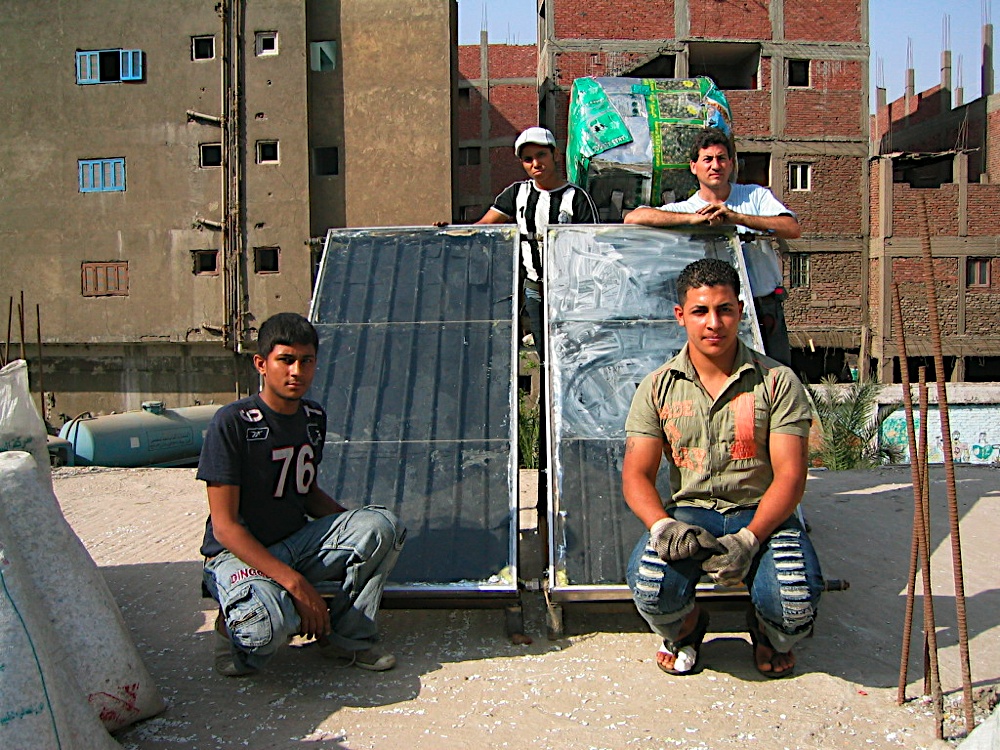
(Solar CITIES innoventor and carpentry trainer/educator Mustafa Hussein with his first hand-made Solar Hot Water System in 2006)

Once we make our households into the fundamental units of power production, and use that power to recycle the waste and water that houses generate in situ, I am confident that we will not only stop climate change, but, as Bucky Fuller suggested, "operate our planet in such a manner as to support and accommodate all humanity at a substantially more advanced standard of living than any humans have ever experienced!”

25.

Y una vez que hayamos aprendido a crear sistemas ecologicos a nivel comunitario aqui en casa, en la Tierra, hasta lo podemos hacer en Marte.


And once we’ve learned to create community level industrial ecology systems here at home,on Earth, we can even do it on Mars.

26.


Como dijo mi mujer en en anuncio del nacimiento de nuestro hijo, una frase del cosmonauta ruso Zlolkosky, “la tierra es la cuna de la humanidad, pero quien quiere pasar su vida en una cuna”. Cuando aprendamos a utilizar nuestros hogares para salvar a nuestra cuna la Tierra, nuestro planeta, realmente podemos alcanzar las estrellas.


As my wife quoted in our son’s birth announcement, from the Russian cosomonaut Ziolkovsky, “the earth is the cradle of humanity, but who wants to spend one's whole life in a cradle?” When we learn to use our homes to save our cradle Earth, our home planet, we can truly reach for the stars.

Wednesday, April 29, 2009

If "Pearls before swine", perhaps Biogas after? When Egypt's pigs are gone, what will we do with the garbage?


Was fur eine Schweinerei!

Egypt is engaging in an unprecedented mass slaughter of it's 300,000 pigs due to fears of swine flu. While some outsiders might applaud this "precautionary" measure in an overpopulated country that has already suffered 26 cases of the deadly avian flu, the impact on the Zurayib Zabaleen population -- Coptic Christians who make a living efficiently recycling more than 85% of Cairo's garbage -- will be devastating.

Not only will they lose their livelihoods (and some insiders say that perhaps that is one of the points -- using this excuse to exterminate not only pigs but a livelihood that can then be replaced by multinational companies and privatised landfill owners) but the city of Cairo will lose one of the most efficient and sensible urban ecology solutions the world has ever seen -- the use of domestic pigs (which evolved with humans for thousands of years) to manage and recycle urban waste, turning it into useful products and fertilizer. Now that beautifully integrated industrial ecology system will be destroyed.


Many of the poor will lose their sole livelihood.

The city will be in a bad position vis a vis massive quantities of organic waste.

What to do?


How do we turn a sow's ear into a silk purse?

( Photo: Hanna Fathy's neighbor keeps donkeys, cows and pigs to help convert city garbage into useful meat, hides, fertilizer and other saleable products. Without these animals the fabric of an urban ecology system that has been working for centuries will fall apart. Another ecological system needs to be put in its place. We suggest the safe use of methanogenic bacteria.)


At Solar CITIES we are confident that this disaster can be mitigated by immediately implementing and extending the "urban-garbage-to-cooking-gas solution" that we learned from Dr. Anand Karve at the Appropriate Rural Technology Institute in Pune, India. We started piloting the ARTI BIOGAS SYSTEMS in the Zurayib Zabaleen and Darb Al Ahmar communities in February.

And we met with great success:


Solar CITIES green-collar coordinator Hanna Fathy prepares to demonstrate the power of his home biogas system on his roof in the Zurayib Zabaleen neighborhood of Manshiyet Nasser, Cairo to the World Bank on Earth Day.


The idea is simple -- since the Coptic Christian community can no longer rely on pigs to efficiently transform the city waste into useful and saleable products, let us now empower them to turn the garbage into power.


Biogas.

Instead of using pigs, Cairo's residents can now use the same symbiotic organisms the pigs themselves were using: safely contained methanogenic bacteria which quickly and efficiently turn kitchen waste into clean natural gas.


(Photo: Women from the Darb Al Ahmar Environmental Science Center train with Solar CITIES to build home biogas systems from local materials in February 2009. )
( Photo: Hussayn Farag (right) smiles as local community environmentalists help fill the new biogas system on his roof with cow manure from the nearbye Darb Al Ahmar Historic Public Bath)

( Photo: A satisfied trainee in the Agha Khan Trust for Culture Environmental Science Program inspects the biogas system she learned to build with Solar CITIES on a neighbor's roof.)

In fact Dr. Karve's Household Scale Biogas digestors are cleaner and more efficient than not only pigs but all other forms of waste management. They eliminate all threats of disease, both viral and bacterial. They take the city's kitchen and restaurant and market wastes and turn them directly into safe cooking gas and easily transportable liquid fertilizer. They create no smells or odors, don't breed flies or rats and can be scaled to suit any situation.


Even smaller home scale systems are appearing all over India, made by do-it-yourselfers out of old plastic barrels:


In Kerala, southern India, thanks to Sajis Das of "Biotech", a fish market is using all of its organic waste to actually generate biogas fueled electricity.


We intend to do the same thing in Cairo.

(Photo: T.H. Culhane climbs out of the almost completed biogas digestor after fixing a plumbing problem; Hanna keeps him from getting literal "cold feet" by pouring water onto T.H. from the solar how water system)

And we are doing it on our own porch in Germany:


(Photo: On Sybille and T.H. Culhane's birthday at the Solar CITIES home office in Germany, we threw a "Birthday Bonanza Biogas Building Party", inviting friends over to learn how to build home scale biogas solutions. This 500 liter system is connected to the home-built solar heating system (right) which keeps the internal temperature of the biogas system warm enough for methanogenesis.)


(Photo: Solar CITIES board members Thorsten and Jan at midnight celebrate finishing the installation of styrofoam insulation on the biogas digestor to keep the heat from the solar heat exchanger in during the cold German nights)

At both the home level and the market and community level urban biogas holds the promise to providing waste management, poverty reduction and renewable energy all at the same time, and offers a perfect opportunity to deal with the tragic extermination of the centuries old pig-human relationship.

(We note with some irony that nobody is proposing exterminating the pigs here in Germany; instead veterinarians will inoculate our four-footed friends. It also isn't sure that this so-called "swine flu" was directly transmitted from pigs to people in Mexico, although anecdotal evidence may point to that. The current strain allegedly contains DNA from pigs, birds and humans and could have mutated in another host. Also this may also now be a moot point since it is now all over the world and is spreading from human-to-human contact.

Fellow UCLA Bruin and National Geographic Emerging Explorer Nathan Wolfe recently gave a speech at the TED conference in which he talked about his "early warning system" for Zoonoses (diseases that jump between species) and suggested that we can now manage outbreaks much better and keep public health protected by knowing who is working closely with animals and monitoring the health of both species on a regular basis. Although there have been no reported cases of "swine flu" in North Africa, apparently Egypt's authorities would rather deal with this using a sledgehammer instead of a scalpel. The social costs to the already marginalized Christians will be extreme even if the government carries out its intention to "compensate" some of the pig owners with cash payments. The adage "give a man a fish, you will have fed him for a day; teach a man to fish you will have fed him for a lifetime" can be reversed and transmuted: "give a man cash for his pigs, you have will have fed him for a day. Take away his pigs, you will have robbed him of his living."

For this reason many of the Zurayib Zabaleen are already trying to hide their pigs with relatives in the countryside, desperate to hang on to a symbiotic life support system that has helped them survive for centuries. It is not for nothing that the Copts of Cairo moved to the city WITH their pigs.

If the pigs go, so goes an entire co-evolutionary adaptation and solution to the problems generated by the built-environment that emerged along with civilization. And so goes an entire culture.

But all is not lost. Since the pigs were basically finely-tuned waste-food processors, as symbiotic with their stomach and intestinal flora and fauna as they were with their human associates, the solution of keeping the good microbes working on city garbage even as their original hosts are eliminated is the perfect answer to the current crisis.


By providing the Zabaleen with personal and community biogas digestors (already a mature technology in India and, on a larger scale, here in Germany) we can avoid throwing out the baby with the bath water. We can help the Zabaleen to continue providing their heroic and valuable environmental service to Cairo, adding value by turning garbage directly into clean, useful climate-friendly biogas and liquid fertilizer.

If we can secure enough funding fast enough, by this time next year not only the Zabaleen could regain their livelihoods, but Cairo itself could truly lessen the everpresent threat of disease and become a clean and green city, leading the Middle East in sustainable development.


(Photo: Hanna and his wife Sabah experiment with home-biogas in their new kitchen to cook and make tea for their guests using a flame produced today from yesterday's garbage. Photo courtesy of Omar Nagy, who is doing his Master's degree on the Solar CITIES biogas initiative.)


P.S. TO OUR FRIENDS AND SUPPORTERS:
WE ARE TRYING TO RAISE MONEY TO GET BACK OUT TO CAIRO AS QUICKLY AS WE CAN TO BUILD AS MANY BIOGAS SYSTEMS AS WE CAN FOR THE FAMILIES WHO ARE LOSING THEIR PIGS. WE ALSO WANT TO PRESENT OUR WORK TO THE WORLD BANK AND INTERNATIONAL NEWS MEDIA WHO WILL BE IN CAIRO THIS MID-MAY INSPECTING OUR WORK. IF YOU CAN HELP DONATE ANYTHING FROM AIRLINE TICKETS TO MATERIALS AS WELL AS FUNDS AND PUBLICITY, PLEASE LET US KNOW! CONTACT US AT THCULHANE@GMAIL.COM


To learn more about what we do in the Zabaleen Neighborhood, why not take a musical tour of the neighborhood with us by watching our Music Video "Talkin' Trash", composed and performed by T.H. Culhane:


Friday, March 27, 2009

Solar Satisfaction Survey in Poor Neighborhoods in Cairo: Results

The following post shows the 30 + solar hot water systems that Roh El Shabab and Solar CITIES have built in Cairo.

The map above shows the relative locations of the systems. 15 are located in Darb Al Ahmar (left-top) and 15 in the Zabaleen community of Manshiyet Nasser (right-bottom). This map is oriented with the top as due north. Al Azhar Park can be seen in green and the city of the dead to its right. The Muqattam hills are visible at the bottom right of the map; downtown Cairo is to the left side of the map. The Cairo airport is located above the map, reachable by both Salah Salam street (running along the right side of the park) and the Autostrad (running to the right of the city of the dead and adjacent to the Zabaleen commuity).

NOTE: THIS POST IS STILL UNDER CONSTRUCTION! PLEASE COME BACK IN A DAY OR TWO TO SEE THE FULL RESULTS. THANKS FOR YOUR PATIENCE!


The enemy. All over Cairo advertisements for electric hot water heaters tower over the streets. The intent of the electric hot water appliance companies is clearly illustrated by this photo: where buildings are under construction create the illusion that the logical thing to have when your apartment is finished is an electric heater. The electric heaters inefficiently draw on an overstrained electric grid supplied by climate changing fossil fuels (no, The Aswan High Dam no longer provides enough energy for Egypt!). In nearby Tunisia, however, another paradigm rules. In Tunisia all new buildings MUST have solar hot water systems. With its old modernist paradigms Cairo seems to be rushing headlong into the 1960s while other North African countries are well into the 21st century...


_________________________________________________________


The hero. Roh El Shabab (Spirit of Youth) renewable energy coordinator and Solar CITIES' Green Collar Job Trainer Hanna Fathy apprenticed with T.H. Culhane and then built and installed all 30 of the hand-made solar hot water systems now gracing the rooftops of Darb Al Ahmar and Manshiyat Nasser! Hana's gift for everything from innovation, design, planning, accounting, sourcing, construction, plumbing, social networking, training, empowering and employeeing local craftspeople make him the most important community catalyst in Cairo, with a very bright future ahead of him! In a time when the fossil fuel and nuclear industries threaten us all with pollution, violent conflict and climate change, Hanna is ushering in a brighter future for the beleagured Middle East and North Africa region.


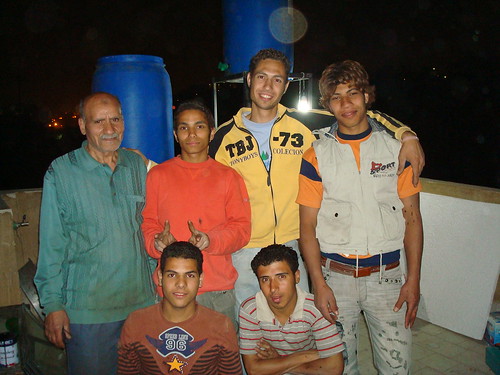
The Team: Here Hanna poses with his crew -- "the boys of Roh El Shabab", Adham, Nabil, Abu Nob and Moussa, working on 'Am Hussein's roof at night as they collectively build Solar Hot Water System DH 3 (see below).

DARB AL AHMAR'S HAND-MADE SOLAR HOT WATER SYSTEMS.


The map above shows the locations of each of the 15 systems currently operating in the Darb Al Ahmar Neighborhood. Note that the map is oriented with East on top, South to the right. The green area on top of the map is Al Azhar Park. If you would like to visit the Solar CITIES homes please contact Solar CITIES coordinator Hanna Fathy at .

System DH 1:

DH 1, Building 72 Darb Shuglan Street:


DH 1, Building 72 Darb Shuglan Street.
Date of Installation: April 2008
Period of operation: 11 months

This is one of two professional Chinese vacuum tube systems we purchased from RSD Technologies so that we could demonstrate to each community the latest technologies being used in solar heating and provide training so that the thermodynamic principles could be understood. The system cost 5300 LE and supplies three families.

System Size: 300 liters
Number of people served: 8
Previous system: Electric
Results: Now keep electric hot water heater off.
Savings: 30 LE per month
________________________________________

System DH 2:


System DH 2, #4 Abu Huryeba.
Date of installation: October 2007
Period of operation: 1 year six months
This was actually the first system we built. We constructed the parts at the Roh El Shabab Zabaleen Recycling School and carried them across the city of the dead and set them up on building 72. Later we moved it to the roof of the Solar CITIES apartment. The absorber plates on this model are made from recycled butter tins.
________________________________________

System DH 3:


'Am Hussein's family previously heated their water in the narrow stairwell, using a smoky, dangerous kerosene brass "bagur" as is the tradition in this area of the city. It is estimated that more than 10,000 people die in Cairo each year from respiratory illnesses while over 300 suffer third degree burns from water heating accidents.


DH 3 #50 Haret Aslan, the home of Carpenter/Furniture Maker 'Am Hussein.
Date of installation: March 2008
Period of operation: 1 year

Today 'Am Hussein's family has safe, clean, reliable, hot water 'on-tap'. When we visited last time with National Geographic TV they proudly said, "we threw our babur away. Now we only use sunshine."

Maintenance: Cracked glass, needs silicon repair. Silicon needs replacement elsewhere -- seem sthat over time silicon shrinks and cracks so needs periodic replacement. 10 cm strip insulation (cylindrical) not finished. Must keep all pipes (including vent pipe) on Hussein's side of the roof to prevent leakage to neighbors roof.

________________________________________

System DH 4:


System DH 4, #75 Darb Shuglan.
Date of Installation: June 2008
Period of operation: 10 months
This system is also next to and visible from the old Ayyubid Wall.
As in System DH 5, the wind shear along the wall tore the insulation off of the hot water tank.

Survey Data:
Name: Abdul Hamid Badawy
Address: 75 Darb Shughlan
Occupation: Army, retired
Age: Over 50
Education: Technical Diploma, Airplane Technician
Number of people served: 2
Number of connections: 2nd floor and 1st floor apartments.
2.1 (2) Had heard about solar but never seen.
2.2 Has had system less than 1 year
2.3 When there is no sun supplements with electric heater
2.4 (1) Doesn't consider this a problem at all.
2.5 Ratio 90% Solar, 10% electric
3.1 Previous system was Electric Olympic 30 liters
3.2 Has had this system for 10 years.
3.3. Disadvantages of electric heater: No water pressure in community so it burns up when there is no water. It also accumulates bad stuff on heater element because water is not clean
3.4 Before previous electric system had another electric system for 12 years. They last about 10 to 12 years, but get eaten by bad water. Heater element burned out when water lower.
4.1 Savings are 1/3 from energy bill. Used to be 70 LE per month for electricity. With solar he now pays 40 LE per month (savings of 30 LE monthly).
In Winter, January and February it is overall weak but on sunny days it is still good. Out of the 60 days about 20 were good.
4.2 How satisfied (3) Middle.
4.3 Disadvantages: None, but had problem because neighbors misunderstood that they must not open both electric heater and solar heater valves at same time; caused backflow to roof, flooded. Also, insulation broke because of wind.
4.4 Advantages: Saving on electric bill. Immediate Hot Water (remarks that with electric heater must wait 15 minutes for water to heat.)
5.5 Leaks and lack of understanding: Opened electric and solar at same time last year flooded the downstairs. Problem caused by human error, ignorance, too many users and not all of them trained. Didn't know what valve to close to stop the flooding.
Maintenance problem: Insulation on square box dried, flew away. Otherwise not a problem keeping it up. "We would clean the panels from dust every two weeks. But we weren't told about repairing the silicon. Still the minor maintenance is worth it."
6.1 Would definitely recommend to neighbors.
7.1. WTP: Would pay up to 1,500 LE upfront for the system and would ask for micro-credit loan for 2000 and pay 40 LE monthly for 4 years to pay off the balance . Has constant work.
10. Thinks biogas system would be unpopular because of the 2 hour time limit factor for the 1000 liter system. Says "this is an urban problem -- people do not want to make the effort in the city to be self-sufficient. In India it may be different, they live in less dense high rises maybe. But we are used to butagas bottles here. People won't understand the need to grind up their bio waste.

________________________________________

System DH 5:


System DH 5, # 73 Darb Shuglan.
Date of Installation: July 2008
Period of Operation: 9 months
Osama Mohammed, Carpenter
9 people served in two bathrooms on second and third floor
Had heard about SHW, generally from hotels.
Period of operation: 6 months (since Ramadan)
Previous system: Butagas (stove) (had electric for 3 years but abandoned because of danger and expense). In 60's and 70's used babur (kerosene) but says "it was dangerous, could explode". Brother Mustafa Mahmoud Mahmoud "Youssef" has a gas heater, but is also connected to the solar HW and saves money this way. Both prefer solar because of SAFETY and running costs.
Rank systems in terms of safety: Solar/Gas/Electric/Butagas/Hamil/Babur
Rank systems in terms of Cost: Solar/Gas/Electric
Rank in terms of Convenience: Gas/Electric. In the Summer Solar is the Most Convenient, but not in the winter.
Uses only solar water when sun is strong; on cloudy days uses warmed water from solar system and heats it on the stove.
Now saves one gas bottle (8 LE) per month. "We had an electric heater but we shut it off because it used too much electricity. We went back to using stove, but we kept the electric heater. But when we got this solar heater we had the electric heater removed completely. We had had it for three years. We don't want it around any more. We are afraid of electric heaters. They are dangerous, so we don't like electric heaters. The SHW is safe and only takes 30 seconds to get the hot water. But in winter it is inconvenient." Satisfaction level 3. (Would be highest if we had a built in back up heater). " Yes, we would recommend to neighbors. The toilet float valve (Owama) was a problem -- nobody understood how it worked. We had the same problem that our neighbor (System MN 4) had with water backing up onto the roof when somebody turned on both their conventional heater and the solar heater at the same time but we avoided flooding (nafura) because we had learned from our neighbors experience. But the operation and maintenance of the system had not been explained fully enough. We would like more training.
WTP: "People are poor in this community. And we don't like loans, but maybe if the systems were financed like the big companies do the electric heaters, with a guarentee. I would like to be able to pay the same sort of downpayment -- about 500 LE, and maybe 20 LE per month. When the AKTC proposed cost sharing for paving the street of 100 LE per month people refused"
Says average income of area is about 300 LE per month.
Would participate in Biogas project: "We wouldn't throw out garbage if we had such a system. It would be good because it would help keep the street clean, and would save us about 8 LE per month for the cooking gas bottle."


This system is along the old Ayubbid Wall. You can see the rooftop garden in this photograph. High Winds from along the wall tore the insulation off of the hot water tank reducing system performance. As a consequence all new Solar CITIES systems will be built with cylindrical rather than square insultion surfaces.

Maintenance: T.H. fixed their cold water storage tank Owama. Silicon needs replacement on panels (dust and moisture getting in). HW tank needs new insulation method (wind blew apart the square styrofoam box). Valve on HW rise was closed -- consumer needs to be trained in how to use valves!.

________________________________________

System DH 6:

Photo missing.

System DH 6, #8 Abu Hureyba. Gada's System,
Date of Installation: October 2008
Period of operation: 6 months

________________________________________


System DH 7:


System DH 7; #5 Haret Al Rom. Ali's system overlooking the historic Public Bath.
Date of Installation: March 2008
Period of operation: 1 year


System DH 7; Ali and his system. This system, located above the public bath, was featured in the National Geographic Television piece on our work. It didn't require two tanks because Ali already had his own elevated roof storage tank.

________________________________________

System DH 8:

System DH 8 at 19 Darb Al Ahmar Street, The Historic Public Bath of Islamic Cairo:
Date of Installation: System 1, February 2009, System 2 March 2009.
Period of operation: 1 month


System DH 8 at 19 Darb Al Ahmar Street, behind the venerated Darb Al Ahmar Public Baths. Here Hanna Fathy and the bath proprietor, Omar, worked with T.H. Culhane and trained members of the Darb Al Ahmar Environmental Science Center team to build a 4 panel, 4 tank solar hot water system providing the bath with 400 liters of hot water each day to look for ways to revive the famous Hammam tradition in the area.

________________________________________

System DH 9:


System DH 9, #16 Haret Saddalah (Hassan Muhammed).
Date of Installation: January 2008
Period of operation: 3 months.


This system complements a rooftop garden.

________________________________________

System DH 10:


System DH 10, # 15 Haret El Souq. Hag Muhammed.
Date of Installation: January 2009
Period of operation: 3 months

The owners of this system didn't want their roof space occupied so they had the system placed too close to the western wall. Consequently it gets shaded after 3 o'clock. Nonetheless it was producing 55 degree water in early March. The family didn't know this however. When interviewed they said they would continue using their electric system until the winter was over. When we checked the roof we found that the valve was closed and that they had never tried the system, making the assumption that it wouldn't work until the weather was warm -- a common misunderstanding about solar hot water systems. We showed them that it was producing hot water every day and had them try it in their bathroom. They promptly turned off the electric heater saying, "if we had known that we would have been using this every sunny day this winter!"

________________________________________

System DH 11:


System DH 11, #2 Zuqaq Al Nakhla. Hag Fathy's system.
Date of Installation: February 2009
Period of operation: 2 months

This system is on the roof of the home of Hag Fathy whose shoe business is on the famous Bab Zuela-Khan El Khalili road. Hag Fathy has a rooftop garden so he also appreciates the presence of 200 liters of cold water storage (blue barrel) under pressure all year long. This way, even when the water is cut in the community his plants don't die and he and his family can take hot showers.


System DH 11. Hanna inspects the system as part of his "quality assurance rounds" and finds the water to be bath temperature even on a cloudy day.


System DH 11. Hanna demonstrates a solar hot water tank temperature of 37 degrees on a cloudy afternoon of March 13 2009. On the sunny day previous he recorded 62 degrees.


________________________________________


System DH 12:


System DH 12, #7 Atfet Mubayyid.
Date of Installation: November 2008
Period of Operation: 5 months

The owner, an elderly woman named Hana, has a rooftop garden.

________________________________________

System DH 13:


System DH 13, #5 Atfet Mubayyid.
Date of Installation: September 2008
Period of operation: 7 months
The owner also has a rooftop garden and is a member of the Aga Khan Trust for Culture Environmental Group. She attended a Solar CITIES presentation on the possibility for local industrial ecology systems given by T.H. Culhane at the AKTC a year ago and now wants to complement her SHW system and rooftop garden with biogas and wind power.


System DH 13 at night with the enthusiastic owner.


________________________________________

System DH 14:


System DH 14: Abdullah Baik Street.
Beneficiary: Sulaiman Agha.
Date of Installation: October 2008
Period of operation: 6 months

Previous system: Electric
Monthly savings with solar: 20 - 30 LE
Participation: Helped build system
Complaints: None
Satisfaction: Highest
Interest in personal biogas system: high
Rooftop garden: Present


DH 14, Sulaiman Agha used to heat his home on Abdullah Bak street with a 40 liter electric system. Since installing the hand-made Solar CITIES system he says he hasn't used the heater once. "I cover it up with this gray cloth" he says, removing the shroud like covering "because I don't even want to look at it any more. It cost me too much and I am happy to be rid of it!"


________________________________________

System DH 15


System DH 15, #19 Harat Zarat Al Nawat under construction: A family affair: Hussein, his daughter Rana, his son Amr and his wife work late into the night with Hanna Fathy on their roof building solar collectors.


System DH 15. Solar CITIES co-founder T.H. Culhane teaches Darb Al Ahmar Environmental Science Center Teacher Rana Farag how to weld polypropylene plumbing pipes while she participates in the construction of her family's very own hand-made solar hot water system.


System DH 15, Solar CITIES Green Collar Job Coordinator Hanna Fathy supervises while Rana Farag drills holes to create her family's solar hot water tank from a recycled plastic shampoo barrel. Her father and sister, who have just finished painting solar absorbers, cheer her on.


System DH 15. Rana Farag, a teacher at the new Darb Al Ahmar Environmental Science Center, training with Solar CITIES as she builds a solar hot water and a biogas system on her own roof. She stated "I'm going to be Darb Al Ahmar's Hanna Fathy" and then added, smiling at Hanna competitively-- "only better!"


System DH 15, completed. Hussein Soliman Farag's system.
Date of Installation: March 15th 2009
Period of operation: 2 weeks

Hussein had the brilliant idea to hang the solar panels from the wall of his roof so that they wouldn't take up any roof space. He also saved us the cost of a stand for the hot water barrel by mounting it on wooden crossbeams between two walls. For the panel hanger Hussayn created a design with Hanna and T.H. based on a hanging flower planter he had on his roof, and had the local ironsmith weld it together. This is the first hanging panel system in Egypt. The author had previously seen only such system before, in Pune, India. Thanks to Hussayn's ingenuity now Solar CITIES can provide balcony and roof wall hanging systems for family's without sufficient roof space.
This will increase our service area dramatically!


________________________________________

MANSHIYAT NASSER'S HAND-MADE SOLAR HOT WATER SYSTEMS.


The above map shows the locations of the 15 + hand-made solar hot water systems Roh El Shabab and Solar CITIES built in the Zabaleen community. The map is oriented with the top facing roughly E-SE and the right side of the map facing S-SW. The road at the bottom of the map is "Kubry Manshiya" (the Manshiyat Nasser Bridge on the Autostrad) and the top most part of the map is the Coptic Samaan Monastery, where we installed a solar hot water system for the cafeteria. The left side of the map shows the Association for the Protection of the Environment, where we installed a hot water system for the women who recycle paper (so they don't have to work all day with their hands in tubs of cold water) and the Coptic Church.


System MN 1:
System MN 1: Dir Samaan Monastery (Dir Al-Qadees Samaan Al-Khiraz):
Date of Installation: April 2008
Period of Operation: 11 months.

T.H. Culhane, visiting from Germany, inspects the system and interviews the Monsastery cafeteria staff to determine their satisfaction with the imported vaccum tube solar hot water system.

System MN 1, Equivalent to DH 1 -- a 300 liter vacuum tube system purchased from Alaa Watidy at RSD Technologies, Heliopolis. We installed one of these in each community so that they could learn about the latest technologies for solar thermal applications and be able to compare them with our home-made, hand-made systems.

________________________________________
System MN 2:
System MN 2, Hanna Fathy's roof.
Date of Installation: November 2007
Period of operation: 1 year, 4 months.
Hana Fathy's "Penthouse Pad "
This is Solar CITIES central office in the Zurayib Zabaleen community. Here Hana and the team build all the solar hot water panels and systems we use to make our community-created industrial ecology systems.
Hanna's house has the first truly functional solar hot water system we built, reflecting all of our iimproved designs.
The roof serves as a base not only for cold and hot water storage but the beginnings of the first rooftop garden in the area.
Since it is one of the tallest buildings in the neighborhood it offers a supreme view of the community, the city of the dead and even Al Azhar park. A great place to watch sunsets!
Hana's family serves guests tea and home made bread and cheese here before you continue your tour. The bread is baked in a traditional mud brick oven just behind the solar panels and the rooftop animal shed.
Prior to building a solar hot water system Hana's house had no water service at all and no pipes, merely a standpipe at the entrance to the door that gave water perhaps once a week. Home has mother, Romani, Ayman, Sister, wife of Ayman...
On Saturday, Nov 3rd 2007, after AUC field trip after dark, I stood in the street surrounded by rats. Ayman, Hana's brother drove me and Darb Al Ahmar Solar CITIES coordinator Mahmoud Dardir to Al Azhar park and tod us his Uncle's 10 month old baby was killed by rats two years ago. Now they have a new child and must always worry about the rat threat.
Solar Hot water systems can allow families to better seal the windows in the house against rats. Normally windows have to be kept open because people heat water on the stove which creates carbon monoxide and dioxide poisoning.
________________________________________
System MN 3:

System MN 3 Roh El Shabab (Spirit of Youth) NGO Office.
Date of Installation: February 2008
Period of Operation: 1 year and 1 month
This system was the first solar hot water system we know of where the collector box is built out of recycled plastic trash bags. The bags were collected, sorted, washed and shredded by the Zabaleen, then sent to the desert factory of PrimaPlast where they were melted and then pressed into a sheets under a thousand ton press. While heavier than the aluminum boxes we normally use they work quite well. Their cost however is currently equivalent to that of the aluminum sheets and the factory at Madinat Al Badr is too far away for us to practically use them given the weight and transportation costs. Still, we have proven that one can find an aftermarket use for plastic bags residuals in the solar heating industry.
Roh El Shabab (Spirit of Youth) is an NGO made up of members of the Zabaleen community and is active in all areas of Environmental Technology. Roh El Shabab is responsible for the 30 hand-made solar hot water systems now on roofs throughout Cairo, and is looking to expand its green-collar job training program. The director is Ezzat Naem Guindy, who can be reached at ezzatnaem@hotmail.com.
________________________________________
System MN 4:


System MN 4, Adham Fawzy's "solar shelter", a combination goat house, cooling rabbit hutch and hot water system.
Date of Installation: December 2007
Period of Operation: 1 year 3 months
________________________________________

System MN 5 :
Prior to the building of the Solar CITIES solar hot water system, Mina and his family heated water on a "kanoon" -- a traditional rural campfire, fueled with garbage -- urban wastes -- rather than agricultural wastes. This led to the production of dangerous toxic smoke.


System MN 5 Mina Atwan''s House
Date of Installation: December 2007
Period of Operation: 1 year, 3 months


Solar Cities' "Mina House"
This is the first site on the Solar CITIES trail, at the edge and entrance to the Zabaleen community. Mina and his family live as though they were still in the countryside because they have open space in front of the dramatic rock quarry. With all that sunlight it was natural to build a solar hot water system here -- the first one you see as you drive into the community.
On this stop you can see the impressive rock quarry, almost as deep as a pyramid is tall, with its massive stone cutting blades, and see a traditional mud brick oven in use.
T6 - Street Furn - Zarayib Abu Mina Adwan Head of Household None - Kanoun 1
Mina is a student at the informal school. He is 12 years old. His family has 9 people in it -- Mama, Baba, and 7 children. Youngest is 2 and 1/2 years old.
The main occupation is rock quarrying in the deep quarry in front of the house. Mina's family lives in a makeshift house bult of unfinished concrete lock on wide side and cut stone from the quarry on the other. Most of the house cluster is one story and is built without mortar. Most of the rooms have no real roof, but are covered with corrugated tin, wood boards, cardboard and thin veneers of concrete. We determined that most of the house's roof, even the parts with concrete, will not support water storage. The family has invested in a 1000 LITER WHITE OBLONG HEAVY DUTY PLASTIC WATER STORAGE TANK (the kind with a metal support cage) that is kept outside the door of the house module on the far right, next to the only available water tap.
The Water Tap is outside the front wall of the 3 houses that make up the cluster. It supplies water at a good pressue because, as the family says "we are at the bottom of the hill so all the water flows by gravity down to us." Water pressure, without a motor (which the family does not have) is sufficient to pump water to the roof.
One of the sons, Sam'aan, has built a sturdier house to the left (where our placemark is) with two stories, out of cement and brick with a roof that can "support 7 tons" (he tells me proudly). Sam'aan has experience working as an air condtioning and refrigerator repair technician. His roof is now covered with plastic bottles and cans, but he wants to make room for a solar hot water heater. Solar exposure is optimal here, with a wide open skyline.
The households all heat their bathing water in metal containers (20 liters) in a QANOON made of uneven rocks from the quarry area. They fire the QANOON with garbage and waste wood. They say it takes only 10 minutes to get the water to a boil, as opposed to 20 or 30 minutes using butagas. This, they say, is because the fire is hotter and the rocks stay hot (basically this is a big campfire.)
The family also has a mud brick cone oven like Hanna has on his roof, and plenty of fruit trees (guava, grape arbor shading the door, balah (date palm) and vegetables. They explain to me that they moved here from the Countryside 50 years ago and settled here. 32 years ago Sam'aans father came here (families come here in waves, invited by other family members, as opportunities dry up in the countryside). Sam'aan was born here 20 years ago. He says "we just take the traditions we used in the countryside and do them here. We have an advantage having this open area, so it is like we are still on the farm. We can grow food and we can cook and warm water the way we always did on the farm. People inside the community are less fortunate -- they can't use an oven like ours for example (although Hanna's and Romani's family do have similar mud brick ovens on their roofs) or boil water in a Qanoon because there is no space and the smoke and fire danger are too great. But we can do this here. We have a butagas oven for cooking inside, but the Qanoon is cheaper and faster. When people come home from work around 4 p.m. we start the fire. We have no pipes in the house, and no bathroom. We just pour the boiling water into buckets with colder water and carry into the house and bathe in whatever room is free. There are no drains."
The water storage tank is for when the entire communities' water is cut.
They use 2 butagas bottles a month for cooking as opposed to 4 or more for a similar family heating water for bathing.
"People have offered us lots of money for this property but we refuse to sell because of the view." They pay the government 200 LE per year for land taxes. Govt. can take land away at any time.
________________________________________

System MN 6:
System MN 6, Imad Ridha's House.
Date of Installation: February 2008
Period of Operation: 1 year and 1 month
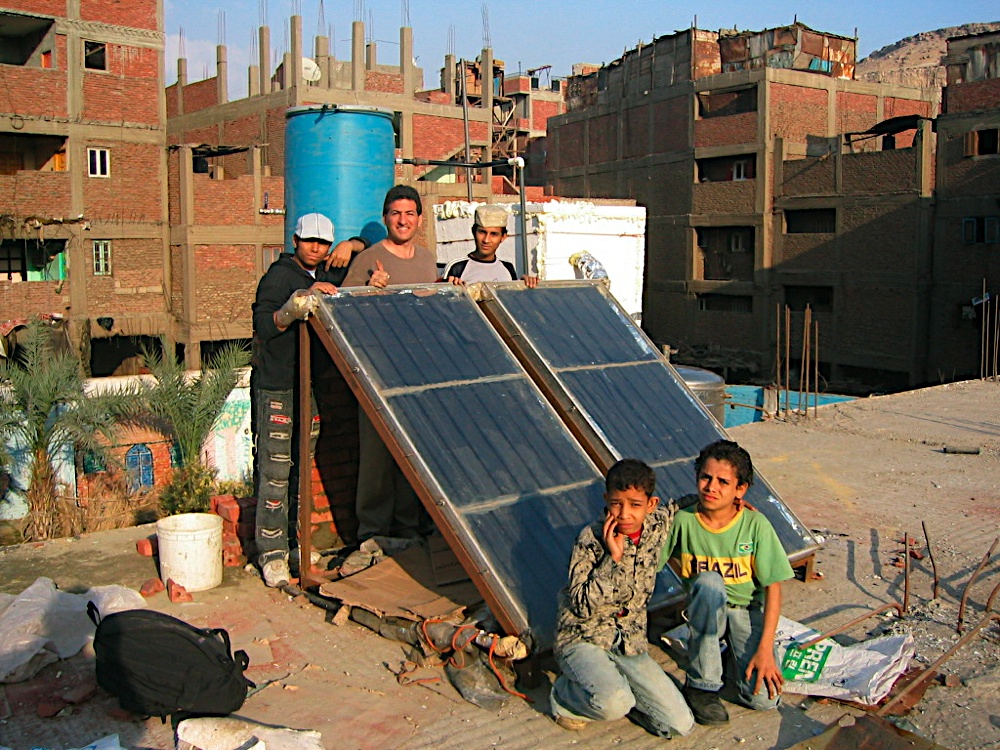
Moussa and Hanna finish installing the system, this one also with collector boxes made from recycled plastic bags. Here, on this windy roof under the pigeon house, experiments with cylindrical insulation on the hot water tank proved that this design is better at withstanding the wind shear which caused the rectangular box insulation to break in Darb Al Ahmar.
________________________________________

System MN 7:
System MN 7 Romani Magdy's House.
Date of Installation: February 2008
Period of Installation: 1 year and 1 month

Romani's system, like that of the Roh El Shabab NGO head office, also uses boxes constructed from recycled plastic trash bags pressed into panels. Romani's system had to be moved when the family built an additional floor on their house. Fortunately the Solar CITIES design permits easy disassembly and reassembly.

Romani is Hana Fathy's cousin. His roof is the first one to have a solar hot water system whose panel box is made from recycled plastic trash bags (compressed into panels by the PrimaPlast factory out in Madinat Badr). Behind the panels is a traditional mud brick oven where his mom bakes bread; the rest of the roof is covered with trash that is destined for recycling, and serves as a sorting and storage center. Beneath the house is a literal pig stye!
Previous Experience:
T3 - Street راجب حكيم - Zarayib ام رماني مجدي Wife Yes Present 1 USES ONE EYE HEATER 1
Romani's House
9 people in family: Mama, Baba, 6 Sisters, Romani, ages 20, 19, 18, 17, 16, 14. Romani is 19.
"We all bathe after work: 4 bottles every 20 days. 2 big, 2 small.
6 LE - 7 LE per bottle for the big ones, 4.5 - 5 LE for the small bottle.
Adham's mother says they use gas for meat, mulakhiya, tea, milk and bathing. She says they spend about 25-30 LE per month on hot water for bathing.
They have a color TV and a computer but they say these use "little electricity." They say TVs and computers are important because they can "share experiences with others" and be part of the global community.
Mother says "it takes 1/2 hour to prepare hot water for one bucket." Romani says, "But one bucket is not enough for me to bathe so it takes me up to an hour to take a bath. Especially in the winter when the water is colder. If I am late or in a hurry I have to take a cold bath."
Romani's mother confirms that with 7 children it takes 3-7 hours a day for preparing bath water, especially when they were young and needed two baths a day.
Everyone in the family takes 1 Bastila (10 liters) except Romani who takes 2 (20 liters).
Household earnings in this area can be approximately 400 LE per month.
________________________________________

System MN 8:


System MN 8, at the Association for the Protection of the Environment.
Date of Installation: February 2008
Period of Operation: 1 year and 1 month
This system is used by the women who make recycled paper. They normally spend 5 hours a day with their hands in tubs of cold water making the paper. In the winter months this is particularly painful. Now they can work comfortably. The only problem is that children living in nearby apartment blocks have twice thrown stones and smashed the glass. We are looking for solutions now.

________________________________________

System MN 9:


System MN 9, on the Muqattam "Kanisa Al-Idhra Maryam" Church roof.
Date of Installation: May 2008
Period of Operation: 10 months

Part of our goal is to work with the Coptic Church to contribute to their service helping people understand that God provides for His children. Consider the birds, consider the lilies of the field... (Matthew 6).

________________________________________

System MN 10:


System MN 10, Nabil William's System.
Date of Installation: June 2008
Period of operation: 10 months.

The glass on the right panel is broken and the float valve in the cold water tank failed after 9 months of operation.


System MN 10, T.H. Culhane demonstrates that the problem with this system was merely a broken Zahran float valve. Why did it break? It seems that because water is frequently cut in this community the cold water barrel will often become empty. This causes the float valve balloon, which is filled with sand, to hang downwards and the weight is too much for the plastic joint where the metal screw is. A possible solution for this community is to place some kind of float rest under the baloon's lowest point so it is free from stress when the tank is empty. This is yet another problem we face designing systems for communities with inadequate water service.

________________________________________

System MN 11:


System MN 11, Imad Tharwat's System;
Date of Installation: December 2008
Period of Operation: 4 months
Um Imad
, Hanna teaches this little boy how to clean the solar panels from dust to radically improve their performance.


System MN 11. This happy little boy now feels empowered to participate in his family's well-being.


System MN 11.


________________________________________

System MN 12:

MN 12, Samaan Shanuda (Baheet)'s system
Date of Installation: November 2008
Period of Operation: 5 months
Like Adham Fawzy's System (MN 4), this water heating installation serves as a goat shelter as well as a solar hot water system. The sun's heat is taken away by the panels and transferred to the insulated water tank, providing an extra cool shade spot for the animals.

MN 12. Even the family's ducks enjoy hanging out under the cooling shade of the solar panels.


________________________________________


System MN 13:

System MN 13, Sa'eed Shawky's system (foreground) and MN 12 (background).
Date of Installation: November 2008
Period of Operation: 5 months

Note that in the absence of a compass one can usually use the direction of the TV satellite dishes to determine the correct direction for the solar panel (facing due south or slightly SW).


This has to be the most dangerous installation Hanna has ever done.


System MN 13, at the edge of eternity.


________________________________________

System MN 14:

System MN 14, Mina Rashid's roof.
Date of Installation: May 2008
Period of Operation: 10 months

Milad demonstrates the solar hot water system that he helped innovate in his community.


System MN 14, rear view

System MN 14: Mina Rashid's roof.
________________________________________


System MN 15:


System MN 15: Walid's House next to the Zabaleen Recycling School
Date of Installation: September 2007
Period of Operation: 1 year 7 months
System MN 15 was actually the first system we built as an environmental technology training exercise with the students of the Zabaleen recycling school. We later connected it to the neihboring home of Walid, one of the teacher's in the school who had no running water. We ran cold water pipes to his house underground and then hot witer pipes from the roof of the school.

The placement of the cold and hot water tanks in the above pictures were an attempt to economize on materials costs by keeping the size of the stands small. We started with a steel tank but when the water kept cutting out the vacuum created eventually caused metal fatigue and leaks. We then decided to experiment using plastic tanks, which was a suggestion of Walid's. Walid said, "We Zabaleen make our living recycling plastic. Surely we can use plastic for our solar hot water systems?" He turned out to be correct. This led a to experiments of how to use the plastic shampoo barrels that a beggar child from the city of the dead found for us. We learned through painful trial and error that the hot water tank must always be at least one fist length above the top of the solar panels and the cold water tank should be fully above the hot water tank.


This system was the very first system we built and went through many iterations through trial and error before we hit upon a design that worked.


Walid and T.H. celebrate the joy of hot and cold running water at the turn of a tap!

_____________________________________________________________