Solar Power isn't Feasible!

Solar Power isn't Feasible!
This cartoon was on the cover of the book "SolarGas" by David Hoye. It echoes the Sharp Solar slogan "Last time I checked nobody owned the sun!"

Saturday, August 29, 2009

Continuing refinements to the "endless shower" system.

Imagine if you could take a 10 minute hot shower  every day using only the amount of hot water that fills the green watering can pictured above (2 gallons or about 8 liters).  Imagine how much water, energy and money that would save you... imagine how much greenhouse gas reduction it would permit if we all did it!  Imagine if we could give everybody their right to enjoy bathing in clean hot water every day.  Imagine the effect on health and hygiene and comfort and well-being. Imagine the impact on productivity and dignity. Imagine the end of water wars...
 
 
In my obsessive empirical studies of hot water demand and dogged persistence toward the goal of adequate clean fresh water for everyone I have developed and started using a recycling shower system. People ask, "how can you take a shower using the same water over and over for 10 minutes?" I ask "how does it differ from taking a bath?" Actually, the recirculating shower I developed, which has an inline filter, is cleaner and more flexible.  
 
Tonight, after "spelunking" on my belly and back in the crawl space under the house with a video camera and lights looking for places to hook up the graywater system that will turn all shower and bath water into edible landscape irrigation, I washed off the grime and dust and cobwebs using my recycling shower with a new "bucket" technique. The yield: a nice 10 minute hot shower using only 2 gallons (7.5 to 8  liters) of water.
 
 I'm liking it more and more every day myself. Still can't get over how simple it is to cut water and energy consumption by up to 10 times with NO sacrifice in utility or lifestyle quality. I remember that one of the thing that cost Jimmy Carter the presidency was the misperception that he wanted us to "stay in thedark and wear sweaters" and Obama was ridiculed for saying we should keep our tires inflated to reduce energy consumption. The "bourgeoisie" everywhere (not just America) do NOT want to sacrifice, not even to save their own civilization.  So I'm looking for solutions that require little or no sacrifice at all but simply DO MORE WITH LESS. This one is almost scary in how obvious it is. Am I the only person doing this? I can't believe it. If you are reading this please give it a try so we are at least two and can compare notes...
 
My thesis research shows that most under-capitalized Cairo residents living in Manshiyet Nasser (where 60 % of the population heat bathing water on the stove) and Darb Al Ahmar (where 25 % of the population heats bathing water on the stove) use 10 or 20 liters per person per bath. The limiting factors are the size of the containers people can safely put on their stove (anything over 20 liters weights too much) and the amount of time people are willing to wait to heat it (10 liters can be heated in 5 to 10 minutes, 20 liters can take 20 minutes to a half an hour, depending on the strength of the stove flame). The water used is then slowly poured over the body, pausing to lather up. The most frustrating thing is when you miscalculate the amount of water you have left and can't get all the soap and shampoo off of you or out of your hair.

This invention is targeted at those who are limited to 10 liters, which, when recycled, provides adequate water to bath and clean for 10 minutes of CONTINUOUS showering -- no pausing in the cold to lather up. The first 3 to 5 liters can be used to rinse off all the soap and discarded down the drain. The next 7 to 8 liters can be used to luxuriate. in the shower, enjoying the warmth. Note the water only needs to be heated the once. A normal shower of that length would consume 40 to 50 liters of hot water.
 
My goal initially  is to create a useful, replicable system for families in Darb Al Ahmar (like us) and Manshiyet Nasser who heat water on the stove and are restricted to using a 10 liter bastila. With this system that 10 liter bastila can be brought to 40 degrees (bath temp) in about 10 minutes and then one can stand in the ... Read Moreshower using it for 10 minutes -- imagine a hot shower for 10 minutes using only 10 liters of water. Normally we use 40 to 50 liters for a shower of that length (and Americans use 100 liters for a shower of that length!). We, of course, heat our water using a solar hot water heater we built. We get 200 liters of hot water from the sun every day, and now need only 20 of that each day for me and my wife to take long hot showers. That leaves a huge surplus of hot water for washing clothes and dishes and cleaning and we can splurge and fill the bathtub! My bathroom redesign hopefully will make it all turn-key and replicable everywhere.

In my song "Maey, Oh Maey, the water song" (http://melodic-mnemonics.blogspot.com/2009/01/maey-oh-maey-water-oh-water.html) I claim that since we live on a water planet we shouldn't ever have to worry about water scarcity. Now that I've got showering down to 8 liters for 10 minutes of luxury I think I can recycle that 8 liters through my shmutzdecke slow sand filter for re-use the next day or so. Then we've got to take these solutions on the road in India and Egypt  again.
 
The next step is to "prettify" this system so that it is easy to install and use without disrupting the bathroom.  No tubes, visible pumps or batteries or buckets.  I've already made progress toward this.  The battery is already solar powered and easily recharged with a small 25 watt foldable panel like we took on tour of Morrocco and India. The system is entirely portable and can be taken with you anywhere in the world to be used in homes, hotels and even out in the field when camping.  Only the aesthetics need to be improved.
 
I'll keep you posted!

Wednesday, August 26, 2009

Extending the range of biogas digesters using Extremophiles

Lest one believe that psychrophils only have potential for winter biogas production it is worth noting that this summer in Essen, Germany, in mid-July, the average daytime temperature was highs of 16 degrees C ( 60.8 F) and lows of 13 degrees C (55 F) with a couple of days peaking at 24 degrees C (75 F). 15 Celsius is generally considered sweater-wearing weather and professional biogas producers have had to add heat to the systems (resulting in profit losses) to keep them productive. Our own mesophilic biogas system on our porch, which prefers temperatures of 37 degrees C (body temperature, 98.6 F) , has given us very poor performance this summer with the temperatures being at the bottom of the mesophiles range. We have supplemented by putting in heating coils connected to our solar hot water system at additional expense. But Katey's bacteria are at their best at this new European summer temperature range. We can expect that temperature swings will become the norm as climate change continues, threatening conventional systems that use warm-loving bacteria with unexpected shut downs and performance drops. But it isn't only the northern countries that can benefit from this; we believe our psychrophilic digesters can immediately address biodiversity and social challenges in tropical and subtropical areas.

Working with National Geographic Explorers in Residence Dereck and Beverly Joubert and fellow National Geographic Emerging Explorer and Ethnobotanist Grace Gobbo we intend to build identical systems our testing phase in Botswana and Rwanda at the Joubert's networks of eco-safari lodges and in villages at the edge of critical habitats and in Tanzania at or near The Jane Goodall Institute at the Gombe Reserve so as to determine whether or not biogas can be an effective solution to that part of the deforestation problem caused by the collection of cooking and water heating fuel.

Although these African sites are considered tropical locations, NG Explorers confirm published reports that, for example, at Gombe temperatures in July can be as low as 11 degrees C, with an average minimum of 19 degrees. Most importantly, many of the remaining forested and vegetated areas that serve as the last strongholds of great apes and other endangered megafauna are areas pushed up into the mountainous parts of the country where the altitude can create almost alpine temperature regimes.

In the Usambara mountains of Tanzania, for example, the average temperature at 900 meters is a mere 19 degrees. Even at 300 meters the mean temperature is only 24 degrees C (see W.D Newmark, Conserving biodiversity in East African forests,Springer, 2002) . While this is far too cool for the normal methanogenic bacteria found in biodigesters, Katey has shown that her psychrophiles, while happy at 0 degrees, perform best at 25 degrees C, a temperature at which mesophiles generally shut down production. This suggests that the use of these Arctic extremophiles is ideal for African deployment of biodigesters in the very environments whose biodiversity is most under threat.

The goal is to discourage any regress to the use of wood fuel in these critical forest edge habitats as well as in the lowlands during colder times. Grace shared with us that the the chimpanzee populations are very threatened because of habitat destruction but ironically even the scientific research stations and park protection facilities use fossil fuels, wood and charcoal for cooking and heating and have a hard time disposing of their waste, thus providing an example to visitors that only exacerbates the very problem they are struggling to solve. Meanwhile the Jouberts have documented a surplus of "rotting yams and other poverty class produce" in most of these areas that could completely eliminate the need for collecting firewood. A viable year-round biogas system (coupled with solar energy systems) could mitigate and even solve many habitat destruction root causes, particularly as the high profile of the Joubert's safari eco-lodges and the Goodall Institute act as catalysts for regional and international change.

What the Walter-Anthonys and the Fruetel-Culhanes have decided to do is to start using psychrophiles and mesophiles together in the same digester, much in the same way the Chinese (and now development agencies) have done "stereo-breeding" of different species of fish in the different temperature zones of aquaculture tanks to improve productivity. The cold loving bacteria will occupy the colder bottom strata, while the mesophiles will occupy the upper, warmer parts of the tanks thermocline. It might even be possible to populate the top region of the digester with thermophiles and have "a bacteria for all seasons". Theoretically, if the tank is designed correctly, the psychorophiles will dominate in the winter and the mesophiles (and possibly some thermophiles?) in the summer, but both will hang on during the periods when the temperatures are not optimal for them by occupying the parts of the tank most suitable to their metabolism. And together they will keep the system producing gas all year round. In this way, it is surmised, the winter energy costs for keeping a biogas digestor at the appropriate temperature can be reduced, hopefully to the point where it makes sense to depend on biogas and obviate the need for fossil fuels. (It would also obviate the need for external garbage disposal, since all the other household wastes would remain clean and easily recyclable, and it would eliminate most need for composting, which tends to shut down in the winter time; the biogas digestors would produce liquid fertilizer all year). The key is finding the right combination of bacterial species that can work together across different temperature regimes.

Tuesday, August 25, 2009

The do-it-yourself endless hot shower: never have to fight over water again

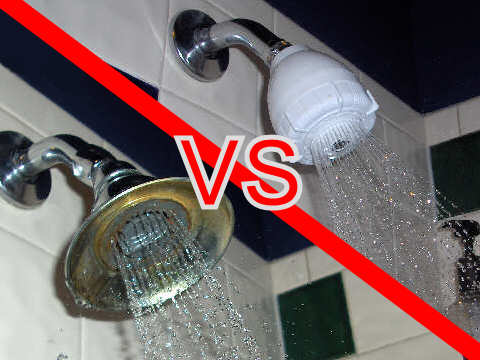
Low-flow shower heads? Nice idea, old paradigm.

No more "low flow" shower heads for this bad boy! No more 5 minute showers! I just took a 10 minute hot shower at a delivery rate of 3 gallons per minute and used only 5 gallons for the whole shower. What?!! That's 18 liters, less than the average for the Cairo poor who heat a 20 liter bastila on the stove and must pour it over themselves in less than 3 minutes. Do the math: with a federally recommended low flow shower head delivering 2.2 gpm you would use 22 gallons for a 10 minute shower. The best available low flow shower head delivers 1.5 gpm, which would use 15 gallons (56 l). The ultra ultra efficient low flow heads deliver 0.8 gpm and that measly shower still uses 8 gal (30 l) in 10 minutes. By using my water recycling pump I used only 5 gal , with a normal shower head that has three settings -- massage, pulse and flow. Try that with a low flow shower head! Annual US family of 4 H2O cost for 5 minute showers w/1.5 gpm head is $44. Ours: $14, and we get 10 minutes!

What we're interested in at Solar CITIES is providing "the other 90%" (the have nots) with the same luxuries the 10% haves have, WITHOUT increasing our ecological footprint, without using substantially more energy or water or other resources than the world's "poor" already use. The idea is to raise the standard of living world-wide, not lower it.

How do we do it? Read on below!

______________________________________________

HERE IS AN ENERGY AND WATER CONSUMPTION TABLE FOR CALIFORNIA. NOTE THAT IT REFLECTS EXCESSIVE USE AND RIDICULOUSLY LOW PRICES.


The Flex Your Power website is a comprehensive statewide resource for energy efficiency, providing information and tools to help California consumers and businesses save energy and money.

Cost-Effectiveness Example
Performance Base Modela Recommended Level Best Available
Water Use Only
Gallons per minute/cycle 2.5 gpm 2.2 gpm 1.5 gpm
Annual Water Use 18.250 gallons 16,060 gallons 10,950 gallons
Annual Water Cost $73 $64 $44
Lifetime Water Cost $590 $520 $350
Electric Water Heating
Annual Energy Use 2,370 kWh 2,120 kWh 1,540 kWh
Annual Energy Cost $142 $127 $92
Lifetime Energy Costb $1,070 $960 $690
Lifetime Energy and Water Cost Savings - $200 $600
Gas Water Heating
Annual Energy Use 131 therms 120 therms 94 therms
Annual Energy Cost $53 $48 $38
Lifetime Energy and Water Cost Savings - $100 $350
aThe flow rate of the base model just meets the current Federal standards for showerheads.
bLifetime energy cost is the sum of the discounted value of annual energy or water costs, based on average usage and an assumed showerhead life of 10 years. Future energy price trends and a discount rate of 4.1% are based on Federal guidelines (effective from April, 1998 to March, 1999). Future water and wastewater treatment costs are conservatively assumed to increase only at the rate of inflation.
Note: Metric Conversions: 1 gallon = 3.8 liters By reducing the demand for hot water, a household reduces the amount of energy needed to heat the water. In this way, a low-flow showerhead helps to cut the emission of 376 pounds of climate-changing carbon dioxide each year and a faucet aerator helps to prevent the release of 83 pounds of carbon dioxide per year.

In Germany we pay 3 Euro for every cubic meter of water, about 4 times more than Americans. And our energy costs are 4 times higher too. But this doesn't stop us from living a quality life style and paying LESS for each "unit of satisfaction". The trick is always to "do more with less". The idea is to achieve high efficiencies and Pareto optimality wherever possible.

The Culhane Endless Shower:

I've finally created an easy easy easy way to take almost "endless" hot showers using hardly any water or energy. Recycling 25 liters (6 gal) to 50 liters (12 gallons) of solar or biogas heated bath water is enough to luxuriate in a half an hour long shower using a simple 12 volt RV water pump and a 12 volt 7 amp hour hobbyist battery. Imagine never having anybody tell you to "get out of the shower -- you are going to cost us an arm and a leg" or "you are using all the hot water, get out so someone else can take a shower" again. Imagine if we could stop the regional and international conflicts over water! The 12 volt Flojet (or Surflo) 3.5 gallons per minute water pump is run by a 12v battery charged by a 200 dollar 55 watt solar panel each day for over an hour of showering. When I finish the housing the unit will be portable and can be taken to countries that experience water stress and life-threatening water wars to supplement our Solar CITIES Solar and Biogas water heating systems. As for me, I'll never go back to using a regular shower again...


Back when I was a kid in the late 1960s and early 70s, before the OPEC Oil embargo, we didn't think much about water and energy costs (they were heavily subsidized and thus appeared cheap), but that doesn't mean we weren't conservative. My grandmother, Isabel Culhane, who raised our parents during the depression and the rationing of World War II, was a paragon of recycling, victory gardening, second hand shopping, do-it-yourself pride and conservation.


Every summer Grammie would hold a "grandchildren's camp" at "the house that Jack Built" on Montague Road amidst the cornfields of rural Rockford Illinois. She would invite her 16 grandchildren to fly, drive or bus in to her midwest country abode from all over the U.S. (as far away as New York and San Francisco) where she would instill in us frontier survival values and the American can-do ethic. We would visit Maury Patrick's farm and spend two or three months learning how to sheer sheep, card and spin their wool, gather berries and bark and make our own dyes and pies, and learn weaving, wood carving and other pioneer day skills. Occassionally a mid-west storm would knock out the electricity and we'd be forced to "rough it"; like my hero, naturalist Georges-Louis Leclerc Buffon (1707-1788) , I used to gather lightening bugs ("fireflies") in mason jars to make my own disaster proof lanterns to read by under the covers. We thought it was grand fun.


What we didn't like, however, was the limited amount of hot water. Imagine: 16 grandchildren, a grandmother, and a guitar playing, prank playing and sometimes irascible Uncle Mark all sharing ONE bathroom for an entire summer, every summer for years, and a mere 80 gallon hot water tank for all those guests. The rule of the house was "you must take short showers and use as little hot water as possible". Otherwise -- no hot water for anybody.


It never occured to us in those days to build a solar hot water heater. It never occurred to us to install a tankless hot water heater (instant on-instant on-demand). America didn't offer up such consumer goods in those days (it would take 40 years and the end of a series of oil administrations before we would see these things become marginally common place in the good old U.S.A). Instead we would fight.


Uncle Mark would boom to my brother (who had a penchant then, and still does, for languid daydreaming in the shower) "Michael, get the hell out of the shower, your time is up!". Grammie would intone "girls, please take shorter showers so the boys can get in" (girls got first dibs of the hot water tank at grandchildren's camp -- common courtesy, women and the little children first).

I remember vowing that one day, "when I grow up -- I'm going to be able to take endless hot showers. Nobody will EVER tell me to cut my shower short again."

Fast forward to Egypt in 2005 when Sybille and I moved in to an unfurnished apartment in Cairo, and found that we could not afford to put in the four electric hot water heaters that the plumbing of the building demanded. We spent a miserable month heating water on the stove and pouring it in the bath until we learned enough and were able to use social capital to construct a solar hot water system. Once that was done the rest of our time was quite enjoyable, providing we stayed within the limits of the 200 liters (55 gallons) of hot water that we could heat each day.

We went on to form Solar CITIES and build and install three dozen solar hot water systems and 5 urban biogas systems in poor communities in Cairo, a feat that earned us a National Geographic Emerging Explorer Award in 2009. You would think we had the hot shower thing licked.

But for all our success in do-it-yourself hot water goodness, two things kept gnawing at me. 1) The idea that when taking a hot shower, all the heat you have expended so much money, time and effort capturing falls on your body for mere seconds before tumbling down the drain -- a huge and unconscionable waste that belies our efforts to help "the other 90%". 2) the sheer amount of water used, hot or cold, just to stand there and feel a waterfall on your body can not be justified in an era when fresh water is in short supply and people are fighting water wars in India and other nations that are claiming lives.

How to construct an endless hot shower that allows the luxury we crave without the resource wastage we decry?

I had done some experiments on the subject when I was a resident of the Los Angeles Eco-Village from 1999 to 2003, but hadn't put them into long-term effect. In Germany, where water costs over 3 Euro per cubic meter (the most expensive in the world), even though we have a fancy vacuum tube solar hot water heater, I was feeling miserable because of the sheer amount of water we were wasting every day (we could see it because we collect all of our gray water in a tank outside the bathroom window to flush the toilet and irrigate the rooftop garden). Between me and my wife and our baby son we were using up 1000 liters every two days. The water bill at the end of the month was a shocker. So it was back to taking short showers, solar heater or no.

Tonight I decided enough is enough. Frank DiMassa and I drove to RV specialists in Santa Rosa (on Yolanda) where Curtis, the owner, sold me a Flojet Premium Quiet Quad Model 4406-143 Type IV 12 Volt self-priming RV water pump (3.2 gallons per minute, consuming 3.3 amps). It cost $95 dollars. I also bought an in-line filter for it. The rational (which I used when I took my L.A. Eco-Village apartment off-grid for three years): Imagine your home to be a mobile-home without wheels. An RV that you use for living instead of recreation (an LV?).

By outfitting my static home with solar panels and a 12 volt water pump run off of a 12 volt 7 amp-hour sealed hobbiest battery (you can find them at Home Depot for security gates), just like you would in a mobile home, I have finally achieved the holy grail of an endless hot shower.


Well, not quite endless, but at least a half an hour to 40 minutes of hot water, without using more than 50 liters (13 gallons) per shower. I can even get it down to 25 liters if I want to, and still get about 30 minutes out of it. I've found that after 30 minutes I'm sick of being in the shower anyway. So for my purposes, the shower is endless. 25 liters can be recycled through a slow sand filter water purifier and used again the next day, so it is in some sense endless if you use recycled water.

The set-up is very very simple (see picture). The pump (which is very very quiet) sits on a table in the bathroom. it is connected to a little 12 volt battery which will be recharged by the solar panel. It has an on off switch and a 10 amp fuse in line with the positive wire. The water intake is fitted with a 1/2 inch hose adapter and 10 feet of hose. At the end of the hose is the in-line water filter that Flojet makes for the pump. This prevents hair from getting into the pump. The water outflow is a 1/2 " thread connector connected to two flexible shower hose for length (joined by a male-male 1/2 " nipple). Before the shower head itself I put a fixture that lets me turn the water on or off; this also turns on and shuts off the pump automatically without having to get out of the tub to flick the switch on the battery until I'm nice and dry (the pump senses a lack of water flow and shuts off by itself).

And that is it. Now I fill the bathtub with just enough hot water to cover the in-line filter (which sits at the bottom of the tub where the soap bubbles don't hang out) and then start showering. Since the pump is self-priming I don't have to do anything. The water stays warm far longer than I care to stay in, and I can just forget myself, daydreaming, shampooing, shaving, massaging sore muscles. Nobody can EVER yell "get out of the shower, you are using too much water" or "too much electricity" or "too much gas" or "you are using up all the hot water, leave some for somebody else." That 25 to 50 liters is MINE to use for as long as it stays warm. And you can actually get two or three showers out of it if you keep each shower to 15 minutes or less.

Improvements: I will build a nice water-tight, vibration proof housing for the pump and the battery with the switch on the outside so it can be easily carried to any bathroom anywhere and instantly set up, and will make it a portable endless hot shower to be taken to arid countries where people are fighting wars for a resource that should never be in short supply.

We live on a water planet. As Silvia Earle said, "we should call this the planet Ocean, the planet Water". There is so much of it!
Wouldn't it be nice if we no longer had to fight to use it?


Comments:
Kabir liked this on facebook.

Culhane replies:
Thanks for liking, Kabir. I was galvanized into action when IYCN (was it you?) posted the link about the water wars in India that were claiming so many lives. I can't any longer take long showers without thinking about all the people who not only "have not" but are dying in the struggle to have very little. This is National Geographic's Water year. So between the Shmutzdecke slow sand water purifier we built on our porch and this little water recycler we have new projects to bring to Cairo this October and hopefully around the world. Try this out -- it really is simple and effective. Cheers, T

Mustafa liked this on facebook.

Culhane replies:
Thanks for liking Mustafa -- I will hope to bring a working model to Cairo in October. Meantime, check and see what the price of a 12 volt water pump is in Egypt. What is happening with your house that collapsed? Are you moved into your new place in Darb Al Ahmar? Have you been able to put up the solar hot water system? How is your family? What a tragedy you faced! If you get in touch with Omar Nagi and Hanna (who is about to have a baby) and with Hussein Al Farag this week you might be able to connect with Kimberly from National Public Radio who is there looking at Solar Hot water and biogas and the Solar CITIES initiative. It would be great for you to connect with everyone! I will facebook friend suggest them to you.

Elisa commented:
5 minutes is plenty of time for a shower - why should anybody take a longer shower unless it is a medical/life sustaining measure. great for large families where 5 minutes of hot water per person may be a luxury - to the others of us who want to 'luxuriate' under hot running water i say 'suck it up'. get clean & get out:-)

Culhane replied:
Good point Elisa, but old paradigm. Since my energy costs are nil to null (solar heating and PV for the 12v battery) and my water use over 10 minutes is lower than the lowest ultra low-flow shower-head using 5 minute shower taker (i.e. about half of what the miser would use), what would the objection be? Everyone else is simply throwing water and heat down the drain that only passed over their body for mere seconds. That is the travesty. With my recycling shower the same water and heat is used over and over again until the heat is gone. And then the water is used to irrigate the garden and flush the toilet.

Amanda liked the link on Facebook.


Culhane replied:
Thanks for liking Amanda! One thing I neglected to mention is that if the bathroom is well insulated (double pane glass windows etc.) the same 5 gallons can last even longer than 10 minutes -- it is all about delta T -- the temp difference between the water and the air.  If the bathroom (or shower stall) is warm and steamy the hot water just cycles around and around and around without losing heat to the air. So a 10 minute shower can turn into a 20 minute shower without using any more water or heat energy (and just about 30 watts for the pump, easily supplied by solar).


Sybille liked the link on Facebook.


Culhane replied:
Thanks for liking the link Sybille. We should be able to cut our expensive German water bill (where water costs us 3 euro every 1000 liters, which is currently every couple of days, the most expensive water in the world!) down to a fraction of what we are now spending. I know that our greywater is recycled into the rooftop garden and the ... Read Moredownstairs garden and flushes our toilet, so we don't waste it, but now imagine that a 10 minute shower won't use more water than two toilet flushes! That is gong to be amazing, huh? The idea for our Solar CITIES project should be to provide the same luxuries to the 'have nots' that the 'haves' have, WITHOUT raising the ecological footprint at all! I think it is achievable if we rethink the way we do things.
Posted by T.H. Culhane at 12:08 AM

Thursday, July 2, 2009

Archaic Wisdom: Working with Bacteria to Make a Better World


They've been with us since the beginning, predating the arrival of human beings on Earth by not millions but billions of years. And they will be here for billions of years after we've gone. After everyone and everything else is gone.

They were the first and they will be the last, the alpha and the omega.

They are the Archaea -- a kingdom unto themselves, the kingdom of prokaryotic bacteria whose sheer numbers even today create a biomass that dwarfs that of all other living creatures combined, and may contain more biodiversity than all other kingdoms combined. Their kingdom contains the extremophiles -- bacteria that thrive in extreme environments -- from the subzero temperatures of the arctic to the hottest of hot springs, from corrosive surface pools of sulfuric acid to the deepest volcanic vents on the ocean floor, and possibly even other planets or their moons . And this Archaic Kingdom contains the creatures Methanobrevibacter smithii and Methanosphaera stadtmanae, which live benignly within us, in the human gut.

Over half of the known species are methanogenic -- turning organic material into methane gas -- CH4. And therein lies the rub.

The methanogenic Archaea, in our world of accelerating climate change, are a Janus-faced coin. On the one hand they are responsible for the climate changing methane released by billions of belching/farting cows and other livestock, by fetid swamps, and bloated rice paddies and agricultural-waste polluted wetlands, by decaying landfills and, most notably, by the "time-bomb" tundra -- the organic material under the melting permafrost that threatens a catastrophic release of greenhouse gases as the ice thaws. Methane in the atmosphere is considered to be a greenhouse gas 25 times as potent as CO2.

On the other hand, the methanogenic Archaea provide an unprecendented opportunity to create net-climate-neutral fuel supplies for our homes, restaurants, businesses, factories and vehicles. Harnessed, the methanogenic areas of the planet that are causing concern could drastically reduce our dependency on the real greenhouse-gas culprits -- fossil fuels; created de novo in our cities and agricultural areas, specially desinged biogas digestors could eliminate waste and pollution and create rich organic fertilizer as well as power our homes, farms, businesses and industries with clean fuel.

To explore the more sanguine of these possibilities, Solar CITIES, which has implemented Dr. Anand Karve's India ARTI home biogas solution in Cairo, Egypt, is teaming up with arctic ecologist Dr. Katey Walter, who studies the "Methane Time Bomb" in Alaska and Siberia, to see if there is a way to harness the power of the Archaea at the household and community level for temperate zones that experience cold winters.

Household and community level solutions are necessary, Solar CITIES maintains, because it can be assumed that the enthalpy of the fossil fuels that must be consumed in the process of collecting, compacting, transporting and disposing of urban organic wastes, primarily from kitchens, restaurants and markets, is actually greater than the amount recoverable from their transformation into biogas. A quick thought experiment suggests that the net amount of greenhouse gas offset by the creation and use of biogas must be less than the amount produced in transporting the feedstock to the bacteria in a centralized production facility: imagine that your city had no more fossil fuels available and that you had to power the garbage trucks that collect your waste purely from the energy contained within the garbage you produce. If this were the case garbage collection would most likely grind to a standstill (or people would return to using donkey-carts, as the Zabaleen of Cairo do).

This assumption, of course, could potentially be at least partially obviated if every home had an "insinkerator" type waste disposal unit installed that allowed liquid effluent to flow to a biogas facility. In California we have long experience with the environmental benefits of garbage disposal units, which use less than 50 cents worth of household electricity consumption and less than 1% of household water consumption to operate per year. When piped to the sewer system they can use natural gravity flows to send a slurry of food waste to the water treatment plant where it can be easily turned into biogas. Still, many communities do not have such systems. Also, in Europe, for example, it is still very difficult to find garbage disposal units (they have been in the UK since at least 1965, and can now be found in Spain, where they are called "trituradores de desperdicios de comida" and in Italy, where they are known as "dissipatori di rifiuti"; in Germany, they are called "Kuchenabfallentsorger", but they are new to the market, hard to find and very expensive, and plumbers still question whether their connection is allowed. )

However, where natural gravity flows are not available, the energy consumption associated with pumping large volumes of wastewater to a treatment facility, and the energy costs associated with then purifying, storing and delivering gas back to households and other end users reduces the efficiency of the system and its potential to relieve the greenhouse gas burden. (Culhane, in his home in Germany, is convinced that the amount of methane his food-waste produces each day would probably not even be enough to run the 750 Watt Inskinkerator or the 350 Watt Sump Pump (which delivers the food slurry to the digestor) and still leave enough useful gas left over for cooking or other utilities. Fortunately they have photovoltaics to do the job of running the appliances).

From a distributed energy point of view, it makes the most sense to use the waste in-situ, at the point of its creation. Since methanogenic bacteria are self-reproducing, and merely require an anaerobic container to do their work, each household and business could maximize the energetic efficiency of the process by directly converting the slurry produced by a sink-mounted waste disposal unit into methane (in a digestor on the roof, on the porch, under the stairs or in the basement) which would offset a certain percentage of the gas provided by the municipality. In this "household offset model", methane produced from farms, factories, wholesale markets, and sewage treatment plants would be piped into houses, supplying perhaps 75 to 90 % of the household's needs (primarily water and space heating when solar and ground-source heat-pump supplies are unavailable) while the household's own waste would offset 10 to 25% of the household's energy demand (primarily for cooking heat). Household generated methane contains about 40% carbon dioxide, but it burns cleanly and well and does not need any expensive and energy intensive purification.

This is indeed the model being pursued by ARTI in India, where thousands of home-scale biodigestors have been installed. But the limitations of cold weather production have so far have apparently discouraged such thoughts for the temperate zone.

How archaic is the use of the Archaea-based technology?

Before I left for Pune, India last January to learn from Dr. Karve how to build the ARTI urban biogas digestors, I took a taxi cab from the Zabaleen neighborhood of Cairo to the airport and got into a conversation with the driver, a thickly bearded man dressed in a traditional balady galabaya, about solar energy and biogas. When I mentioned to him that I was headed to India to learn about biogas he said, "why go all the way to India? I am from the oases of southern Egypt and in my village we have been using biogas forever. Many of the fellahin know that if you take your garbage and throw it in a ditch, cover it with straw and mud and put a bamboo pipe in it you can get usable gas that you can burn. It works until the winter cold sets in. Only people in the city forget these things..."

I began to wonder if biogas isn't perhaps one of the oldest technologies humans have exploited since the dicovery of fire by Homo erectus.

Nothing new under the sun?


At the recent National Geographic Emerging Explorers Symposium in Washington D.C. (June 7th through 13th, 2009) Katey Walter and Solar CITIES' T.H. Culhane shared their ideas for collaboration in a panel discussion after their presentations. Culhane had shown video clips and images of the household biodigestors he and his wife Sybille have built on rooftops in Cairo and on their own porch in Germany, and Walter, who has become famous with her videos and images of lighting the methane that is dangerously building up beneath arctic lakes also showed images of Scandinavian households that have been harnessing and producing biogas for domestic use for hundreds of years.

In the discussion that followed, we mused about the possibility that human beings might actually have been using biogas since time immemorial. Certainly bacteria have been transforming the wastes humans generated into methane since we first appeared on the planet. And people have been very observant about both combustible material and bacterial processes since long before civilization began -- in fact, the ancient and highly developed arts of fermentation that led to the invention of bread, dairy products and alcoholic spirits prove that Homo sapiens have been well aware of how to harness the generative properties of various species of microbes for at least 10,000 years.

So how is it that the generation of biogas from offal is now considered a "new" bio-technology?

Actually it isn't. Biogas use is documented going back 2,000 to 3,000 years in the Chinese literature, is documented from the 10th Century BC in Assyria, was well known in Persia during the 1500's and was being used on a municipal scale to light the street lamps of Exeter in England in 1895.

One of the answers for why we hear so little about its past importance could be the north/west/temperate zone bias of modern civilization. Southern/eastern/tropical peoples may have been using biogas all along, but their solutions may have been marginalized or erased when they encountered hegemony from northern colonizers who were only familiar with burning wood and charcoal; in any event biogas depends on a stable place for biomass-accumulation and digestion and in the diaspora that follow conquest, displaced people with insecure land tenure would have found it easier to scavenge for woody material wherever they happened to be. They would have then forgotten this earlier technology.

Culhane pointed out from his personal experience that one of the limitations of small-scale biogas production in northern temperature zones like Germany was the winter temperatures stopping the metabolism of the thermophilic bacteria. Many biogas industries, finding it hard to keep temperatures in the appropriate range, stopped using thermophils for this reason and switched to mesophiles. The bacteria now used in most biogas systems are the mesophiles found in the guts of animals and they do best at body temperature. In industrial biogas facilities, like the nearby Imbrahm Recycling plant in Kettwig, which collects the kitchen waste from restaurants all over the area to produce biogas for electricity and heating, a portion of the heat generated from the gas is sacrificed to keep the digestors near 37 degrees Celsius.

But Walter's observations of snowy Scandinavian household biogas digestors that predate the industrial revolution and the discoveries of coal and oil opens up a whole new world of possibilities. The trick in the arctic circle is the use of a complete different group of methanogenic species -- the "psychrophiles" or "cryophiles" -- "cold-loving" bacteria.

It is these extreme members of the Archaea -- these "extremophiles" who can thrive and produce biogas beneath the ice -- that make it now possible to conceive of a north temperate biogas-based society that can efficiently produce energy from garbage all year long. Dr. Walter's studies of the arctic bio-gas producing bacteria have shown that their peak output occurs at 25 degrees Celsius, but they remain healthy and active below the freezing temperature. This high range of viability makes them ideal for systems that experience winter temperature fluctuations from 0 to 15 C; it is supposed that they would also do well in the bottom of digestor tanks in the summertime where, due to thermal stratification, temperatures can easily remain as low as 25 degrees even when the top of the tank reaches 40 or more.

But lest one believe that psychrophils only have potential for winter biogas production it is worth noting that this week here in Essen, Germany, in mid-July, the average daytime temperature has been highs of 16 degrees and lows of 13 degrees with a couple of days peaking at 24 degrees. Our biogas system, which prefers temperatures of 37 degrees, has given us very poor performance this summer with the temperatures being at the bottom of the mesophiles range. But Katey's bacteria are at their best at this European summer temperature range.

What the Walter-Anthonys and the Fruetel-Culhanes have decided to do is to start using psychrophiles and mesophiles together in the same digestor, much in the same way the Chinese (and now development agencies) have done "stereo-breeding" of different species of fish in the different temperature zones of aquaculture tanks to improve productivity. The cold loving bacteria will occupy the colder bottom strata, while the mesophiles will occupy the upper, warmer parts of the tanks thermocline. It might even be possible to populate the top region of the digestor with thermophiles and have "a bacteria for all seasons". Theoretically, if the tank is designed correctly, the psychorophiles will dominate in the winter and the mesophiles (and possibly some thermophiles?) in the summer, but both will hang on during the periods when the temperatures are not optimal for them by occupying the parts of the tank most suitable to their metabolism. And together they will keep the system producing gas all year round. In this way, it is surmised, the winter energy costs for keeping a biogas digestor at the appropriate temperature can be reduced, hopefully to the point where it makes sense to depend on biogas and obviate the need for fossil fuels. (It would also obviate the need for external garbage disposal, since all the other household wastes would remain clean and easily recyclable, and it would eliminate most need for composting, which tends to shut down in the winter time; the biogas digestors would produce liquid fertilizer all year). The key is finding the right combination of bacterial species that can work together across different temperature regimes.

Archaea-ic diversity to the rescue


So much hype is made about "genetic engineering" and the creation of "new organisms" that can "do man's bidding" that we tend to forget that during nearly 4 billion years of evolution the Earth's own microbes have come up with solutions to almost every environmental challenge we can imagine. So spectactularly successful have the Earth's micro-organisms been -- even anticipating the spread the of certain environmental threats -- that some researchers now talk about the possibility of bacteria forming the equivalent of "neural networks" and having some kind of "bacterial intelligence". One researcher particularly active in this field is Israel's Eshel Ben-Jacob, whose 1997 paper "Bacterial wisdom, Godel's theorem and creative genomic webs" has become a favorite among astrobiologists. Another researcher looking into the possibility that micro-organisms express a kind of collective intelligence is Zann Gill, whose book "If Microbes Begat Mind" was presented at the NASA Ames Research Center . In the realm of literary fiction, the idea of microbes forming a kind of swarm mind is the subject of Frank Schatzing's well-researched techno-thriller "The Swarm" and Greg Bear's sci-fi parable "Blood Music". Nebula Award nominee Raymond Gallun's Bioblast pays homage to Altmann's 1886 discovery of the bacterial nature of our mitochondria (Richard Altmann, a German pathologist, studied mitochondria in the 1890s and was the first scientist to theorize about their role in energy production). And in the film world the concept of bacterial symbiosis aiding us in the next step of human evolution is found in such movies as the little known but deep-thinking Alice Krige thriller "Habitat" (Krige, who was also in Dinotopia, is best known to sci-fi fans as the Borg Queen in Star Trek: First Contact) and in Star Wars, where the explanation George Lucas gives us for "The Force" is to be found in bacterial symbionts called "Midi-Chlorians" (both the name and the concept are based on the role mitochondria play in providing energy or "life-force" to our cells; the connection is spelled out by Nick Lane in his book "Power, Sex, Suicide: Mitochondria and the Meaning of Life" on page 5 ).

Whether the subjects of speculation or fiction, in the realm of fact the Archaea must be considered our distant but direct ancestors, that is to say, our (albeit genderless) forefathers and foremothers. Lynn Margulis' theory of Endosymbiosis goes so far as to hypothesize that our own eukaryotic cells are the result of a symbiosis between prokaryotic microbes, and others have suggested that "we are the chimeric product of the fusion of the two main branches of ancient Life, the bacteria and the Archea." We often think of bacteria as food spoiling competitors, disease causing parasites or even flesh-eating predators, but as any beer-lover, wine-connoisseur, cheese-aficianado or probiotic yoghurt, kombucha, sauerkraut, kimche or kefir eater can tell you, bacterial symbionts play a tremendously important role in our well-being. And if you ask a cow or any other ungulate, who depend on bacteria to eat grass, or a termite, who needs bacteria to digest wood, they would tell you life without bacteria would be impossible.

It may well be that it is the invisible Archaea that connect us all in the web of life, a thought that can take all almost spiritual proportions.


Regardless of how one views the Archaea specifically or bacteria in general, it would be hard to contest the notion that if we are looking for an effective and efficient way to terraform our planet away from the impending climate crisis, we could hardly do better than to harness the very creatures that created the biospheric life support system we depend on in the first place. Without having to engage in any bioengineering or gene-tinkering at all, we can most likely find bacteria capable of transforming our wastes into raw materials that are climate friendly.

Working with, instead of against, the bacteria who share our planet, may be the wisest thing we can do to prevent catastrophic climate change. Metaphorically you can be sure that when Noah heard the call to save biodiversity from the great flood, he listened to this Archaic wisdom too - in the stomachs of every creature on the Ark, the Archaea also hitched a ride.
____________________________________________________

What we propose

Solar CITIES and Katey Walter propose a series of controlled field experiments operating on several continents and in several climates throughout the year for the next three years.


Dr. Anand Karve, inventor of the ARTI Urban Biogas Digestors that we build in Egypt, discussed with Culhane a need for more experimentation with cold climate digestors. One of the limitations he experiences in India is that the cold season production of biogas can be reduced by 50%. Since a 1000 liter system (the size most suitable to households in weight and size) produces roughly 2 hours of cooking gas each day from the normal kitchen waste produced by a family of 4, the winter reduction to one hour or less of fuel can be limiting and either discourage use or force families to supplement with other fuels which may damage health and environment. In colder climates the winter shut down of gas production may stop families from using biogas altogether.

Dr. Katey Walter's Arctic pscychrophiles may hold the key to improved performance in cold conditions.

We propose the following phased experiment (subject to modification):


Phase I: Home testing in Germany

1) Dr. Walter ships some of the bacterial-laden mud she has collected from bio-active Arctic lakes in Alaska and Siberia to Solar CITIES in Germany.

2) We build three identical small scale digestors in the backyard, one containing only the psychrophiles from the arctic, one containing only the normal mesophiles from German livestock, and one containing a mix of the two. Total cost of construction: 600 Euro ( 200 Euro per digestor).

3) We feed each digestor the same amount of feedstock each day, noting the ambient temperature, the temperature of the feedstock and the temperature of the digestor, and measure the volume of gas produced each day.


Phase II: Field testing in Egypt

1) In preparation for the chilly winter in Cairo we build a similar set up there, in the garbage recycling Zabaleen area, to be monitored by Solar CITIES coordinator Hana Fathy. This will show us if the yields are sufficiently enhanced to make it worth while using psychrophiles in the slums of sub-tropical areas with cold winters (ambient temperature 10 to 15 degrees C) as a waste management solution. (Costs: Construction -- 2000 dollars -- 1000 for the digestors, 1000 for coordinator/engineer Hanna Fathy to build, operate and monitor the digestors for six months. Travel -- 2000 dollars for Solar CITIES coordinators T.H. Culhane and Sybille Fruetel and for Katey Walter to travel to Cairo)

2) Based on the results of the German and Cairo experiments, after determining the viability of systems containing mesophiles and psychrophiles, we work on improved designs to maximize the productivity of the bacteria associations.

Phase III: Field testing in Tanzania

1) Working with fellow National Geographic Emerging Explorer and Ethnobotanist Grace Gobbo we build identical systems in Tanzania at or near The Jane Goodall Institute at the Gombe Reserve to determine whether or not biogas can be an effective solution to that part of the deforestation problem caused by the collection of cooking fuel. Although Gombe is considered a tropical location, temperatures in July can be as low as 11 degrees C, with an average minimum of 19 degrees. The goal is to discourage any regress to the use of wood fuel in this critical habitat during colder times. Grace shared with us that the the chimpanzee populations are very threatened because of habitat destruction but ironically even the scientific research stations and park protection facilities use fossil fuels, wood and charcoal for cooking and heating and have a hard time disposing of their waste, thus providing an example to visitors that only exacerbates the very problem they are struggling to solve. A viable year-round biogas system (coupled with solar energy systems) could mitigate and even solve many of these problems, particularly as the Goodall Institute acts as a catalyst for regional change.
Estimated Costs: Construction of 2500 liter biogas digestor: 500 dollars, construction of local solar water heater: 500 dollars, Travel to Gombe for Sybille, T.H., Katey and Solar CITIES coordinator and biogas/solar construction engineer Hanna Fathy, 4000 dollars).


Phase IV: Field Testing in Minnesota, U.S.

1) At the farm of Katey and her husband Peter Anthony we work together to build a 2500 liter digestor so they can monitor performance at home and see how the system works through the cold northern winters. The results of this rural home-scale development will help determine the viability for the U.S. home market.
Estimated Costs: 600 dollars for digestor construction materials. 1000 dollars if free local labor unavailable and a Solar CITIES member must be flown in.

Phase V: Learning from Scandanavian Households

1) To prepare for our Artic Circle Home Biogas Initiative we visit households in Scandanavia that Katey has identified using Biogas and examine the systems and their efficacy. Costs: 5000 dollars for 4 airfares and lodging.

Phase VI: Field Testing in the Arctic Circle

1) Alaska: Extending the experience from Katey's farm we take the concept up to her research site in Alaska and introduce the concept to the Inuit villages. There we build 3 systems -- 1 1000 liter system, one 2000 liter system and 1 3000 liter system to seed the idea in local communities and to see if different volumes affect performance (just as large fish like sharks, though technically poikilotherms, exhibit homeothermic characteristics because their size keeps their internal temperature warmer than their surroundings, it may be assumed that larger biogas tanks maintain a higher temperature in their centers that could affect the bacterial production. This would be tested in this phase of the experiment. Estimated Costs: 1000 dollars for the materials to construct the digestors; 1000 dollars for testing equipment to monitor and log internal temperatures, 4000 dollars for airfares.

2) Siberia: With experience from the Alaska initiative we move on to Katey's field site in Siberia to introduce the system's there. With what we learn from the Alaska experiment we concentrate on building the optimal sized biogas systems and do so for three families so that we can begin creating a culture of biogas use. Cost: 1000 dollars for materials, 4000 dollars for airfares.

Phase VII: Comparing notes with ARTI India

With systems in place and in use by households in Essen, Cairo, Gombe, Minnesota, Alaska and Siberia we should be able to gather useful data on the utility of household digestors using a combination of mesophiles and psychrophiles. The final phase of the experiment would be to share microbes and ideas with Dr. Karve and his team in India.

1) We would bring Dr. Anand Karve and his daughter Dr. Pria Karve to one of the Arctic Circle locations and to Cairo to share their expertise. (Cost of flights and lodging and per diem estimated at 5000 dollars)

2) We would bring Solar CITIES coordinator Hanna Fathy, the Culhanes and Walters to Pune, India to share results and establish an on-going research collaboration. (Estimated cost of flights and lodging estimated at 4000 dollars).


This itinerary puts the low side of the budget at about 40,000 dollars for materials and airfare, without including lodging (except in the case of Phase V and Phase VII it is assumed that we can find free lodging with colleagues), meals and incidentals and equipment (excluding Phase VI).
10,000 additional dollars are estimated to be needed for laboratory equipment so that all of the systems can be rigorously tested and performance data for the bacteria under different design regimes can be gathered.

Why work with couples and families?

The household is the primary unit of reproduction in our economy and families are fundamental. But until now households have not been seen as primary units of energy production. Nor have they been conceived of as the most effective solution to the climate change problem. We know that households around the world are considered to be part of the problem -- families are conceived of as "consumers" and the rate of forms of consumption we engage in to satisfy our family needs and desires are said to be the major factors damaging our life supporting ecosystem.

Our proposal is to make energy production and waste management household level solutions. We seek to turn consumers into "prosumers" by making biogas digestors a family affair. We seek to make the use of methanogenic bacteria a part of daily domestic life. This is not an outlandish idea -- when famed Physicist Freeman Dyson spoke at the TED conference, the first thing he talked about was the future of biotechnology, saying

...we should follow the model that has been so successful with the electronic industry: that what really turns computers into a great success in the worldas a whole is toys. As soon as computers became toys, when kids could come home and play with them, then the industry really took off. And that has to happen with Biotech.
There's a huge community of people in the world who are practical biologists, who are dog breeders, pigeon breeders, orchid breeders, rose breeders -- people who handle biology with their hands, and who are dedicated to producing beautiful things, beautiful creatures: plants, animals, pets. These people will be empowered with biotech, and that will be an enormous positive step to acceptance of biotechnology. That will blow away a lot of the opposition. When people have this technology in their hands, you have a do it yourself biotech kit, grow your own --grow your dog, grow your own cat... Just buy the software, you design it. I won't say anymore, you can take it on from there. It's going to happen, and I think it has to happen before the technology becomes natural becomes part of the human condition,something that everybody's familiar with and everybody accepts."

In this "coming to a home near you" future, the idea of people having "useful pet bacteria" shouldn't seem odd. We've been carrying them around in our body since birth, and having them in our homes as climate change solutions, energy providers and waste managers could seem completely normal to the next generation.

To start that process going, Sybille and T.H. Culhane in their home in Germany and Katey Walter and Peter Anthony in their home in Minnesota, along with Hanna and Sabah Fathy in their home in Cairo will be the methanogenic families taking the first steps toward the biotechnology future that Dyson envisions. We hope to share our experiences with other families around the world and usher in a domestic revolution, now playing in a kitchen near you!

To learn more about Solar CITIES solar and biogas work in Egypt, watch this ABC News Spot on "Green Tech in Garbage City", by Ben Barnier, here:


To learn more about Katie Walter's work on arctic biogas from permafrost, watch this newsspot here:


Monday, June 8, 2009

National Geographic Emerging Explorers Symposium, Washington DC

We've arrived in Washington DC for what must be the most exciting symposium I've ever attended: The National Geographic Emerging Explorer's Symposium where, for an entire week, we get to present our Solar CIITES work alongside what one of our colleagues called a veritable "pantheon of luminary explorers", among them Zeresenay Alemseged, Gregory D. S. Anderson, Tim Appenzeller, Robert Ballard, Kenny Broad, Christina Conlee, Wade Davis, Jared Diamond, Luke Dollar, Sylvia Earle, Kirsten Elstner, Mike Fay, John Francis, Terry Garcia, Grace Gobbo, Beverly Goodman, K. David Harrison, Kristofer Helgen, Fred Hiebert, Zeb Hogan, Ben Horton, Shafqat Hussain, Dereck and Beverly Joubert, Albert Lin, Malik Marjan, Boyd Matson, Sam Meacham, Kurt Mutchler, Robert Pitman, Reza, Dominique Rissolo, Eric Sala, Katsufumi Sato, Paul Sereno, Greg Stone, Josh Thome, Katey Walter, Jonathan Waterman , Ted Waitt, Spencer Wells, Michael Wesche, and Nathan Wolfe, and Cheryl Zook.
One of the joys of this is being able to bring our friends and colleagues from Cairo into the auditorium of National Geographic through the medium of the blogosphere. We are presenting our ''melodic-mnemonic'' music-video "Talkin' Trash" to bring science, urban planning, social and environmental advocacy and authentic voice from marginalized communities to the world and presenting a short video of Hanna demonstrating the "home kitchen-waste to cooking gas system" we built. Since you may not be able to make it to the symposium, you can view both here, in this "virtual classroom without borders" in the blogosphere:


Tuesday, May 5, 2009

Salvar el planeta: Empieza en casa

Salvar el planeta: Empieza en casa
por T.H. Culhane
Saving the climate: It Starts at Home
by T.H. Culhane

A presentation given at the Fox TV Iberia/National Geographic Earth Day Press Conference in Madrid, Spain on April 16th, 2009. It describes the history of Solar CITIES, its mission, philosophy and activities.
(The presentation was given in Spanish. The English translation follows; the presentation will be given again at DePaul University in Chicago at the "Knowledge to Action" Seminar on Sunday, May 17th, 2009).

1.


Buenas tardes, soy T.H. Culhane de Solar CITIES, Connecting Community Catalysts Integrating Technologies for Industrial Ecology Solutions, una ONG que trabaja en las barriadas de Cairo, Egipto, dando respuestas, a nivel de hogar, a los retos de la pobreza y la degradacion medioambiental. Llamo a mi presentacion Salvar el Clima: Empieza en Casa, haciendo eco de un articulo de portada en el numero de National Geographic de Marzo:
Ahorrar Energia: Empieza en Casa. Hago esto porque nuestras investigaciones y nuestra experiencia me han sugerido que hablemos de los retos especificos de la energia, del agua, de la basura o del reto global del cambio clinatico las respuestas pueden estar en el nivel del hogar. En las fotografias que veis sale nuestro hogar en Alemnia donde, en nuestros cumpleanos yo y mi mujer Sybille hicimos una fiesta en la que invitamos a todos los asistentes a ayudarnos a construir un sistema de reciclaje de aguas grises para que ya no tengamos que usar agua potable para tirar de la cadena del bano o para regar nuestras plantas, un digestor de biogas casero, para convertir la basura de la cocina de ayer en el gas para cocinar en hoy en en fertilizante liquido, y un jardin en el tejado para plantar comida utilizando el fertilizante del sistema de biogas y el agua del sistema de aguas grises. Y todo esto era para complementar tanto un sistema casero de agua caliente por energia solar y un sistema profesional de agua caliente solar por tubo que acompanan a nuestro sistema fotovoltaico y nuestro pequeno sistema de viento.


Good afternoon, I'm T.H. Culhane of Solar CITIES "Connecting Community Catalysts Integrating Technologies for Industrail Ecology Solutions", an NGO that works in the slums of Cairo Egypt on household level answers to the challenges of poverty and environmental degradation. I call my presentation メSaving the Climate: It Starts at Homeモ as an echo of the cover story from the March Issue of National Geographic: Saving Energy: It Starts at Home and I do so because our research and experience has suggested to me that whether we are talking about the specific challenges of energy, water, and waste or the global challenge of climate change the answers may lie at the household level. In the photographs above you can see our home in Germany where, for our birthdays my wife Sybille and I threw a party at which we invited all the guests to help us build a greywater recylcing system so that we no longer use drinking quality to flush our toilet or water our plants, a home-scale biogas digestor, to turn yesterday's kitchen garbage into todays cooking gas and liquid fertilizer, and a rooftop garden to grow food using the fertilizer from the biogas system and the water from the greywater system. And all that was to complement both a home made solar hot water system and a professional vaccuum tube solar hot water system that goes along with our photovoltaic and small wind system.


2.

Desarrollamos nuestras soluciones caseras con nuestros amigos, familiares y trabajadores locales. Por ejemplo, nuestro primer sistema de agua caliente solar casero surgio por una apuesta de 100 Euros que hice con mi suegro sobre si podiamos o no hacer una estufa con un viejo radiador, un barril de cerveza de plastico y algo de madera que el tenia tirada en el garage. Como podeis ver, yo gane la apuesta!
El sistema de aguas grises, que coge toda el agua de la ducha, el bano, el lavavajillas y el fregadro y la envia al water y al jardin fue el resultado de un debate que tuve con nuestro fontanero Turco. El tambien acabo convencido. Nos gusta trabajar en especial con trabajadores inmigrates, los cuales se entusiasman ante la oportunidad de co-inventar tecnologias simples y baratas que luego pueden llevar sus paises, asi que hemos empezado una “una red de entrenamiento de immigrantes” en la que desarrollamos ideas en nuestros propios paises que luego se llevan al mundo en desarrollo.


We develop our home-scale solutions with our friends, family members and local craftspeople. Our first home-made solar hot water system, for example, was the result of a100 Euro bet between me and my father in law about whether or not we could make a water heater out of an old radiator, a plastic beer barrel and some wood he had lying around the garage. As you can see, I won the bet! The grey water system, which takes all the shower, bath, dishwasher and kitchen sink water and pumps it into the toilet and garden was the result of a debate I had with our Turkish plumber. He too ended up convinced. We like to work ,particularly with immigrant laborers who are enthusiastic about having an opportunity to co-invent simple, inexpensive technologies that they can take back to their own homelands and thus have started an „immigrants green collar training network“ where ideas we develop in our host countries can find their way to the developing world.


3.

Y si que llegan - - por que la parte principal de nuestro trabajo en Solar CITIES es llevar las ideas que desarrollamos en casa a los hogares de otras gentes en las barriadas o en las comunidades extraoficiales de Egipto y, desarrollando relaciones y creyendo en la inteligencia colectiva, hemos podido aumentar la escala del trabajo, construyendo systemas de energia removable para casas de toda la ciudad. Por ejemplo, hace poco que hemos terminado de construir 30 sistemas de agua caliente solares y dos y medio digestores de biogas en las comunidades islamistas y Copticas del Cairo, con vistar a implantar de todo, desde fotovoltaicas a sistemas de viento a reciclaje de aguas. Esta es nuestra carrera - - esta ocurriendo una silenciosa revolucion casa por casa, con la fe de que en cuanto haya bastantes hogares que conservan energia, agua y basura, veremos que no hemos solucionado solo los problemas diarios de supervivencia de la gente si no que a la misma vez hemos salvado el plantea. Como empezo este viaje?


And find their way they do -- because the principle part of our work at Solar CITIES is taking the ideas we develop at home to other peoples homes in the slums and informal communities of Egypt and, through developing relationships and believing in collective intelligence, we are able to take to a much larger scale,buiilding home-scale renewable energy systems all over the city. Recently, for example, we have finished buildng 30 hand-made solar hot water systems and two and a half biogas digestors in the Islamic and Coptic communities of Cairo, with plans to implement everything from photovoltaics to wind power to water recycling. This is our career -- a quiet revolution that is taking place household by household, with the faith that once enough homes start saving energy, water and waste, we will find that we have not only solved people‘s daily survival problems but saved the climate at the same time. How did this journey begin?


4.

Cuando yo tenia 13 anos era el Payaso a Sueldo Mas Joven de la Historia de los circus Ringling Bros, Barnum y Bailey Circus. Viajando con lo que es llamado “El Espectaculo Mas Grande del Mundo” en el momento mas algido de la Guerra fria, y con Domadores de animals Rusos y acrobatas Chinos, con elefantes, leones y tigres y osos, vi como la gente de todas las naciones, culuras y posturas politicas, e incluso las diferentes especies, pueden trabajar juntos con algo de armonia bajo la misma carpa para montar un espectaculo. Esa fue la base de mi filosofia basica de cooperacion para cumplir objetivos communes. Luego, a los 14, mi padre, que trabajaba para Disney, me llevo a ver los modelos originals que Walt Disney habia hecho para mostrar al mundo su idea para “Un prototipo de comunidad experimental del manana” – una vision utopica de la socieda que aunque nunca se construyo acabo convirtiendose en el parque de atracciones EPCOT en Disney World. Esto me dio la idea de reinventar la ciudad.


When I was 13 years old I was the Youngest Salaried Clown in the History of Ringling Bros. and Barnum and Bailey Circus. Traveling with the what is called the “Greatest Show on Earth” at the height of the Cold War, with Russian Animal Trainers and Chinese acrobats, with elephants and lions and tigers and bears, I saw how people of all nations, cultures and politics and even different species could work together somewhat harmoniously under the same tent to put on a show. That formed my basic core philosophy of cooperation toward common goals.. Then, when I was 14 years old my father, who was working for Disney, took me to see the original models Walt Disney had done to show the world his idea for an “Experimental Prototype Community of Tomorrow” - a eutopian vision of society that, though never realized, was later turned into the EPCOT theme park at Disney World. This gave me the idea of re-conceiving the city.


5.


Mi viaje urgente hacia la vida sostenible y el compartir estos descubrimientos con todos empezo en serio despues del terremoto de Los Angeles de 1994. Yo viva en Beverly Hills en aquel mometo y trabajaba como professor de ciencias en los guetos del Sur de Los Angeles, ensenando ciencia del espacio con el Centro de “Jovenes con riesgo” de la NASA. Asi que tenia un pie en el lugar de los que no tienen nada y otro en el lugar de los que si. Pase mucho tiempo en mi clase de “biospherics” discutiendo sobre como podriamos sobrevivir en estaciones espaciales y en la Luna o Marte.


My urgent journey toward living sustainably and sharing those discoveries with others began in earnest after the Los Angeles Earthquake of 1994. I was living in Beverly Hills at the time and working as a science teacher in the South Central Los Angeles ghettoes, teaching space science to "at-risk youth" with NASA's Challenger Center. So I had one foot among the "haves" and one among the "have-nots", and spent a lot of time in my "Biospherics" class discussing how we could survive on space stations and on the moon or Mars.

6.

Con la NASA conoci a los miembros Profesores del Programa Espacial y visitar con ellos el Kennedy Space Center para ver el lanzamiento de un cohete. En los Laboratorios de propulsion co-dirigi un programa durante dos veranos para preparar a profesores de la ciudad para que ensenaran a sus alumnos a pensar holisticamente sobre como utilizar las mates, la biologia, la quimica y la fisica para crear y mantener sistemas de vida que permitieran a los humanos a sobrevivir no solo en otros planetas sino en este tambien si el medio ambiente fuera destruido.

(South Central Rappers Kofi Narty and Robert Jones join educational reformers T.H. Culhane, Dr. Sherry Kerr and others from the NASA Challenger Center to perform the melodic-mnemonic music videos "Taking Up the Challenge and "We Don't Have a Thing to Fear, We're Living in a Biosphere" presented at the McGraw Hill/Challenger Center Awards Ceremony in Washington DC.)

With NASA I was able to meet the members of the Teachers in Space Program and visit the Kennedy Space Center to attend a shuttle launch. At Jet Propulsion Labs I then co-directed a program for two summers that trained inner-city teachers to teach students to think holistically about how to use math, biology, chemistry and physics to create and maintain life support systems that would enable humans to survive not only on other planets, but on this one if our environment got destroyed.

7.
Con simulaciones y experimentos converti mi clase en una oportunidad para ensenar a los jovenes de la ciudad y a los jovenes inmigrantes que prodriamos sobrevivir si comprendemos a la naturaleza y si es necessario, creando ecologias naturales. Cada ano participamos en el proyecto nacional "Marsville", conectandonos con otras escuelas por satelite y pasando un fin de semana en el que fingiamos estar construyendo una colonia en Marte, buscando soluciones para encontrar comida, agua, aire, calor y refugio en un ambiente hostil y mortal.

(South Central L.A. Rapper Carlos Galloway from Jefferson High School raps the song "Marsville" with space science instructor T.H. Culhane at the Beverly Hills Community Access TV studio in a melodic-mnemonic music video that was included in the NASA/Challenger Center education kit. )

Through simulations and experiments I turned my classroom into an opportunity to teach inner-city and immigrant students how we might survive by understanding nature and, when necessary, creating artificial ecologies. Each year we participated in the National "Marsville" Project, linking up with other schools by satellite video conferencing for a weekend during which we all pretended we were building a colony on Mars and shared solutions for getting food, water, air, heat and shelter in a hostile and deadly environment

8.

Cuando ocurrio el terremoto en el 17 de Enero de 1994, a las 4:31 de a madrugada, rompio las tuberias de agua, de deshechos y del gas y elimino la electricidad. De repente los sistemas de supervivencia de la ciudad se colapsaron. En Beverly Hills se tardaron dias en reparar la infraestructura – durante algun tiempo vivimos con velas y linternas, hacer cola para comprar agua potable y cocinar sobre hornillos de camping. Durante mucho tiempo no podiamos tirar de la cadena del water. Eso era Beverly Hills.


When the earthquake hit on January 17, 1994 at 4:31 in the morning it broke water, sewer and gas pipes and knocked out the electricity. Suddenly the city's life support systems were in collapse. In Beverly Hills it took many days to repair the infrastructure -- for a while we had to live by candlelight and flashlights, line up to buy drinking water, and cook on camping stoves. For a long time we couldn't flush the toilet. That was Beverly Hills.


9.

En las zonas mas pobres, donde Vivian mis estudiantes y muchos de mis amigos y colegas, pasaron mas de dos semanas antes de que la gente pudiera volver a la normalidad. Los que menos tienen, aprendi, siempre tienen aun menos cuando hay un desastre. Empece a tomarme muy en serio el pensamiento de como de vulnerables seriamos cuando la degradacion del medio ambiente eliminara tantos de los subsidios de la naturaleza que damos por hecho en este planeta.
La emperiencia me marco mucho y me llevo a apuntarme como estudiate de graduado de Planificacion Urbana en UCLA, donde esperaba desarrollar no solo estrategias de preparacion para los desastres sino tambien como re-disenar las ciudades para que los residentes no fueran tan vulnerables cuando ocurriera un desastre. Tambien me llevo a dejar Beverly Hills y mudarme al Eco-Village de Los Angeles, un experimento urbano en una zona economicamente deprimida cerca del centro en la que se anima a los residentes a experimentar con mejores formulas de vida urbana.


In the poor areas where my students and many of my friends and colleagues lived, it took weeks before people could go back to normal. The have-nots, I learned, always have even less when disasters strike. I began to really take seriously just how vulnerable we would be when environmental degradation took away so many of the subsidies from nature that we take for granted on this planet.
This experience disturbed me greatly and led me to enroll as an Urban Planning graduate student at UCLA, where I hoped to figure out not only disaster preparedness strategies but how to redesign cities so that residents weren't vulnerable to deprivation when "the grid went down." It also led me to leave Beverly Hills and move into the Los Angeles Eco-Village, an urban experiment in an economically depressed area near downtown where residents were encouraged to experiment with better forms of urban life.

10.

En el Eco-Village me desconecte de los sitemas electricos, de gas y de alcantarillado de Los Angeles y me instale mi propio sistema fotovoltaico. Un Indio Nativo Americano que vivia en una reserva me enseno a construir mi propio sistema de agua caliente solar, y con libros averigue como fabricar mi propio water y sistema de reciclaje de aguas grises. Incluso instale dos generadores de bicicleta para que pudiera hacer ejercicio mientras le daba energia a mi televisor.

Para mi todo esto fue una aventura, porque yo no tenia preparacion en ingenieria ni en la construccion, solo tenia la preparacion teorica de un profesor de ciencias y como biologo-antropologo. Pero pense que si yo podia solucionar los problemas de la vida urbana ante un desastre, cualquiera podia hacerlo. La diferencia entro yo y mucha gente pobre era que yo tenia acceso al credito y a las bibliotecas, y sabia como poner en marcha lo que aprendia. Y descubri que casi todas las tecnologias eran accesibles o se podian construir utilizando materiales de cualquier ferreteria.

At the Eco-Village I cut myself off the electric, gas and sewage systems of Los Angeles and installed my own off-grid photovoltaic system. From a native American Indian how lived on a reservation I learned how to build my own solar hot water system, and from books figured out how to make my own composting toilet and greywater recycling system. I even put in two bicycle generators so that I could get exercise while I powered my television.

For me this was quite an adventure because I had no background in engineering or construction, just theoretical training as a science teacher and biological-anthropologist. But I figured that if I could solve the problems of urban living in the face of a disaster, anybody could. The difference between me and many poor people was that I had access to credit and libraries and new how to put knowledge into action. And I found that most of the technologies were "off the shelf" or could be built using materials from local hardware stores.


11.

La prueba de mi concepto ocurrio durante varios apagones en Los Angeles entre el 2000 y el 2001, cuando la avaricia de la Corporacion Enron causo una crisis energetica en California. De Nuevo, fueron los pobres los que mas lo sufrieron, pero yo ni me di cuenta al principio porque mi apartamente estaba relativamente preparado para los desastres. No fue hasta que la gente empezo a llamar a mi puerta una no noche que me di cuenta de que habia un problema. Me encontre con el pasillo del edificio a oscuras y lleno de gente con velas y linternas. Querian saber porque mi apartamento era el unico de la zona que aun tenia luz y del que salia musica. De hecho hasta el aire acondicionado estaba en marcha - - funcionando con energia solar que mis baterias acumulaban durante el dia – pude invitar a la gente a entrar y tomarse algo fresco de la nevera.


The proof of my concept came during the rolling blackouts of Los Angeles during 2000 and 2001, when the greed of the Enron Corporation caused an energy crisis in California. The poor neighborhoods, again, were the hardest hit, but I didn't notice at first because I had made my apartment relatively disaster-proof. It wasn't until people began banging on my door one night that I realized there was a problem. I found the hall of the building dark and filled with people holding candles and flashlights. They wanted to know why mine was the only apartment in the area that still had light and music coming from it. Indeed I still had the air conditioner running -- running on solar power stored in my batteries during the day -- and was able to invite people in for a cold drink from the fridge.

12.


Despues de esta experiencia decidi que tenia que mostrarle a todo el mundo lo facil que es auto-proveerse. Monte un grupo de rock que fucionaba con energia solar con mi amigo Filipino Peter Padua. Lo llamamos “Solar Plexus” y nuestro proposito era el de llevar el mensaje de lo liberador que era tener energia removable en el hogar a la gente, haciendo talleres para educar a la gente y que aprendieran que si sabias enchufar una guitarra y un amplificador o un equipo de musica, ya sabias como enchufar un sistema electrico solar.


After this experience I decided I had to take the discovery of how easy it was to self-provision to the streets. I put together a solar powered rock band with my Filipino film-maker friend Peter Padua and my Harvard Krokodiloe venture capital friend Dr. Stephen Cass called "Solar Plexus" to take the message of how liberating home scale renewable energy was to the people, doing workshops to show that if you knew how to hook up a guitar and an amplifier or a music stereo system, you already knew how to hook up a solar electric system.


13.

Con mis antiguos alumnos de las barriadas, como Al Hernandez Silva, y alumnos companeros mios de UCLA, como Angel Orozco, decidimos que el nivel de horar el el nivel apropiado para la planificacion medioambiental y montamos un grupo llamado “Solar Sourh Central”. Utilizamos la revista “Home Power” como guia, ensena como crear tus propios sistemas de energia renovable y decidimos convertirnos en “Guerrillas Solares” en el ghetto de habla hispana. “Guerrilla Solar” es un movimiento en los Estados Unidos en el que los residentes pobres, al dares cuenta de que la ciudad no les ayudara en momentes de problemas, como vimos en el desastre del Huracan en Nueva Orleans, deciden sencillamente saltarse las reglas municipals y solucionar ellos mismos sus problemas de energia, agua y aguas fecales.


With my former students from the slums, (among them video-producer and photovoltaic electrician Al Hernandez Silva) and fellow Planning students from UCLA (among them Eco-Villager Angel Orozco), we decided that the household level was the appropriate level for environmental planning and formed a group called "Solar South Central". We used the magazine "Home Power"as our guide, which teaches how to create your own renewable energy systems, and we decided to become "Solar Guerillas" in the spanish speaking ghetto. "Guerilla solar" is a movement in the U.S. where poor residents, realizing the city will not help them in times of stress, such as we saw in the New Orleans Hurricane debacle, simply bypass municipal regulations and solve their energy, water and waste problems by themselves.
14.


Creamos un estudio de produccion multimedia que funcionaba con energia solar y empezamos a introducir la Energia Solar, las Conversiones a Coche Electrico, el Compostaje y otras tecnologias medioambientales a los ghettos, donde la clase trabajadora ya tenia la mayoria de las aptitudes necesarias para construir hogares sostenibles, pero simplemente les faltaba que alguien invirtiera y alguien les ensenara como hacerlo.


We created a solar powered multimedia production studio and began introducing Solar Energy, Electric Car Conversions, Composting and other environmental technologies to the ghettoes, where the working class already had most of the skills to build sustainable housing, but simply lacked investment and somebody to show them how.


15.

Reforzado con mi exito en el Eco-Village, lleve estas tecnologias a los pueblos del bosque y las barriadas urbanas de Guatemala, donde trabaje con la gente de los pueblos y los residentes, y lideres communitario de desarollo sostenible como Pedro Cuc, construyendo hogares con energia solar y de viento y con recuperacion de agua de lluvia, asi como wateres que reciclan. A la vez, hice la investigacion para mi Master.


Empowered by my successes at the Eco-Village, I took these technologies to the rain-forest villages and the urban slums of Guatemala, where I worked with local villagers, residents and community sustainable development leaders (among them Pedro Cuc) to build solar and wind powered dwellings with rainwater catchment and composting toilets while I conducted my Masters Degree Research.


16.

En este momento yo ya estaba seguro de que el arquitecto y futurista Buckminster Fuller tenia razon cuando dijo que ya teniamos la tecnologia y la informacion necesaria para acabar con el sufrimiento, la pobreza y el deterioro medioambiental. En 1983 dijo “Se que tecnologicamente la humanidad tiene ahora la oportunidad, por primera vez en la historia, de operar nuestro planeta de tal manera de que sostenga y cobije a toda la humanidad bajo un nivel de vida sustancialmente mas avanzado del que an tenido jamas los seres humanos… Estamos aqui como recolectores locales de informacion, como solucionadores de problemas locales en apoyo a la integridad de un Universo que se regenera eternamente… Cada uno de nosotros tiene algo por contribuir.” Ahora era solo question de unir a la gente y hacer que funcionara nuestra inteligencia colectiva.


By this point I was sure that the architect and futurist Buckminster Fuller was right when he said that we already had all the technology and knowledge necessary to end suffering and poverty and environmental decay. He said back in 1983, "I do know that technologically humanity now has the opportunity, for the first time in its history, to operate our planet in such a manner as to support and accommodate all humanity at a substantially more advanced standard of living than any humans have ever experienced...We are here as local information harvesters, local problem-solvers in support of the integrity of eternally regenerative Universe... Each one of us has something to contribute." It was now just a matter of connecting people and letting our collective intelligence work.


17.

Tras la tragedia del 11 de Septiembre y el comienzo de la Guerra de Irak, encontre una nueva direccion en mi vida. Mi madre, nativa de Iraz, volvia a Baghdad para ayudar en la reconstruccion y yo, a sabiendas de que mis amigos y mi familia en Baghdad y en otros lugares estarian sometidos a continuas interrupciones de los servicios de la ciudad debido a la Guerra y los ataques, decidi irme a Oriente Proximo para empezar a enfrentarme a los mismos problemas que estaban sufriendo. En Egipto, conoci a mi muer Sybille, la cual estaba dirigiendo una escuela Montessori para ayudad a cambiar el sistema educativo.
Decidimos quedarnos en Egipto y fundar nuestra ONG porque pensamos que seria un lugar seguro para experimentar. Yo habia vivido alli como estudiante a principios de los ochenta y las barriadas del Cairo historico habia conocido a un artista del Circo Egipcio que generaba su propia electricidad en casa utilizando un generador conectado al pedal de una maquina de coser. Queria volver si el mismo espiritu de auto-proveerse se podria utilizar para solucionar problemas aun mayores.


After the September 11th tragedy and the beginning of the war in Iraq, I found a new direction in life. My mother, an Iraqi native, was returning to Baghdad to help in the reconstruction, and I, knowing that friends and family in Baghdad and elsewhere would be subject to continuous disruption of city services because of war and terror attacks, decided to move to the Middle East to start tackling the same issues in our homelands.
In Egypt I met my wife, Sybille, who was directing a Montessori school to help change the Education system.
We decided to stay in Egypt and form our NGO because we felt it would be a safe place to experiment. I had lived there as a student in the early 1980s, and in the slums of historic Cairo had met a performer with the Egyptian Circus who generated his own electricity at home using a generator connected to a pedal powered sewing machine. I wanted to return and see if the same spirit of self-provisioning could be used to solve even bigger problems.

18.

Durante los ultimos dos anos y tras ayudar a crear y dirigir un centro de ciencias medioambientales para escolares Egipcios desde 2003, ensenando ciencias basicas y cosas como como instalar sistemas solares electricos y como construir cochecitos electricos, mi mujer Sybille y yo decidimos mudarnos a las barriadas y empezar a trabajar con los pobres, disenando y construllendo soluciones caseras de agua, energia y desperdicios y haciendo “Preparacion de clase pobre” para crear una fuerza laboral preparada para enfrentarse y solucionar los problemas que el cambio climatico va a incrementar. Empezamos trabajando con carpinteros locales, fontaneros locales, trabajadores manuales y recicladores para innovar sistemas de agua caliente solares de bajo coste.


For the past two years, after helping to create and direct an environmental science center for Egyptian school children since 2003, teaching basic science and things like how to install solar electric systems and how to build electric go karts, my wife Sybille and I decided to move into the slums and start working with the poor, designing and building home-scale water, energy and waste solutions and doing "green-collar job training" to create a labor force that is up to the task of confronting and solving the problems climate change is going to exacerbate. We started by working with local carpenters, plumbers, craftworkers and trash recyclers to innovate low cost solar hot water heating systems .

19.


Ahora tambien construimos digestores urbanos de biogas basados en sistemas que convierten las sobras de la comida en carburante que conoci en la India de la mano del Dr. Karve del Instituto de Tecnologia Rural Apropiada. En el futuro tambien ensenaremos a los residentes a construir pequenos sistemas de viento y de reciclaje de agua. No nos preocupa el hecho de no tener todas las respuestas porque sabemos que las soluciones emergen a traves de la inteligencia colectiva en cuanto la gente empieza a compartir ideas. Lo impartante es que trabajamos a nivel local, dando la capacidad a las personas de solucionar problemas dentro de sus hogares y en los alrededores. Empieza en casa.


Now we also build urban biogas digestors based on the kitchen-waste-to-cooking-fuel systems I learned about in India from Dr. Karve at the Appropriate Rural Technology Institute. In the future we will also train residents how to build small wind generators and water recycling systems. We aren't worried that we don't have all the answers because we know the solutions emerge through collective intelligence once people start sharing ideas. The important thing is that we work on the local level, empowering each other to solve problems in and around their own homes. It starts at home.


20.

Como Explorador Emergente de National Geographic supongo que se podria decir que siempre intento aplicar lo que aprendo de la revista en mi vida cotidiana. Personalizo la informacion. La traigo al hogar. Y supong que siempre lo he hecho.
El hecho de leer National Geographic de nino me inspiro a pasar mis anos de instituto explorando los arrecifes de coral y los oceanos del mundo, estudiando la ecologia mariana y la fotografia subacuatica, y mis anos de Universidad estudiando la ecologia de los bosques y los orangutans de Borneo con una beca de Harvard. En la escuela de graduacion fue un articulo de National Geographic sobre los Zabaleen, una poblacion del el Cairo que se dedica a reciclar basura, lo que inspiro el trabajo que hacemos actualmente en CITIES, “Catalistas Conectando Comunidades Integrando Tecnologias para Soluciones Industriales de Ecologia”.


As a National Geographic Emerging Explorer I guess you could say that I always try to apply what I learn from the magazine to my daily life. To personalize the information. To bring it home. And I guess I always have.
Reading National Geographic as a child inspired me to spend my high school years exploring the coral reefs and oceans of the world studying marine ecology and underwater photography, and my college years studying rain-forest ecology and orangutans in the jungles of Borneo on a Harvard fellowship. In graduate school it was a National Geographic article on the Zabaleen, the garbage recycling population of Cairo, that inspired our current Solar CITIES work, "Connecting Community Catalysts Integrating Technologies for Industrial Ecology Solutions".


21.

Los Zabaleen son emigrantes rurales recientes que han acabado en la poblada ciudad con sus cerdos, burros, ovejas, cabras, vacas, gallinas, patos y conejos, viviendo entre la basura de la ciudad, pacientemente separando y reciclando hasta el ultimo trozito de lo que otros han tirado, para luego darle un uso. Construyen sus propias casas e intentan satisfacer sus propias necesidades, tal cual hicieron antes en sus pueblos.


The Zabaleen are recent rural migrants to the crowded city who live with their pigs, donkeys, sheep, goats, cows, chickens, ducks and rabbits amidst the refuse of the city, painstakingly sorting and recycling every bit of what others considered waste so that they can put it all back into use. They build their own homes and try to take care of their own needs, just as they did in former times in their villages.


22.

Al trabajar con los Zabaleen me di cuenta de que ellos estaban creando una nueva y eficaz ecologia urbana, una ecologia industrial, y de repente entendi que estaban haciendo, para el medio construido e industrial, lo que yo habia visto hacer en anterior trabajo en los corales y los bosques - - personas y otros organismos creando un sistema integrado de movimientos de nutrients y materiales que tiene el potencial para ser sostenible y crear procesos de co-evolucion a largo plazo. Vi que con apoyo y buen diseno esto podria llevar a lo que los biologos llaman una ESE - - “Una Estrategia Estable Evolutiva”. En otras palabres, empeze a ver que los Zabaleen no solo unian todas las cosas que me fascinaban cuando leia National Geographic, sino que para mi, como Planificador Urbano, tenian la promesa de encontar una nueva manera de concebir la ciudad:
Un lugar en el que no se tira nada. Un lugar en el que utilizamos todo lo que tenemos alrededor e importamos lo minimo posible. Un lugar en el que cada hogar y comunidad es lo mas autonoma posible mientras sigue interconectado en forma de apoyo mutuo. En resumen, empeze a ver que cuando anadimos el componente de reciclar nuetros desperdicios urbanos a la solucion de la energia en el hogar, realmente podriamos conseguir que la ciudad funcionara como una biosfera.


Working with the Zabaleen I realized that they were creating a new and efficient urban ecology, an industrial ecology, and I suddenly understood that they were doing for the built-environment and industry what I had witnessed going on in my earlier work in coral reefs and rainforests -- people and other organisms creating an integrated system of nutrient and material flows that has the potential for long term sustainability and co-evolutionary processes. I saw that with the proper support and good design this could lead to what biologists call an ESS -- An "Evolutionarily Stable Strategy." In other words I began to see that the Zabaleen not only tied together the many threads that fascinated me when reading National Geographic, but held the promise for me, as an Urban Planner, to find a new way to conceive of the city: A place where nothing is thrown away. A place where we use everything around us and import as little as possible. A place where each home and community is as autonomous as possible yet interconnected in a mutually supportive way. In short, I began to see that when we added the component of recycling our urban wastes into the home power solution we really could make of the city a functional biosphere.

23.

Y es por eso que he utilizado el titulo del numero de Marzo de National Geographic “Ahorrando Energia: Empieza en el hogar” y he llamado a esta presentacion “Salvando al clima: Empieza en el hogar”. Una respuesta muy importante a la crisis climatica podria ser la ciudad en si. La unidad fundamental de reproduccion economica es el hogar, y nuestras ciudades tienen mas hogares que cualquier otra parte del planeta. No necesitan ser unidades de mero consumo, inexorablemente destruyendo nuestro planeta y sus recursos. Pueden ser unidades de “pronsumo” como sugirio Alvin Toffler, con cada hogar produciendo suficiente para su propio consumo y un poco mas para el bienestar comun.


And this is why I've played off of the title of the March issue of National Geographic "Saving Energy: It Starts at Home" and called this presentation "Saving the Climate: It Starts at Home". One very important answer to the climate crisis may be very well be the city itself. The fundamental unit of economic reproduction is the household, and our cities hold more households than any other part of the planet. They don't need to be units of mere consumption, inexorably destroying our planet and its resources. They can be units of "prosumption" as Alvin Toffler suggested, each home producing enough for its own consumption and a surplus to contribute to the common welfare.

24.

Cuando consigamos que nuestros hogares sean las unidades fundamentales de produccion de energia, y utilizemos esa energia para reciclar la basura y el agua que generan el propio hogar, estoy seguro no solo de que detendremos el cambio climatico, sino que como propuso Bucky Fuller, “operar nuestro planeta de tal manera que pueda sostener y acomodar a toda la humanidad con un nivel de vida sustancialmente mas avanzado del que han disfrutado jamas los humanos!”

(Solar CITIES innoventor and carpentry trainer/educator Mustafa Hussein with his first hand-made Solar Hot Water System in 2006)

Once we make our households into the fundamental units of power production, and use that power to recycle the waste and water that houses generate in situ, I am confident that we will not only stop climate change, but, as Bucky Fuller suggested, "operate our planet in such a manner as to support and accommodate all humanity at a substantially more advanced standard of living than any humans have ever experienced!”

25.

Y una vez que hayamos aprendido a crear sistemas ecologicos a nivel comunitario aqui en casa, en la Tierra, hasta lo podemos hacer en Marte.


And once we’ve learned to create community level industrial ecology systems here at home,on Earth, we can even do it on Mars.

26.


Como dijo mi mujer en en anuncio del nacimiento de nuestro hijo, una frase del cosmonauta ruso Zlolkosky, “la tierra es la cuna de la humanidad, pero quien quiere pasar su vida en una cuna”. Cuando aprendamos a utilizar nuestros hogares para salvar a nuestra cuna la Tierra, nuestro planeta, realmente podemos alcanzar las estrellas.


As my wife quoted in our son’s birth announcement, from the Russian cosomonaut Ziolkovsky, “the earth is the cradle of humanity, but who wants to spend one's whole life in a cradle?” When we learn to use our homes to save our cradle Earth, our home planet, we can truly reach for the stars.