Solar Power isn't Feasible!

Solar Power isn't Feasible!
This cartoon was on the cover of the book "SolarGas" by David Hoye. It echoes the Sharp Solar slogan "Last time I checked nobody owned the sun!"

Friday, November 6, 2009

A low-cost solar heater using ubiquitous black polyethylene irrigation pipes? Why didn't I think of that?!


An effective solar hot water system that can be made using some cheap plastic irrigation tube, scissors, hose clamps and a screw driver. Nothing could be simpler.

"Why didn't I think of that?" you might ask yourself.
Actually you probably did!
And no doubt you've had many many different thoughts about how to innovate our way out of this mess of climate change, pollution, poverty, injustice and discomfort. So many great green ideas are floating around these days, and lots of them will probably work and work well.
The real question we often ask ourselves at Solar CITIES when we have such ideas is "why didn't we implement it?"
And when we reach that point, that half-way place between vision and reality, particularly when it comes to simple, obvious ideas, we feel a sudden urge to get empirical, and DO something.


Photo: A traditional ARTI India biogas digester wrapped in polyethylene pipe as a heat exchanger connected to the solar hot water system. Once insulated, this should keep the digester warm in the winter months.

This month, in Cairo, we stuck ourselves with the task of creating a cheap solar hot water system to improve our biogas digester's performance in the winter months (the mesophilic bacteria we use don't like temperatures below 20 C and all but shut down at 15 C).
At home in Germany we built a solar hot water system for our biogas digester out of an old steel radiator (painted black in a wooden box covered with glass) but these radiators, ubiquitous in Europe, don't exist in Egypt. And the normal Solar CITIES solar hot water systems we build in Cairo cost a lot because of the huge expense and difficulty of copper pipes (both the raw material and the welding). The marginal benefits of laying out a few thousand Egyptian pounds to heat the bacteria so they would increase their output seemed to outweigh the costs and impose an acceptance barrier for most Egyptian families who can't even afford solar hot water for their own bathing.

Was there a way to radically reduce the costs without sacrificing performance?


Photo: The basic parts of this inexpensive but effective do-it-yourself solar hot water system: cheap rolls of 1/2 inch black polyethylene irrigation pipe (thin-walled, 80 LE for 400 meters) and plastic T's, plumbing adaptors and hose clamps.


Photo: To cut the plastic pipe, which has a tendency to curl, to uniform length, we use a piece of aluminum window frame.


In California we are very familiar with black plastic heat-exchangers used for solar heating swimming pools; in the summer everything black gets hot, and water flowing through black plastic pipes is no exception. But these solar pool heaters are specialty products, factory molded to provide the maximum surface area, are far too expensive for the average Egyptian, and in any event do not work in the winter when exposure to the cold air and wind quickly removes all the heat. What we needed was something that would heat up quickly during the short winter days when the sun was out and transfer that heat to the water in an insulated tank to then flow into the heat exchanger around the biogas system. And it had to be cheap.

Some great papers by Iranian and Kuwaiti researchers in Tehran suggested that black polypropylene did in fact have good heat transfer properties and would be suitable for solar hot water systems, but we couldn't find a description of how to make it, and we found little published on the use of polyethylene. (See "An experimental evaluation of copper, steel and polypropylene tubes in solar water heaters with thermosyphonic flow" by M. R. Riazi1 Contact Information, J. Razavi2, A. Sadeghi2 and A. Javaheri in Applied Solar Energy Volume 45, Number 1 / March, 2009). In any case, in Cairo we couldn't find suitable thin walled polypropylene. But we could find polyethylene drip irrigation pipe everywhere.

Bolstered by the graphs and data in Riazi et al., our decision was thus to try to simply get out and do something -- to go into the field and build a collector by hand, replacing the copper pipes in our normal Solar CITIES solar hot water system with the cheapest black polyethylene irrigation tubes we could find but otherwise keep the design exactly the same as we have always done things. This way, if the experiment failed, we could always salvage all the other parts (the galvanized box, the aluminum heat absorber, the glass, the polypropylene plumbing and fitting and the recycled plastic water tanks and float valves) and throw in the copper pipes and still have a solar hot water system (albeit a more expensive one).


This is part of the nature of the Solar CITIES ethos: when experimenting, try to make everything modular and re-usable (re-purposable) so that if one idea fails the net loss is low. Since we are very poor relative to Western Standards (yet relatively wealthy by the standards of the Egyptain poor) we are learning to understand how those less wealthy in this world think while having the flexibility to do experimentation.


Photo: Instead of being imprisoned by the old way of thinking, we've now learned that we can radically cut costs by replacing the expense and labor of using welded copper with plastic irrigation hose.


Photo: The Culhane's cousin Heni, visiting from Germany, shows how lightweight the new plastic heat exchanger is.


What we learned this month in Cairo is that a solar collector made from black polyethylene irrigation pipe inside the glass topped box instead of copper works very well indeed, producing hot water over 45 degrees Celsius even on cold (but bright sunny) days.


Photo: Comparison of a copper heat exchanger with a same sized polyethylene heat exchanger. The one on the left costs about 500 LE, the one on the right about 30 LE.


Photo: Two people can assemble the heat exchanger in less than an hour with scissors and screw drivers. No welding required!


Even better, such a system can be made by children, since it involves no welding. Instead the heat exchanger "shabaka" (matrix) can be made with scissors and a screw driver and hose clamps and plastic T's. This way, the students at the Sekem Environmental Science Center (with whom we are partnering) can learn how to build fully functional solar hot water systems that they can take home to their families, and, in the future, if they want to learn welding and go to the extra expense of buying copper, can simply replace the plastic shabaka with a copper one for improved performance and durability. In this way school kids can learn real skills without having to always build "toys" or "little models" that have no immediate practical value.


Photo: To get the galvanized steel for the box on the micro-buses from Cairo to Bilbaes, we had to cut it into four pieces and reassemble in the field with rivets.


Photo: Sekem students assemble a do-it-yourself portable solar hot water system in the field.


Photo: The experiments in Egypt this month were generously sponsored by the Julius-Stursberg-Gymnasium in Germany.


It is true that the plastic heat exchanger is relatively delicate and is prone to springing tiny leaks if not constructed properly (i.e. if the hose clamps aren't tightened properly and one isn't careful about putting stress on it during assembly). But the total cost of the plastic heat exchanger is merely 30 LE for each box, as opposed to 500 to 600 LE for the copper (425 for the copper itself, about 100 or more for the drilling and welding, to say nothing of the difficulty), and broken plastic T's can be fairly easily replaced. In any event, if it does leak a little it has no effect on the collector -- plastic doesn't rust or create a galvanic response that would degrade the aluminum absorber so no permanent damage is done while waiting for a repair. And when using the panel to heat a biogas digester, slight water dripping and lowered performance isn't a disaster.


Photo: Solar CITIES Egypt Director Hanna Fathy and Sekem vocational student Salah put the glass on the box containing the polyethylene heat exchanger.


The neat thing is that we've found this low-cost do-it-yourself solar heater works just fine for domestic water heating too -- a good entry level solar hot water system for those who want to get into the game and understand how to build and use solar energy infrastructure.


Photo: As is typical for developing countries where quality assurance is a problem, the glass, delivered in three pieces, supposedly 60cm by 80 cm, for easy transport, was not properly cut, so Hanna and Salah have to carefully chip it to the right size with pliers before assembling the box.


Photo: Veteren Sekem teacher Yvonne Floride and Renewable Energy project manager Martin Haagen observe Culhane, Fathy and the students constructing the low-cost plastic solar hot water and biogas systems.


Photo: Hanna checks for leaks while a proud Salah poses in front of the completed system.

I know you've probably thought about doing this too -- building stuff out of the cheapest materials around that your intuition tells you will probably work, to help solve global problems on the local level. The question is "what are you going to do about it?" May we suggest you jump into the game, and as the Nike commercial says, "Just do it?" The devil is in the details, but in this case we've found a relatively simple success! Give it a try!


Photo: Solar CITIES Egypt Director Hanna Fathy and Solar CITIES co-founder T.H. Culhane stand in front of their irrigation-pipe solar heater and solar heated cold-season biogas digester system.


Photo: Fathy and Culhane assemble a traditional copper heat-exchanger next to the polyethylene system for comparison and performance testing. The goal is to see if we can abandon using copper altogether and still get good efficiencies during the winter months with a system that uses plastic pipes and plastic storage tanks.

Tuesday, September 22, 2009

Culhane's "Melodic-Mnemonics": Science Education through Music Video

On October 1st, 2009 in Geneva Switzerland, Melody Dialouge.org will host an


International Forum on Music as a Catalyst for Environmental Awareness

"Under the patronage of UNESCO and the United Nations Environment Programme (UNEP) and with the support of the Swiss National Commission for UNESCO, the Association Melody for Dialogue among Civilizations (www.melodydialogue.org) is organising a two-part programme with the theme "Music for a Green Planet".

One is an International Forum to be held at Geneva’s International Conference Centre (CICG). High-level participants will explore the relationship between music, the environment and sustainable development. It will focus on the potential of music and musical dialogue to heighten awareness of environmental issues – such as water, the oceans, forests, energy and climate change. This Forum will be followed by the second part of the programme, an innovative multi-cultural concert at Geneva’s prestigious Victoria Hall".

As we prepare to participate as speakers at this exciting "Melody Dialouge" Conference we are pausing to review how we got started in this business of using music to teach science:


The video above was the first Melodic-Mnemonic song I wrote during my first year as a science teacher at Crenshaw High School in South Central Los Angeles back in 1989.


The lyrics can be obtained here if you want to sing it with your own students, kids or medical school friends: http://melodic-mnemonics.blogspot.com/2009/09/cytoplasm-blues.html


Why did I pick this topic? Because an understanding of "the lives of a cell" (to quote the title of one of my favorite books by Lewis Thomas which I read in high school -- or rather, in spite of high school!) seemed fundamental to all of our understandings of how our ecosystems and our environment works. As Lewis Thomas wrote,

"I have been trying to think of the earth as a kind of organism, but it is no go. I cannot think of it this way. It is too big, too complex, with too many working parts lacking visible connections. The other night, driving through a hilly, wooded part of southern New England, I wondered about this. If not like an organism, what is it like, what is it most like? Then, satisfactorily for that moment, it came to me: it is most like a single cell."


I didn't write the song to "teach" cell biology to my students, rather I wrote the song because I was in love with the book, in love with the topic, in love with biology, in love with life. I felt there was no better way to celebrate my love of science than to use the artistic side of my brain to express how I was learning to see the world.


I actually started this trend in 1985 when I was at Harvard and was inspired by Stephen J. Gould when he came into class and sang the geologic eras as a close-harmony acapella song accompanied by a tape of his singing group doing the doo-wop. And Tom Lehrer's song about "The Periodic Table" was played for us in Chemistry Class by Nobel Prize winner Dudley R. Herschbach who was also my house master at Harvard's Currier House.


My very first song for science was thus written for my Harvard Senior thesis in Biological Anthropology in 1985, called "A Talking Seal? Get Outta Here". It accompanied a music video that Steve Sessions and I made of Hoover, the Talking Seal -- the only known mammal to spontaneously reproduce human speech.

My second science music video was "The Classification Rap", which was aired on Beverly Hills Community Television from 1990 to 1995 and may have been seen by a few hundred people, but now, thanks to "youtube" has been seen in the past two years by more than 30,000 viewers and is used in schools all over the world. From the emails I get each month on my youtube account I've learned that kids are being inspired by this to make their own songs to help them and their friends learn science. It is certainly fun communicating and interacting with science students around the world this way, decades after I have formally left the class room.


But the Cytoplasm Blues, my very first attempt at this when I moved to "the 'hood" to start tackling the "inner city school problem" evolved during my first month teaching when I brought in a guitar and, in a Burl Ives fashion, tried to explain through a call and response song how to think of "the lives of a cell" and what went on within the cell membrane, using easily understandable metaphors. The call and response theme worked well in place of "rote memorization" -- by getting the students to use a time honored Cab Calloway type technique they seemed to enjoy the repetition that goes with memorization much more.


Of course back in 1989 we didn't have things like "video projectors" and "Power-Point" and other visual multi-media easily available, so I would write all the vocabulary on the blackboard and put up posters and diagrams of cells and organelles around the room. Then I would get out my guitar and get some of my students to literally stand on the tables with me (in a Robin Williams, 'carpe diem' Dead Poets Society kind of way!) , holding diagrams of cells they themselves had made and start the call and response song. Using "Drama in Education", acting out the story of the "lives of a cell", gave the students a kinesthetic, whole-body-whole-mind, multiple intelligence feel for the subject matter.


Culhane and his students at Crenshaw High School, South Central L.A. in 1989 act out the "lives of a cell" in "The Cytoplasm Blues"


The experience led us to become one of the NASA/McGraw Hill/Business Week "Challenger 7" Teaching Fellows. McGraw Hill Published Culhane's lesson plan for teachers around the country to replicate (click on scanned pages to enlarge. You can also download the entire document as a pdf at http://solarcities.eu/Articles/TouchingTheFuture.pdf):


Each Challenger 7 fellow (Barbara Durrett, Tom Greene, Bonnie Price, Thomas H. Culhane, Terry Thode, Helen Martin and Marc Sacerdote, shown above with McGraw Hills Charlotte Frank and Richard Morgan) were invited to visit the halls of congress and received a 3,000 dollar award for educational excellence from first lady Barbara Bush.


At the time we called our Melodic-Mnemonics Science Education through Music and Video Program "Bio-Rhythms" because we were teaching biology through Rhythm And Poetry (RAP) and music. Later we expanded to cover all areas of the environmental curriculum.


The method we use now in workshops around the world is very similar 20 years later except that the technology has caught up with the vision. Students can record music and video on their laptops and download the images -- which we used to painstakingly scan from their textbooks -- from the internet and then share their "self-made educational materials" with the world on youtube.

The simplest way to do a melodic-mnemonic is what we show in the Cytoplasm Blues video:

1) Record the song onto your laptop and put it in the audio track of your video editing program, or as an audio file in Powerpoint.
2) Type the lyrics into PowerPoint (or OpenOffice.org's Impress (freeware!) or any equivalent presentation software.)
3) Browse the web for the appropriate images to illustrate the lyrics and concepts (or, better yet, shoot pictures or video of your own diagrams, drawings, models or live action illustrations!) and put them onto the appropriate slides.
4) Export the slides as a series of .jpg or .png images.
5) Arrange the slides according to the beat in the video program so that they flow with the music.
6) Export your video for youtube.

This is the first step toward creating a melodic-mnemonic music video. Once you have done this what you have, in effect, is a "storyboard" of what you can then turn into a real music video.
The next step is to go out into the field and shoot your band and your singers performing the song, and shoot all your "B-roll" footage of the subjects being discussed in the song and then edit them in to replace the slides and make your own MTV style video!

In this way, the science textbook can truly be "brought to life!"

At the time, back in 1989, when this was much harder to do, and we still had to get training and work in our community access television studios to be able to do this stuff, we teachers realized that the technology was on the thresh-hold of becoming something everybody could use and afford.

I made a speech to the school that our class turned into a really cheesy over-the-top (but still sincere) poor-quality video while learning to edit and composite music.


The script, the philosophy of which we stand by even more vehemently 20 years later, was as follows:


"Once upon a time, school was boring. But that was before "Bio-Rhythms". Bio Science Education Through Music Video. Feel the Beat."

"Now who says school shouldn't be a three-ring circus, huh?

"You see anybody buying tickets to get into biology these days?

"But all that is going to change and let me tell you why:

"Over the past 40 years, ever since the advent of the electric guitar, the technologies of music and television production have changed the way we learn. There was simply no way that high school could compete.

"Now let's face facts folks, you would have rather been home watching television and listening to the radio, right?

"But today, the means of production have fallen into the hands of the masses. And that means that the same technology that the entertainment industry was using to woo kids away from their studies, is now affordable by even the most poorly paid professionals in our country -- I'm referring to the American Teacher.

"Today, with a little bit of creativity and enthusiasm the classroom can be turned into a production workshop, a place where students and teachers from every discipline can put their subject knowledge to use, creating not "busy work", but a product that they can be proud of.

"Now I teach science in the inner city, but our approach can be applied to all areas and all curricula, turning our children from idle consumers into active producers, having fun and learning at the same time, that's what "Bio-Rhythms" is all about.

"All of our children are capable of creative genius. The education problem isn't with them; the challenge is for us to teach them in the ways they learn best...

"Bio-Rhythms: Isn't it time all of our children got turned on to science?"


We would like to think that when we and our colleagues were "touching the future" twenty years ago, we were inspiring a new generation of young people who themselves may now be teachers or parents or both, to use a holistic approach to science education that puts music and video and art firmly into the science curriculum, merging left and right brain together to make science and learning about how to face the challenges of our environment as fun and empowering as it is important.


More examples of our music videos can be found at http://melodic-mnemonics.blogspot.com


Monday, September 21, 2009

Biogas Water Heating Trial 1


The first video clip shows the heating of 2 liters of water with biogas for 18 minutes. We see the full unthrottled six brick flame and the throttled flame.


The second video clip shows the spreadsheet calculations for determining how much of a smaller quantity of hot water must be added to a larger quantity of cold water to get bath temperature water.


Graph shows the temperature curve for heating 2 liters of water with tonights biogas using 6 bricks for pressure, but restricting the pressure using the stove valve . X-axis is time in minutes, Y-axis is temperature in degrees C. We will replicate this with the valve wide open, giving a higher flame but a shorter burn,  to see if this makes much of a difference.


One of the questions I often get is, "cooking with biogas is all fine and good, but what about using it to heat bathing water? Does it produce enough?"

Tonight I started experimenting with this.

We had two sunny days in Germany this weekend with average daytime temperatures between 18 and 20 degrees and tonight were able to use the biogas for 18 minutes.

We decided to put 2 liters of water in a cooking pot (about what you would use to cook spaghetti) and see how hot it would get (water heating is a very energy intensive process). In 18 minutes it reached 84 degrees. It might have gotten hotter if we had remembered to cover the pot earlier -- we only put the cover on after 11 minutes, so we lost a lot of heat to the room!

Originally I wanted to see how long it would take to boil 2 liters of water for a pot of spaghetti using my biogas, but when I ran out of gas after 18 minutes having reached a temperature of 84 degrees -- not hot enough to finish the spaghetti -- rather than throw the water out I changed my plan and decided to see how much bath temperature water (between 32 and 40 degrees) this 2 liters of 84 degree water might give me.

I have created a table in Excel (note: you can use "Calc", OpenOffice.org's Open Source Spreadsheet if you don't want to spend the money on Excel!) called “how to get water to bath temperature” for the families I have been working with in Cairo. It uses the common physics formula for mass and temperature showing that the final or “total” Temperature of a body of water (Tt) is equal to an initial mass of water multiplied by its temperature plus the mass of a second body of water that is added to it multiplied by its temperature, divided by the sum of the two masses.

Tf = ((m1*T1)+(m2*T2))/(m1+m2)
Variables Values Calculations Formulas Description

I had previously calculated what it would take to heat 40 liters of water for a bath (the amount I usually use, which is twice what most under-capitalized Egyptians use in the "poor communities.") The formula showed that if you boiled 10 liters of water and added 30 liters of cold tap water you could take a 40 liter hot bath (at 38.5 C, hotter than your body temperature, so it would feel hot).

m1 30 30.0 (m2*(Tt-T2))/(T1-Tt) mass of water one, the bathtub
m2 10.5 10.5 (m1*(T1-Tt))/(Tt-T2) mass of water two, the water you are going to add
T1 17 17.0 ((Tt*(m1+m2)-m2*T2)/m1) temperature of water one, the bathtub
T2 100 99.9 (Tt*(m1+m2)-m1*T1)/m2 temperature of water two, the water you are boiling
Tt 38.5 38.5 ((m1*T1)+(m2*T2))/(m1+m2) Final total temperature desired


I algebraically manipulated the equation on the spreadsheet so that one could plug in any of the variables to get any of the other unknowns and demonstrated it to the families. We noticed that the average rule of thumb was that you can take a bucket of water at pipe temperature (average 17 degrees celsisus) and add roughly 1/3 of a bucket of boiling water and get it up to the required 38.5 degrees for a bath or clothes washing. This mathematical explanation satisfied the families, who claimed they already knew the principle of this, boiling about a third of the quantity of water on the stove to prepare a bath. This home grown appreciation of an alternative way to get hot washing water is not captured in most attribute tables. As has been reported for India, many residents in Cairo may be exercising a preference for effectively boiling water using biomass or low cost waste materials, defying the modernist assumption of a linear “energy ladder” (see Gupta, forthcoming, Amacher 1993, Barnes 2002, Arnold 2006, Pohekar 2006) Thus, the status quo, if properly explored, may be very revealing!

In our recent experiment shown in the video we heated 2 liters of water with biogas for 18 minutes and got it to 84 degrees.
By the time we went to add it to 5 liters of tap water (at 17 degrees) it had dropped to 82. The theoretical temperature we should have gotten according to the formula was 35.57 degrees:

Spreadsheet formula:
A2 =((B2*C2)+(D2*E2))/(B2+D2)
where A2 is the cell with the final temperature, B2 contains the biogas heated mass, C2 the temperature reached, D2 the larger tap water mass, E2 the temperature of the cold tap water.

T final Mass 1 Temp 1 Mass 2 Temp 2
35.57 2 82 5 17

We recorded a fluctuating 33 to 32 degrees, still very comfortable for a bath, and attribute the difference to losses from pouring and mixing (losses to the air and to the walls of the bucket) and possible inaccuracies of the measuring device. The bottom line is that it was still plenty warm for a bath.

Given that we can get an hour to two hours of biogas from the 1000 liter digestors we build in Cairo, it should be no problem each day to heat enough bathing water for one or two or more people. The average Cairene in my sample used a 20 liter bastila for bathing and heating about 5 liters on the stove to about 90 degrees, mixing it with 15 liters of cold tap water at about 17 degrees, achieving roughly the same temperature as in our experiment. The formula shows it equaling 35.25 degrees C.

T final Mass 1 Temp 1 Mass 2 Temp 2
35.25 5 90 15 17


In 20 minutes of biogas heating we could have gotten the 2 liters up to 90 degrees. This implies that 50 minutes of heating would raise 5 liters to that temperature. On good biogas production days, even with 90 to 100 minutes of gas one should be able to double that amount and provide 2 20 liter baths.

Is it worth it? The India experience is that the biogas is better utilized for cooking, and most families who have biogas digesters still use propane bottles for heating water for bathing. Nonetheless people don't always eat at home, and it is useful to see if it is worth trying to heat bathing water with gas that, after all, came from kitchen scraps. My feeling is that it definitely is.

Further experiments have to be done to determine whether or not it is best to use the biogas to heat the whole 20 liters to bath temperature or heat a smaller quantity to near boiling and add it to 15 liters of cold tap water. There are pros and cons to both, and they are experienced daily by the enterprising Egyptians who heat their bath water on the stove using bottled gas (60 % of Manshiyet Nasser's Zabaleen and 25% of Darb Al Ahmar are in this category).

Placing 20 liters of water on a stove can break the stove and many elderly people and young people can not lift the 20 liters, particularly without spilling. On the other hand, the larger quantity of water never gets hot enough to be dangerous. 5 liters heated to near boiling is lighter in weight, so it can be heated much easier on the stove, but it is very dangerous to carry; spilling causes scalds that puts many people in the hospital every year. Heating 2 small batches of 2.5 liters (a spaghetti pot worth of water) would be safer, but while waiting for the second 2.5 liters to heat one would lose much of the heat in the first batch. If one has a two burner stove one could heat two batches of 2.5 liters simultaneously but many families have only one burner.

What will weigh in here is the efficiency of heating large versus small quantities of water, given that biogas is in limited supply each day. Certainly families using biogas can supplement with bottled gas when needed, but we would like to have the data for the times when fossil derived natural gas is either too expensive or is simply unavailable.

Saturday, September 19, 2009

مخمرات البيوجاز

تتكون آساسا من حيز مناسب يسمح بتوفير ظروف الهضم الاهوایي وتحقيق الظروف المناسبة لنشاط الكائنات الدقيقة وبحخم يكفى كمية المخلفات المتوفرة بعد خلطها بامائ بالنسبة المطل،بة مع إمكانية تجميع وتخزين الغاز المنتج لسحبة عند الحاخة للاستجدام مع توفير وسيلة مناسبة لإدخال المادة العصوية بالقدر و الشكل المطلوب وكذا وسيلة لإخراخها بعد التخمير آو الهظم لضمان استمرار العملية بكفاءة والمخموات تتفاوت في آحجامها حسب كمية المخلفات المتاحة او كمية الغاز المطلوبة كما آنها تختلف من ناحية التصميم فمنها البسيط (منخفض الانتاجية) ومنها المصمم بطريقة توفر آفضل ظروف التخمير لزيادة الانتاجية (شكل ١ - آ ب ج) مخمر بيوغاز هند ي الطراز  و مخمر بيوغاز صيني الطراز   شكل رقم ١ - ٣ بعض مخمرات البيوجاز المنزلية البسسيطة< 

Shmutzdecke

Friday, September 18, 2009

Still experimenting with small engines on biogas


 After a week of cold days (averaging 15 degrees) with clouds and rain we finally got a couple of sunny days to fill our 200 liter biogas tank. We wanted to see how many minutes we could run the generator on this amount. Unfortunately a little over half of the gas was lost experimenting with the in-line oilers (which didn't work) so by the time we got the engine going we had less than 100 liters to work with.  We ended up getting 3 minutes of run time from this (and we had to oil the crankshaft through the spark plug hole.)

All in all it may have been a godsend, because when we pulled the spark plug to see if it was still oily we found it dry. Had the engine run dry it might have been ruined.

We still feel the need to find a way to use two-stroke engines with biogas because 2-strokes are cheaper, more robust, smaller and more often found in "developing countries" and among the "poor" than 4-stroke engines. Obviously 4-stroke engines are much better suited for biogas because they are "self-oiling".  But it would be nice to figure out how to get the right amounts of oil into a two-stroke running on our biogas.

As you can see in the video, we had put too much oil in through the spark plug port, leading the engine to smoke like crazy. Note that this smoke has nothing to do with the biogas. Biogas burns absolutely cleanly with no smoke or smell.  This shows also that the major problems with two stroke engines (and why motorcycles, lawn mowers and rickshaws produce so much pollution) is almost completely due to the oil associated with the fuel.

This will be our last test of two stroke engines for now, until we can solve the oiling problem (maybe using motorkote will help? Since biogas is not a solvent like gasoline, if a better lubricant were in the motor maybe it would last longer.)

In Cairo at Hanna's next month  we will convert a 4 stroke engine to run on "tri-fuel" (principally biogas, but with the option to revert to other fuels if necessary -- 4 stroke engine conversion kits give you hybrid tri-fuel possibilities!) and figure out how long we can run it on a 1000 liters of gas.

Our conservative estimate from this experiment, where we got about 3 minutes from about 100 liters is that we will get about 30 minutes -- a half hour -- from our Cairo systems.  If the generator is a 1 KW generator and we can run it for 30 minutes we can "bank" about 500 Wh in a battery system. Then that 500 W can be used to power 5 twenty-watt light bulbs (100 watts worth) for about 5 hours (or maybe 4, considering losses). That would be a good result if each day or two a family could produce and store enough electricity from their garbage to run their lights for the evening.

Today's experiment is therefore encouraging.

Other encouraging things:

We had had concerns that this open tank design led to losses and that we would need to create totally airtight containers but now that we have covered the digester with plastic and seen it does not fill with gas  we feel more confident that it does not lose a lot from the sides and we can save money and time continuing to use open telescoping digester designs.

In practice we haven't seen any filling of the plastic bag with gases evolving from the open gaps on the outside of the tank. This suggests that methane losses are negligible.  Perhaps the anaerobic bacteria avoid these areas because of the possible air exposure and build their biofilms inside the total anerobic chamber inside. 

One very useful comment we got on youtube was to try replacing the bricks with a 30 liter water tank (given that we need 23 to 25 kg to run the engine) which would allow us to vary the weight by adding or removing water and would distribute the weight more evenly. While the current design of the "cage" surrounding the gas collection vessel precludes this option for the moment, we will incorporate this suggestion into future designs.

Note we've had to abandon the air compressor oilers completely and placed the regulator where it should be, below the engine.  Something that is not shown in the video is just how many times we tried to start the engine and were unable.  Either there was too much oil in the line, or not enough gas, or the air-fuel mixture was wrong. Finally, by removing the in-line oilers, draining some of the oil that was stuck in the feed tube and priming, then starting (as usual for biogas with the choke wide open) we got it to start. But by the time we were able to get the gas flowing properly we had wasted more than half our gas, so we were running on a bit less than 100 liters which lasted the 3 minutes shown.

The very conservative estimate now, considering that we get about 12 to 15 minutes cooking on the same amount of gas, is that running the engine consumes about 4 to 5 times as much gas.  In the 1000 liter systems where we get about 2 hours of cooking gas we thus estimate half an hour of electricity generation. But these are very conservative estimates based on a single flawed sample.  The literature says that 1 cubic meter (1000 liters) of biogas should give about 2 KW of power.  This might be for more pure gas however (our mixture of home made biogas is said to be about 60 percent CO2).  We will be optimistic and hope for an hour of electricity with a 1 KW motor, but would still be happy with 500 Watts worth. That would be just enough to make this worthwhile at the home level.

We'll report back when we know more.

Suggestions and comments are welcome.

Wednesday, September 16, 2009

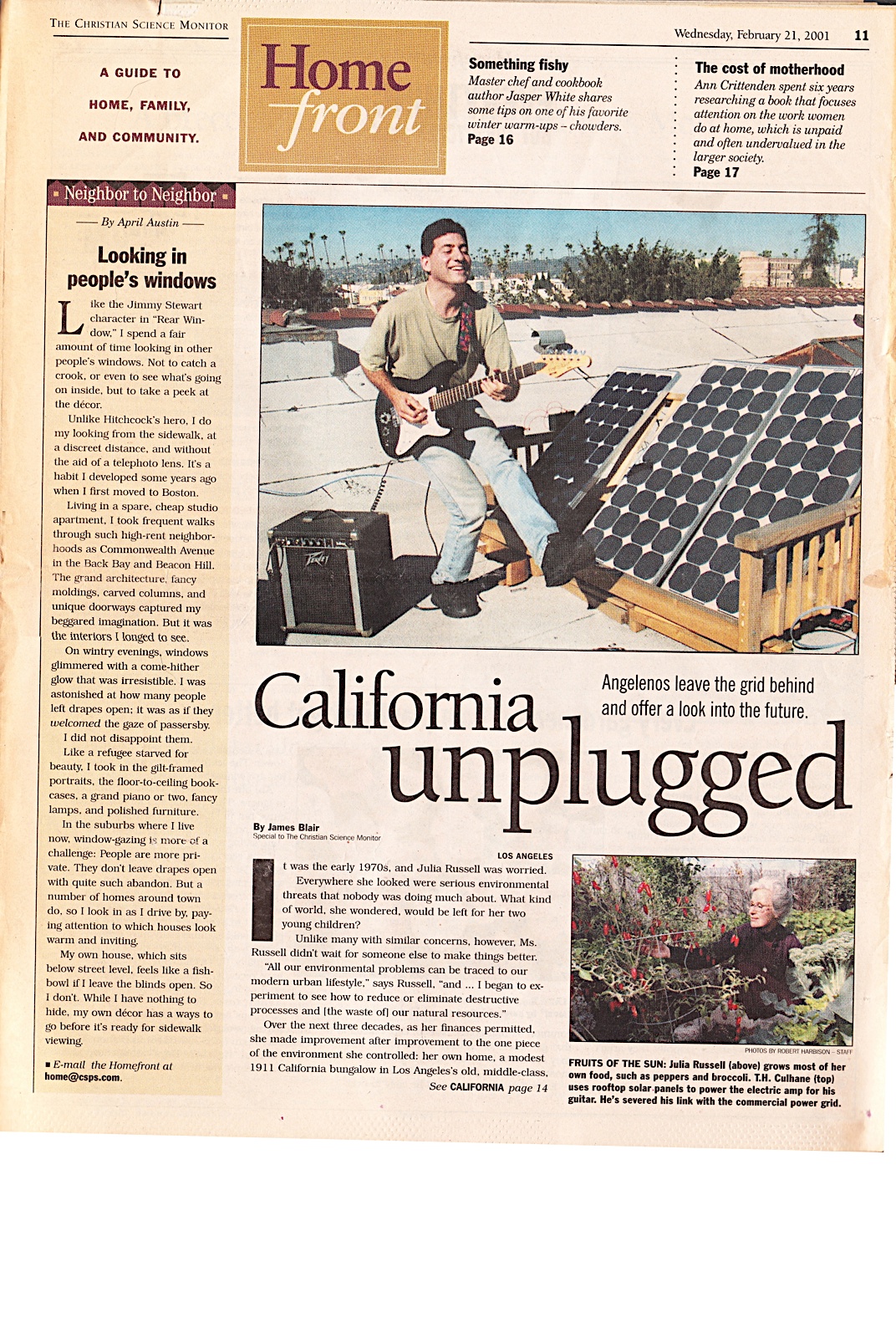
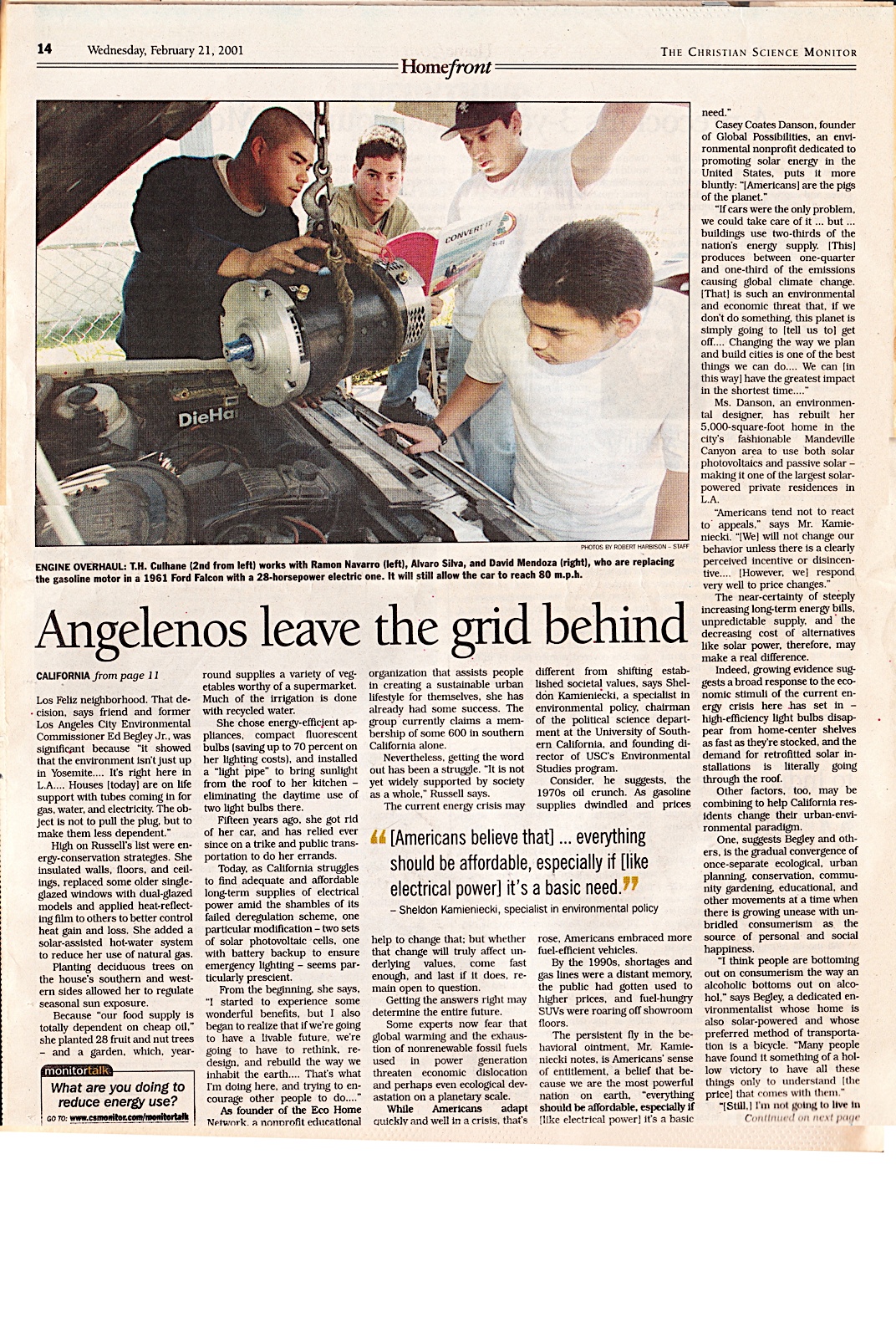
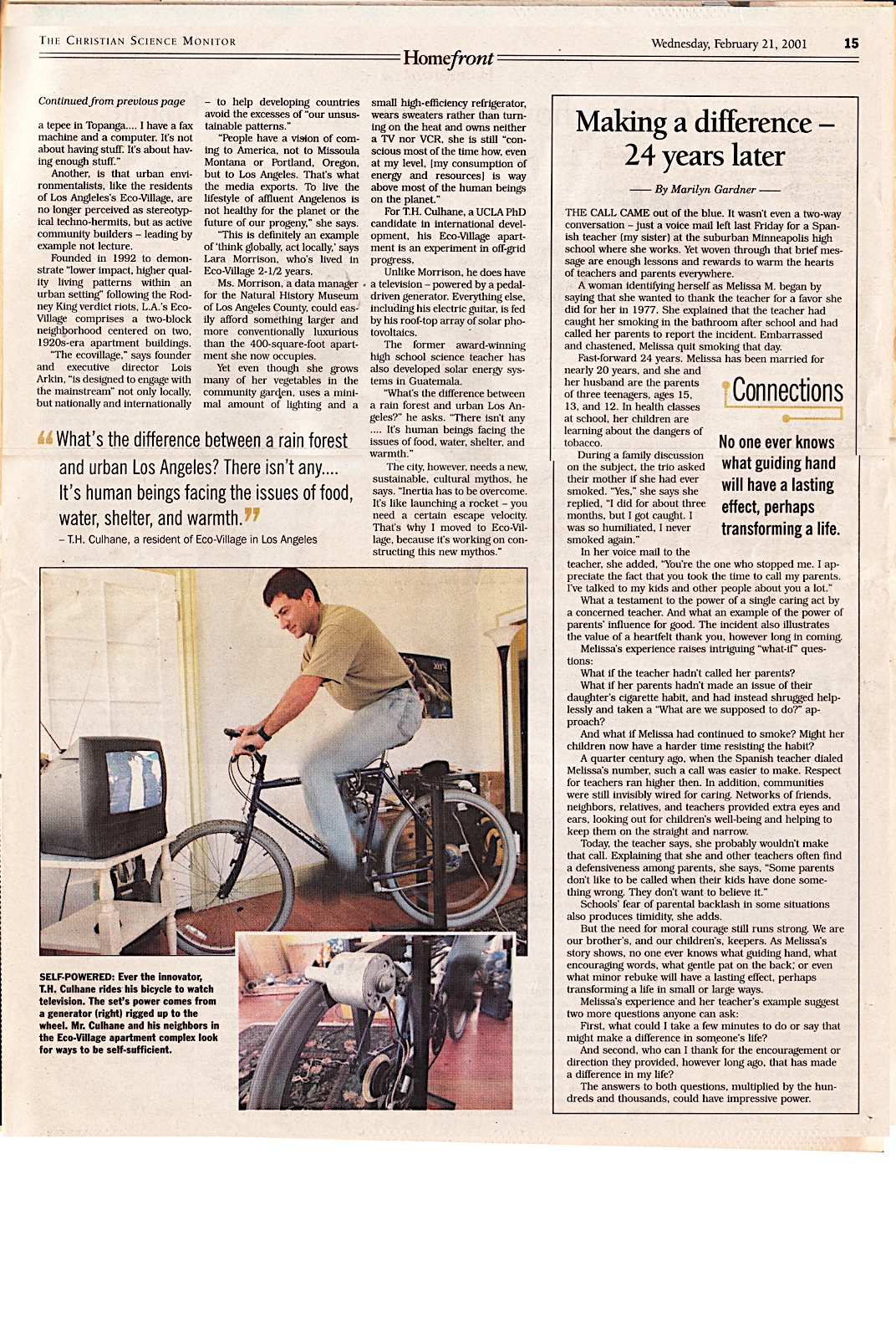
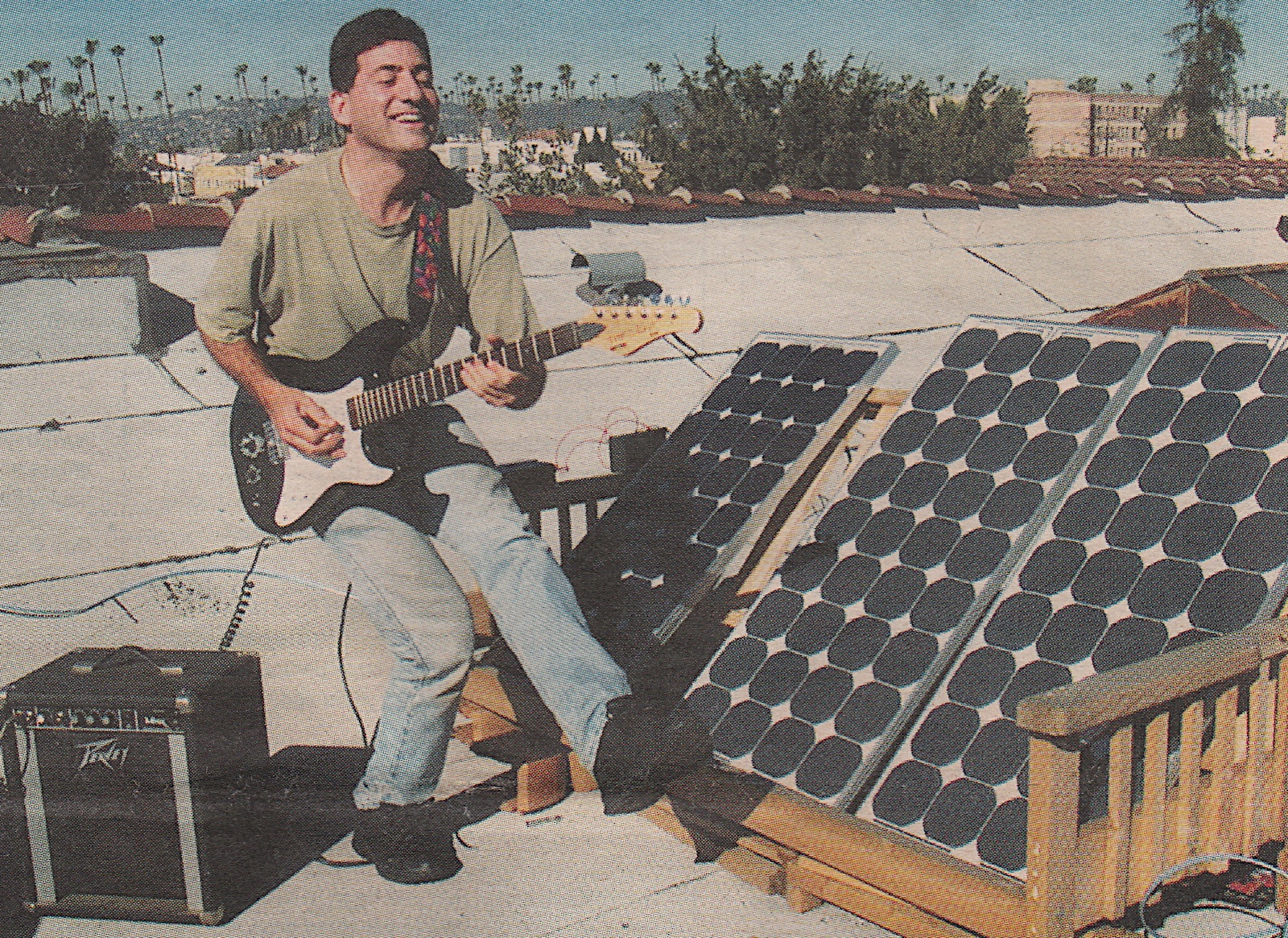
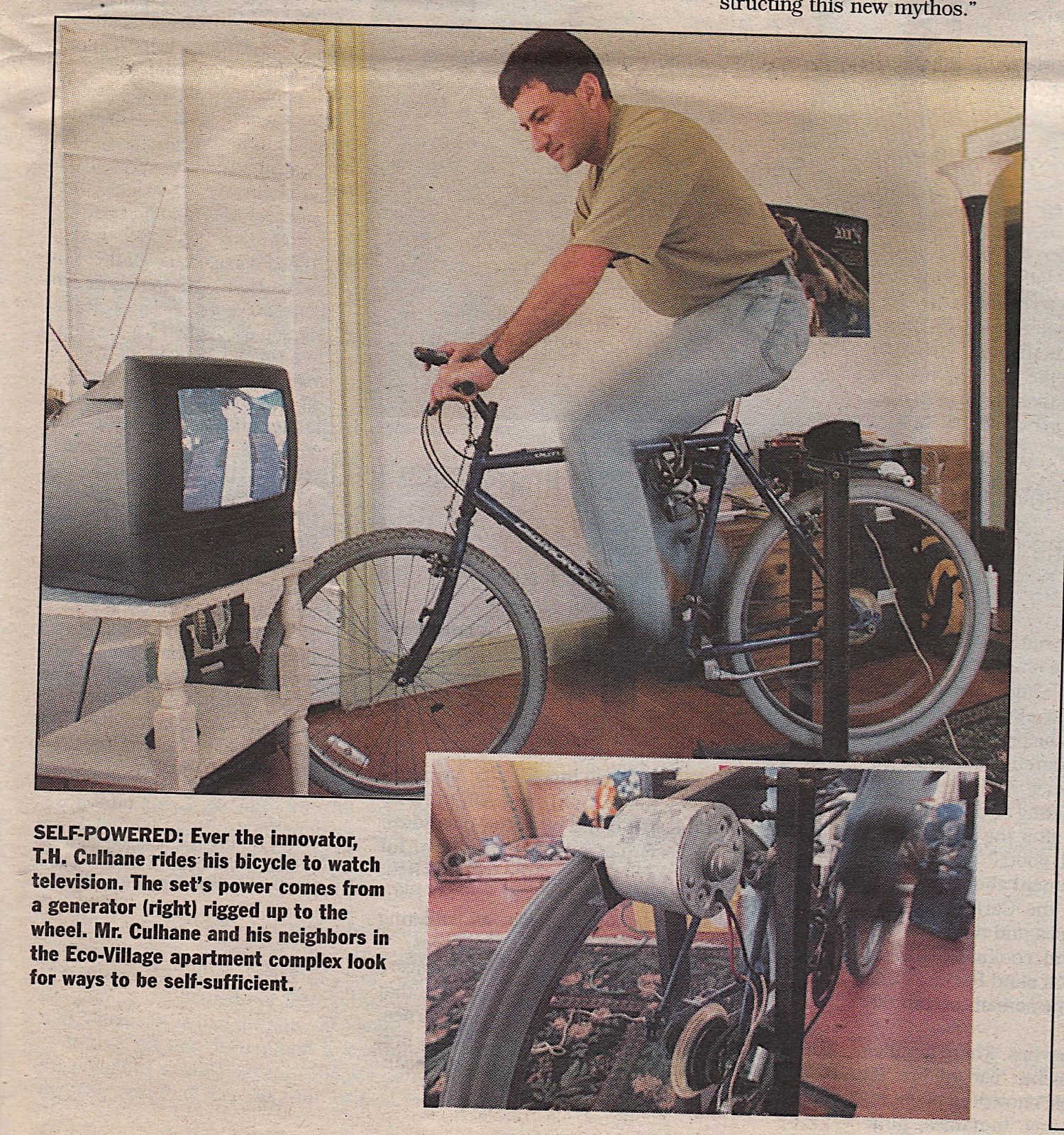
California Unplugged: Solar CITIES at the Los Angeles Eco-Village in 2001

Digging through our archives we found this 8 year old Christian Science Monitor article talking about our activities at the Los Angeles Eco-Village at the turn of the century (!) which also features our colleagues, friends and inspirations, Julia Russell, (founder of the Los Angeles Eco-Home ), Lois Arkin (founder of the Los Angeles Eco-Village) and Lara Morrison (one of the guiding lights and board directors at the LAEV).

You can download a high-resolution PDF of the article here:

http://solarcities.eu/Articles/Christian Science Monitor.pdf

Now that we are working on eco-home/eco-village concepts in Cairo, Egypt, Essen, Germany and Santa Rosa, California it is great to go back and see how we started. Thought you might enjoy sharing the history too!


A special treat is seeing this picture (below) of Alvaro Silva from Solar South Central when we were working on an electric car conversion using Mike Brown's book "Convert It".
The actual electric motor shown in the picture made its way from the L.A. Eco-Village to Solar South Central, then all the way to Cairo for workshops there and is now here in Germany awaiting its chance to be part of an electric car conversion here.
Meanwhile Alvaro was recently working with us on the green-retrofit of the 460 Lucas home in Santa Rosa and will be coming to Cairo to work with us in October. What goes around the world, comes around the world!