Most northerners don't know sh*t.
Most of us don't understand sh*t.
But I know my sh*t.
I know my sh*t, not because I'm a
“professional”, but because I try things at home. And when something works for me at home, then and only then do I take it "on the road" and work on implementing what works for me in other communities around the world . Rather than having the hubrus to "think globally" and then act locally (which always seemed backwards to me!) I "think locally" and then, by solving my own problems and openly sharing the results - the successes and failures - with my worldwide social network through our facebook group "Solar CITIES Biogas Innoventors and Practitioners" (http://facebook.com/methanogens) we find that in fact we are acting globally. We get to know our sh*t together, collectively, iteratively, through trial and error and shared experience rather than hearsay, fiat and decree.

I know my sh*t, not because I'm an “expert” but because I take care of my own sh*t. I've been building and using my own composting toilets and biodigesters for more than 15 years.In my apartment in the Los Angeles Eco-village I started getting into deep sh*t with the paint bucket toilet system found in Joseph Jenkins Humanure Handbook (you can get the entire book free here. It has all the data you need to understand how easiy it is to safely deal with humanure, a.k.a. "sh*t"). Since then I've strived to avoid letting the results of my consumption become somebody else's problem.
Sometimes, like everybody else, I'm full of sh*t. But when the sh*t goes down, it is quickly and safely recycled into the precious life giving organic matter it was intended to be. That way the sh*t never hits the fan. Mine doesn't get distributed over hell and high water, giving hell to others. My sh*t can never be a source of filth and disease, odor or infirmity. My sh*t stinks like everybody else's upon production, but because of the way I treat it at home it never releases its thiols/mercaptans and phenols and sulfuric compounds to the environment and will never attract flies or permit the transmission of cholera, dysentary, typhoid or E. coli contamination. What goes on in Vegas stays in Vegas, and what goes on en mi casa will never affect tu casa. I don't give my sh*t away to nobody. You'd have to fight me to steal my shi*t. I take care of my sh*t. Most northerners don't.
I know my sh*t, not because I'm an “expert” but because I take care of my own sh*t. I've been building and using my own composting toilets and biodigesters for more than 15 years.In my apartment in the Los Angeles Eco-village I started getting into deep sh*t with the paint bucket toilet system found in Joseph Jenkins Humanure Handbook (you can get the entire book free here. It has all the data you need to understand how easiy it is to safely deal with humanure, a.k.a. "sh*t"). Since then I've strived to avoid letting the results of my consumption become somebody else's problem.
Sometimes, like everybody else, I'm full of sh*t. But when the sh*t goes down, it is quickly and safely recycled into the precious life giving organic matter it was intended to be. That way the sh*t never hits the fan. Mine doesn't get distributed over hell and high water, giving hell to others. My sh*t can never be a source of filth and disease, odor or infirmity. My sh*t stinks like everybody else's upon production, but because of the way I treat it at home it never releases its thiols/mercaptans and phenols and sulfuric compounds to the environment and will never attract flies or permit the transmission of cholera, dysentary, typhoid or E. coli contamination. What goes on in Vegas stays in Vegas, and what goes on en mi casa will never affect tu casa. I don't give my sh*t away to nobody. You'd have to fight me to steal my shi*t. I take care of my sh*t. Most northerners don't.
Southerners used to understand sh*t.
Probably many northerners too. But south of the border, down Mexico
way, and in all of the countries between the tropics of capricorn and
cancer, the recycling of shit was so fast that it rarely posed a
problem prior to the absurd human and “pest species” population
growth that characterized the 20th century. After all, every animal
that lives and that ever lived (and the tropics had the lions share
of every phylum) sh*ts in its environment, and none had waste
treatment plants. Fish and aquatic mammals sh*t in the very water
they drink, and that we drink too, but their sh*t is so quickly taken
up as food by other organisms that it rarely if ever permits the
accumulation of pathogenic microbes in threatening quantities. Our
own sh*t, released into an environment rich in biodiversity, also
became immediate feedstock for plants and animals and fungi. And
when we concentrated in certain places, as long as we kept our sh*t
out of our immediate drinking water supplies, it posed no threat.
Safety came from efficient cycling. As long as we didn't overwhelm
the absorbtive capacity of a given ecosystem dealing with sh*t was
easy.
I had a teacher once who chided those
of us in the eco-village movement for thinking we could use natural
processes to deal with sh*t in tropical countries. In the late 1990s
we showed her a video of the John Todd Living Machine that I had
learned about at Harvard in 1980 when I visited the New Alchemy
Institute on Cape Cod (I and my Mercy College students visited a
functioning version of the technology called the “Eco-Machine” at
the Omega Institute in New York a couple of weeks ago). My professor
told us “you can't apply these biological processes to the tropics
and sub-tropics; you will end up killing people”. When we asked
why, she said “you obviously have no understanding of the ecology
of the south, in hot humid environments disease runs rampant.
Bacteria grow everywhere. Flies will breed like... well, like flies.
These living machines will be a disaster”
 |
| The outdoor wicking beds at the Eco-Machine at the Omega Institute with returning cattails and other constructed wetland plants emerging after the spring thaw. These wicking beds, we were told on our recent visit, are the heart of the effective waste-water treatment that goes on at Omega in New York. By summer time this will look like a naturally wetland, thick with greenery The inside part in the building is the sexier "finishing" part of the process, but the beautiful vegetated gravel pits are where the real heavy lifting occurs, eliminating any problems that so called "black-water" might cause. The inside section helps to eliminate the problems associate with the more difficult issue in waste water: soaps and detergents, NOT sh*t. |
 |
| The inside of a John Todd style Eco-Machine or Living Machine at the Omega Institute in New York. It uses plants, fish, snails and microorganisms to create clean water from toilet wastes and washing and cleaning wastes, treating both "black water" and "grey water". |
She was well intentioned
but ignorant of the facts. In fact the rapid growth of all organisms
made possible by the warmth and wetness of the southern latitudes
makes living machines much more effective there than in the north. If
disease is spreading in the south it is because, following the
“western” model of development, people have radically diminished
the transformative capacity of the ecosystem by cutting down forests,
altering watersheds, monocropping, spreading poisononous herbicides
and pesticides, impoverishing biodiversity, overfishing, poisoning
lakes and streams and rivers and oceans with soaps and detergents,
causing eutrophication and hypoxia. Under these conditions, along
with the extra warmth and wetness, can pathogenic and pestulent
creatures experience out of control population explosions? Si, se
puede! But those same conditions also give complex ecosystems an
edge, enabling the establishment of regimes that make short work of
errant “bad guys”.
It is for this reason that waste water
treatment using the schmutzdecke system (a German description of a
natural process that occurs in ponds in the warmer latitudes) works
so well in the south. In a schmutzdecke system a rich population of
interrelated organisms (microbes, algae, protozoa, water insects) is
cultured above a slow sand filter and contaminated water is dripped
in slowly enough that it doesn't disturb the complexity of the
aquatic ecosystem. This shmutzdecke (which means “dirty layer”
and needs to be about 20 cm deep) actually cleans the dirty water by
eating all the pathogens. Residual microbes are trapped by
electrostatic and mechanical forces in the fine sand layer (which
needs to be at least 75 cm deep for proper effectiveness).

When I
tried making one at home in Germany it worked pretty well in the
summer but stopped working in the winter. Of course. And while it
appears to take care of bacteria that can cause disease (development
agencies are using them effectively in Afghanistan) it does nothing
to eliminate the awful smell and taste of greywater. My experiments
with my Shmutzdecke system convinced me that if anything, dealing
with soap is much harder than dealing with sh*t! And I would have
continued my experiments except that living in the north made it so
hard to harness the biology properly. No wonder northerners are so
down on biological treatment – we rarely get a chance to see it
work. Hence the culture of chemical extermination we've created and
promulgated around the world.

So-called Western culture, (which,
given the rotation of the Earth along a north-south axis, and the
distribution of major landmasses above and below the equator, is a
misnomer), has evolved an unfortunate fecophobia that is coupled with
a certain conversational smugness that inhibits rational discussion
of sh*t. The fact that I feel compelled to use an asterix in place
of the letter I in the word is testimony to the taboo we have in our
society – I don't want to risk offending anybody by calling the
result of eating by its vernacular.
Later on in this essay I will resort
to using Latin descriptions like 'feces” or “fecal matter” but
parsimony suggests that when writing expositions like this it is
better to use four letters (even if one of them is a symbol) instead
of five or eleven. Westerners are supposed to be appreciative of
efficiency.
Anyway, the society in question is
really northern hemisphere society, not western. The native
Americans were as west as you can get from England and many of their
members told the anthropological psychologist Erik Erikson that they
found the European practice of crapping into rivers and streams an
abomination. Indigenous peoples around the world were the inventors
of some of the first composting toilets; Eriksson reportd that the
native American habit was to do your business in the forest, as far
from bodies of water as possible, so that the insects and worms could
quickly recycle it back into the forest. Does a bear sh*t in the
woods? You betcha!
I am asserting that perhaps northerners
didn't get sh*t and its transformative properties (with the very very notable exceptions of people like Joseph Jenkins and the Austrian artist/artchitect/activist Hundertwasser whose "Shit Culture Manifesto" should be on every development program's reading list) because they didn't
understand biology and how to deal with winter. Sh*tting on snow
leaves a prolonged and unsightly mess, particularly when accompanied
by the yellow stain of urine, and it is a mess that will last for
months until the spring thaw. At that time biological systems are
struggling to re-establish themselves and it is easy for ecological
systems to get out of kilter. If the sh*t is too concentrated in an
area and there isn't enough biodiversity hopping to balance the flow
of nutrients, the “bad guys” can predominate. How much more
convenient to sh*t in a river and let the lumps of digested food
waste become somebody else's problem. “Not in my backyard”
became “why not in everybody elses?”. The tragedy of the commons
reared its ugly sh*tty head … as well as the tragedy of the less
fortunate downstream.
There were those, of course, who did
try to contain their sh*t, but most northerners, sh*tting into an
outhouse pit or ditch, trying desperately to hide the “shame” of
their defecation, never seem to have figured out that they could
simply use a bit of insulation (straw would have done fine, sawdust
and ashes are the norm, grass and green leaves are even better) to
line their pit, do their business, and then throw some more straw or
grass or leaves on top, increasing the carbon to nitrogen ratio to
the point where exothermia sets in, creating a thermophilic compost
pile that rapidly turns sh*t back into soil (the original source of
sh*t, transduced through plants to animals to sh*t and back to soil
again through solar energy). When it comes to the basic biology of
soil formation, most northerners apparently never got the memo, and
where sh*t wasn't being flushed away into rivers and streams causing
deadly outbreaks of cholera and dysentary and typhoid and E. coli
poisoning, more or less contained outhouses all over stank to high
heaven, the stink attracted numerous flies, and contamination of
ground water become a historical life threatening problem. It never
had to be that way.
Of course I can't indict all
northerners. In the Himalayas in Nepal I visited plenty of
traditional Sherpa villages on our National Geographic expeditions
where they have been doing composting toilets for thousands of years
– forget digging a ditch (the soil is too rocky and frozen), the
clever Sherpa built toilets elevated above a stone chamber filled
with rhododendron leaves, and provided piles of rhododendron leaves
next to the toilet hole for “flushing” with the pleasant smelling
cover material and used the heat of decomposition to partially warm
their houses. But then, nobody really considers the Nepalese
northerners or westerners. With both terms we really mean “the
descendents of the Europeans” and it is, I believe, our cultural
hegemony that makes dealing with sh*t so messy.
Northerners don't know sh*t. We've
created a culture of flush and forget, relegating the transformation
of sh*t nto non-sh*t to a few engineers , most of whom have been
schooled in chemical obliteration as the solution to everything.
Disinfection is the mantra of the northern world in response to the
workings of biology at the digestion or “production' end of the
tube that is the human animal, just as pesticide and herbicide and
fungicide and sterilization is the mantra at the consumption end of
the tube. Kill everything you can before you put your food in your
mouth and kill everything you can when the results come out (and
don't forget to use mouthwash and antibiotic soaps and take your
antibiotic pills to disinfect your whole body in the in-between while
you are at it!).
In these troubled times, with the
legacy of historical colonialism and the nightmare of neo-colonialism
still impeding self-determination in southern countries, the
north-south vector of development aid and “expertise” is a most
unfortunate thing. Because most northerners don't understand how
small a problem sh*it really is, and how easily solved, the
descendants of the colonized in tropical and sub-tropical countries,
where proper temperatures and biodiversity can turn sh*t back into
soil in a matter of days, emulate the sh*tty practices of their
colonizers, having forgotten how easy it was and is to avoid all the
problems sh*t entails and actually make of it a value added
enterprise.
Sh*t looms large in the consciousness
of Euro-American culture, particularly North American culture, like
the shadow of a hand puppet that looks like a giant marauding bear on
the wall until you have the courage to turn around and see it for
what it really is – a really precious feedstock for the very
process of life, rich not only because of its chemical constituents
but because of the very bacteria and other microbes (Archaens aka
“methanogens” – a life form distinct from and much more ancient
than bacteria that transsubstantiate sh*t into recoverable energy in
the form of methane).
An illustration of the difficulty most
northerners (and most of their descendants, wherever they may live
after the conquest) have with understanding sh*t comes from my recent
work in Brazil where we are trying to solve grave waste management
and sanitation problems. I will be blunt and politically incorrect
and say that most of the white people I work with around the world really believe that
sanitation is a difficult technical issue that requires long
processes of technical study and huge investments to solve. They
look to investment intensive and massive centralized waste-water
treatment plants for the answer to the filth that flows into the
lagoons and bays of Rio de Janeiro. They frown uncertainly when it is
suggested that all the sh*t related problems can be dealt with much
more simply and effectively using small anaerobic digestors and
wicking gravel beds and compost bins or aeration tans. They balk at
the idea of open constructed wetlands and the use of banana trees for
transpiration and nutrient uptake, somehow offended by the idea that
sh*t can be taken care of without the use of chemical weapons –
“germicides” like chlorine (the famous chemical in the deadly
mustard gas of World War I). The thought that organic material and
chlorine combine to form carcinogenic compounds that persist in the
water barely crosses their minds – as long as we “obliterate”
the invisible enemy they call “germs” we can let the hospitals
deal with the suffering of the survivors of our “carpet bombing”
strategy for disinfection.

 |
| Constructed wetland for treating toilet waste built by the community at the Alemao Verdejar Favela in Rio Arguably much prettier than a septic tank or waste water treatment plant. |
 |
| Another view of the constructed wetland at the Alemao Verdejar Favela in Rio |
 |
| Constructed wetland at the Alemao Verdejar Favela in Rio |
 |
| The Constructed wetland at the Alemao Verdejar Favela in Rio built by the community uses a bed of used automobile tires and gravel cemented into place and planted with banana trees and other vegetation. It processes toilet wastes from the community creating fertile soil while the banana trees transpire and evaporate the liquids. |
 |
| Constructed wetland at the Alemao Verdejar Favela in Rio |
 |
| A hand made mini kitchen biogas system designed and built by Solar CITIES on a travel grant from Solar Cities Solutions in Alemao Verdejar from a Rotoplas tank. |
 |
| The hand-made Solar CITIES Rotoplas mini biogas system for kitchen waste with a food grinder donated by Insinkerator corporation to assist in the biodigestion. |
 |
| On the left is a three drum vermicomposting system that the favela had already installed in the kitchen. Behind it is the hand-made Solar CITIES Rotoplas kitchen digester prototype built by T.H. Culhane and Luis Felipe Vasconcellos when T.H. was visiting on a trip funded by Solar Cities Solutions in the summer of 2013 to explore larger Puxin type community digesters for treating toilet and food wastes in Niteroi and Rio. An Insinkerator food grinder sits in the foreground which will be used to feed the digester. |
Ironically, some of the most dreaded
consequences of improperly processed sh*t actually aren't so hard to
manage. Yes it is true that one of the weeks I was in Nigeria
building biodigesters for schools and hospitals with former president
Obasanjo to help turn sh*t into safe fuel and fertilizer, 900
children died due to a cholera outbreak in the city of Lagos when a
sewer pipe broke and fecal material contaminated the drinking water
supply. Also, flooding in the city while we were there due to plastic
bags filled with food waste clogging the sewer drains backed up fecal
laden water into the streets. All of this death and misery could
have been avoided if both sh*t and food waste were routinely placed
into biodigesters. But what is far too infrequently told outside of
medical clinics in the “third world” is that cholera and other
water-borne illnesses aren't really the danger they appear to be and
are readily treatable. The reason for so many tragic deaths from
fecal contamination is usually dehydration. Babies, children and the
elderly will get cholera or shigella from contaminated water and
these organisms produce toxins that inhibit water retention so that
they can pass through the body and back into the water to complete
their life cycle. The body responds through diarrhea, eager to flush
the invaders out. If the diarrhea is not deposited back in the
water, the infection dies out. If the body of the host is kept
hydrated with a solution of electrolytes (the right sugars and
salts) the infection can run its course without mortality. Millions
and millions of lives can be saved by simple interventions of
rehydration and monitoring.
If sh*t is causing nightmares in
developing countries it has more to do with our lack of investment
and attention in proper affordable and available medical treatment
than the true danger of the pathogens in sh*t. Most of them are much
more benign than the pathogens that can result from organisms dining
on our food waste – the plagues of Europe were the result of
improper treatment of high-energy organic residuals preyed upon by
flea bearing rats, not improper treatment of sh*t. Airborne
infections, like influenza and other viruses carried by absurd
concentrations of domestic animals (avian flu, swine flu etc.) are
what I fear most when I travel, along with salmonella and other
forms of food poisoning, almost all the result of a paucity of
diversity in our food supply and our tendency to crowd animals and
plants of the same species together. Death by proximity to another
person or animal scares the sh*t out of me. I can avoid most of the
diseases and problems sh*t brings by boiling or purifying my water
and washing my fruits and vegetables and, if necessary, hydrating
myself when I get ill. Diarrhea I can deal with.
For my part, having lived and worked in
areas with poor sanitation for many years, I've never had such a
phobia for feces. Fecophobia, which is extant in the north, doesn't
seem to be a part of the “threat level orange” response of most
people in the south because, as mentioned, most sh*t degrades rather
quickly in a landscape filled with worms and insects and fish and
reptiles and birds and mammals and a trillion different kinds of
protozoa and bacteria and archaea that we haven't even begun to
identify (all of which are sh*tting too, every day). The scarab
beetle, sacred to the ancient Egyptians, is actually the dung beetle,
and one of the reasons it was sacred is because of how quickly and
effectively it carried off our sh*t and turned it back into life
giving soil.
I can never forget living in the
jungles of Borneo for a year on a Harvard University research team in
the mid 1980s and marvelling nights when I squatted over our dung
pits in the forest near our huts watching the ruby red eyes of the
dung beetles magically approach as soon as I had done my business.
With a gentle whir of their wings they would dive bomb between my
legs, quickly roll up a ball of sh*t larger than themselves and then
take flight, whizzing up and out with a tickle of air on my bum,
taking the gift of my sh*t to their lairs to cultivate with the aid
of fungi into food for their larvae.
On other occasions in Borneo we found
ourselves in pools of flowing water where it was actually appropriate
to sh*t in the water because hungry fish were waiting and as soon as
you dropped your load they snatched it up in a flurry of writhing
scales and fins. This interest by fish in human feces was well noted
by Indonesians; in Sumatera we visited a restaurant built over an
artificial fish pond that had bird cages also suspended over the
pond. The birds were there to feed the fish with their feces, but on
inspection I noticed that the toilet for the human patrons also
discharged directly into the pond. I was told that the fish we were
eating were also fed by us. Cooked properly, they assured me, it was
quite safe. I'm not sure about that (even I have my limits when
trying to suspend disbelief) but I finished my meal and I didn't get
sick, nor did anybody else.
In a Dyak village in Kalimantan Timor I
dined with a tribal chief whose hut was built on stilts in two
stories with the bedroom and bathroom on the second floor. The
toilet was a hole in the slotted wooden floor underneath which the
chief's “babi hutan” or forest pigs lived. They ate all our sh*t
and we in turn dined on them, and so the cycle completed itself.
During visits to Quitos, Ecuador and
the Meskital slums of Guatemala city I used composting toilets that I
built using the Jenkins “Humanure Handbook” paint bucket method
to avoid problems when the electricity would go out for a week and
none of the flush toilets worked, and I used the same system for
three years in my apartment in Los Angeles at the Urban Eco-village,
planting trees with my “wastes” so they wouldn't be wasted”.
I've since used my own sh*t, and that of my two children when they
were in diapers, to start and continue to produce methane in home
built biodigesters on our porch in Germany and in New York. I've
taken 100 liter tanks and filled them with sh*t on my porch and run
air through them and watched as algae grew and completely removed all
smell and danger in a matter of weeks.
Basically sh*t doesn't scare me. It is
the least threatening output of the human condition, much more
tractable than the chemicals we use routinely to spray our food and
the produce of our gardens before we eat them and turn them into
sh*t. And I would argue that sh*t is much less of a problem than food
waste as an engineering problem although that too has a simple
solution. And both are really trivial compared to the “grey water
problem” – that grey area in waste treatment where you have to
deal with the awful effects of chemical soaps – basically salts and
fats and perfumes and antibacterial toxic inhibitors – on
waterways. Yet that too can be simply, if more expensively solved,
using the “living machines” or “eco-machines” a la John Todd
that I spoke of earlier (basically constructed wetlands and tanks
with lots of plants, algae, fish and snails, wonderful snails). The
right quantity and diversity of life forms in the right formations
can take care of everything organic we throw at it. It is the
inorganic material – the poisons we put in our environment – that
is the only real threat.
 |
| The two Puxin 4m3 toilet waste digesters and one 10m3 food waste digester built by Solar Cities Solutions at an elementary school in Niteroi, Brazil. For maximum efficiency the two systems should be connected but concerns about safety of the toilet digesters require that we keep them separate until we can prove zero pathogenicity. |
Meanwhile, in Brazil, as “foreign
experts” riding in on our decidedly white horses to save the day in
our bid to “help the poor” in the favelas, we are arguing
endlessly about how we are going to “deal with” the “sanitation
problem”. As if it hadn't already been solved. And while we Norte
Americanos try to call our engineering acumen into play, negotiating
with agencies and drawing up plans and planning public relations
bonanzas to level up our projects once we have our “first
successful demonstration”, the Central Americans, Mexicans in
particular, are quietly going about their business in how to treat
the result of us “doing our business” (sh*tting), creating
business empires at the same time as they save lives in communities.
 |
| The two toilet waste treatment digester tanks before infill. The first tank, on the left acts as a settling chamber and primary digester. The supernatant flows into the second tank where internal surface area further cures the liquid, which then flows back out to a constructed wetland that Solar Cities Solutions team member Marcello Ambrosia is building proposed by team member Yair Teller in discussions with Executive Director Gail Richardson and Creative Director T.H. Culhane and funded by the Insinkerator corporation. |
Around the world many companies are beginning to understand sh*t and providing effective low cost solutions to what was once a scourge of humanity. One huge Mexican company in particular –
Rotoplas - has already installed more than 200,000 “Bano Dignos”
in Latin America with the support of the Mexican and Brazilian
governments, completely eliminating the threat of human waste from
each household by working incrementally, household by household. They will soon be up to half a million installations.
Eschewing the idea of large treatment plants for economic,
topographic, logistical and social reasons, they simply provide to
families a complete home scaled system called the “Bano Digno” or
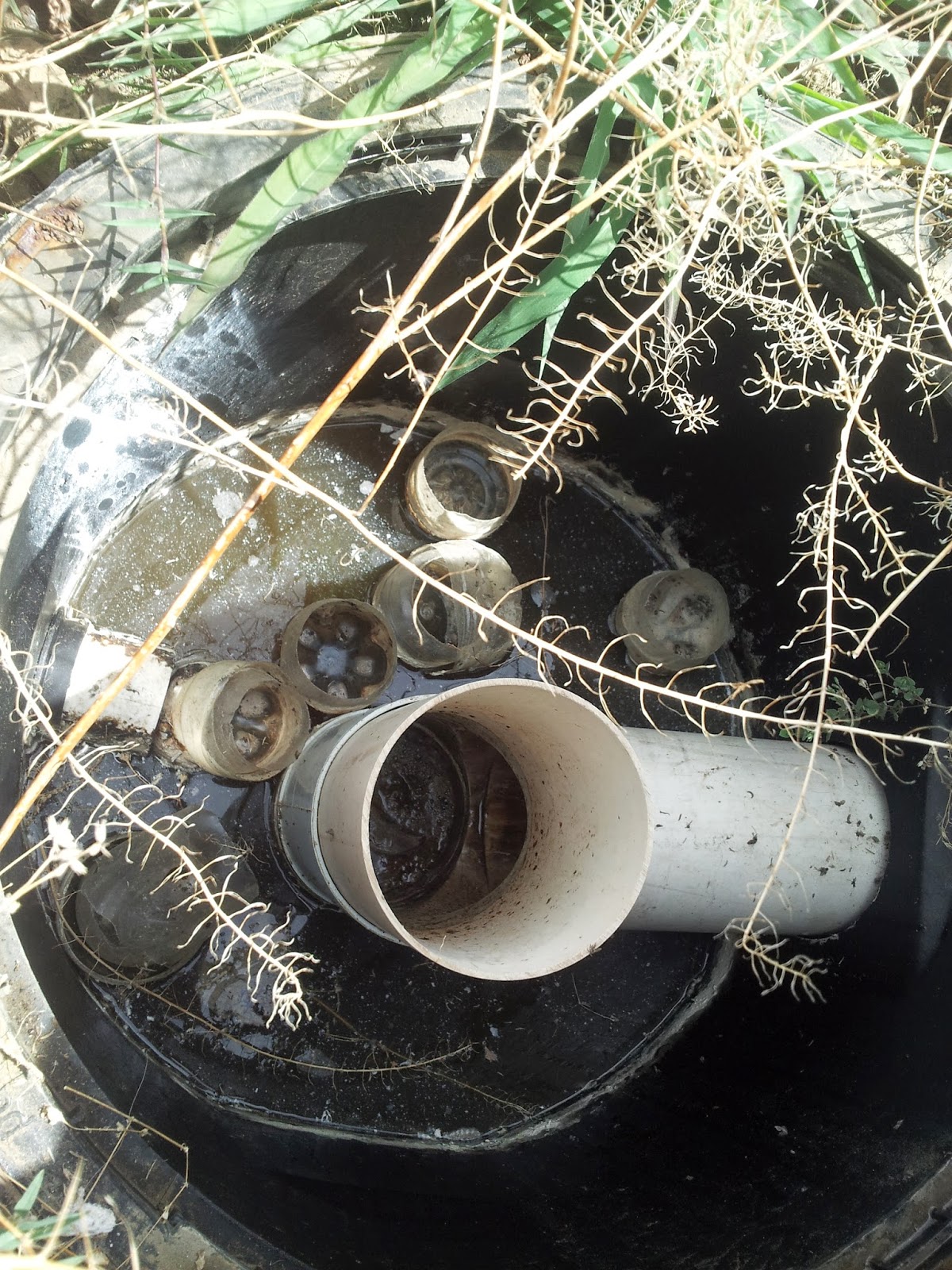
“dignified toilet”. It consists of a rain water collection tank,
a manual pump, a fiberglass molded outhouse with flush toilet and
gravity feed water storage container and a small biodigester system
that in turn consists of a 1300 liter plastic rotomolded anaerobic
chamber, a contained wicking bed (gravel filled plastic chamber of
about 400 liters) and a sludge collection tank of a couple hundred
liters that enables “self-cleaning” of the digestor and yearly
home processing with lime powder to provide good soil for growing
plants.




Each part of the system is modular and can be installed all at once or iteratively, depending on the circumstances and need. The systems scale up for larger families and institutions and can be installed in a day. 600 liter systems are available for families of up to 5 people, 1300 liter systems for families up to 10 people, 3000 liter systems for community centers with up to 20 people, and 7000 liter systems for schools and institutions with up to 60 people. Multiple systems can be concatenated for larger institutions. While the complete systems may be too expensive for most poor families to afford as an initial capital outlay, the governments of Mexico and Brazil and other countries subsidize most of the cost as part of their role in supplying social welfare infrastructure and microloan programs are being considered.
Each part of the system is modular and can be installed all at once or iteratively, depending on the circumstances and need. The systems scale up for larger families and institutions and can be installed in a day. 600 liter systems are available for families of up to 5 people, 1300 liter systems for families up to 10 people, 3000 liter systems for community centers with up to 20 people, and 7000 liter systems for schools and institutions with up to 60 people. Multiple systems can be concatenated for larger institutions. While the complete systems may be too expensive for most poor families to afford as an initial capital outlay, the governments of Mexico and Brazil and other countries subsidize most of the cost as part of their role in supplying social welfare infrastructure and microloan programs are being considered.


The Rotoplas Bano Digno Biodigestores are already sold in Rio De Janeiro at Leroy Martin and other chain hardware stores all over Brazil so there is no technological or logistical hurdle involved in eliminating current scourge caused by improperly treated human wastes. The issue now is purely financial and this is where governmental, non-governmental and other organizations can focus.


The Rotoplas Bano Digno biodigestor intervention is so simple and elegant and readily available that for dignity focused projects like the one that the Brazilian NGO Catalytic Communities is creating with favela community leaders in Muzema it would make the most sense to immediately become part of the program the Rotoplas company already has with the Brazilian government to install hundreds of thousands of household digesters at a subsidized cost and work from there. Can we do this? Si, se puede!


Anybody who doubts the potential of home scale biodigesters to rapidly enter the market and positively impact sustainable development also severely underestimates the power and magic of Mexico. This will be the real revenge of Montezuma, when his people end dysentery. cholera and other waterborne diseases all while also giving clean reliable fuel and fertilizer to make deserts bloom once those features are added to the existing solution set.


I have now had the pleasure of working
with the good folks at Rotoplas to help improve the home scale
biodigesters they manufacture and deploy by adding two dimensions to
their project – 1) to slightly modify the existing systems so the
methane they naturally produce can be captured and utilized (for
example, to cook and boil water, and improve the temperature of the
digester so it can process more effectively, insuring that disease
does not spread if it is present) and 2) to radically increase the
amount of useful methane they produce through the addition of ground
up food waste, spoiled fruits and vegetables, flowers and other
energy rich organic residuals (thereby increasing the utility of the
above). A third improvement is the use of solar heated or gas heated
water (post consumer use in showers) to further raise the effective
temperature of the digestor to get maximum output. But regardless of
whether we add heat or other organic wastes to the system and thereby enable people to have clean, smoke free biogas or just leave
them the way they are to more slowly treat the human wastes alone,
the simplicity of the system makes a mockery of many of the brow
furrowing long winded discussions going on in the north about how to
solve sanitation problems in the south. As the Emerson Electronics
slogan goes, “consider it solved”.


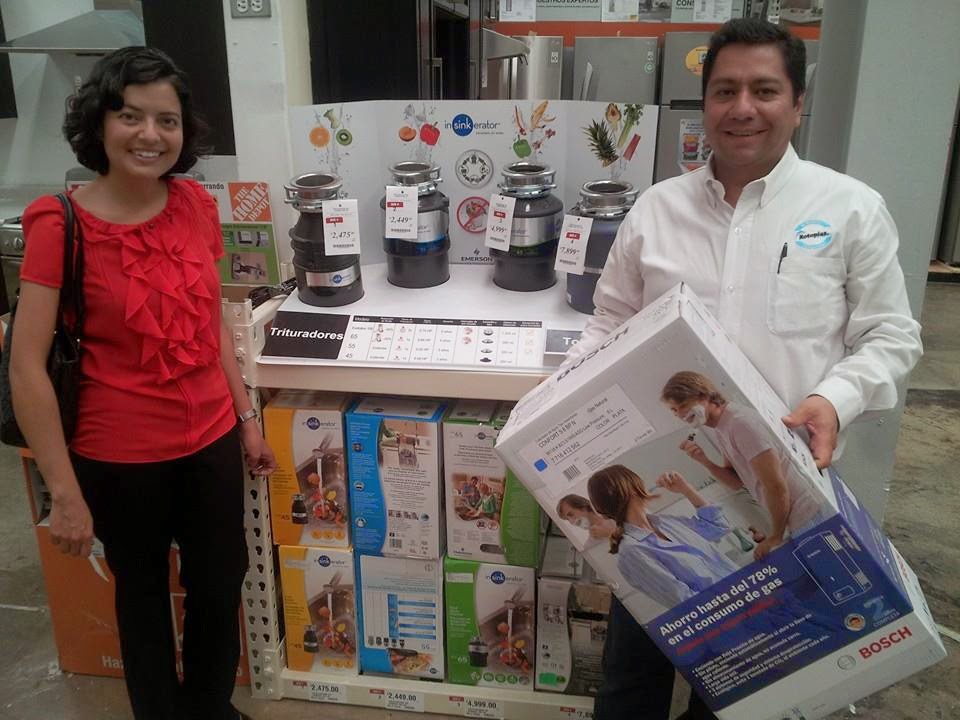
And of course, adding solutions like
the Emerson/Insinkerator food-grinders (or local equivalent) to the
Rotoplas Bano Digno solution really does add dimensions that can
really radically improve their efficiency. High calorie organic
residuals are a huge benefit to biodigestion processes while being a
bane to society when simply discarded.
I will continue to argue (and here I
depart from many of my fellow northern specialists) that food wastes
actually are more of a burden to society than toilet wastes.
Looked at from one perspective (a non
fecophobic perspective) toilet wastes ARE food wastes – food wastes
that have been “pre-digested” because they have been digested by
us. In this sense toilet wastes are already broken down by the
appropriate microbes using our stomachs and intestines as the
anaerobic reactors for partial hydrolytic, acidogenic, acetogenic and
methanogenic processes. This is why you can use your own sh*t to
start an effective biogas system (I used my babies' diaper wastes).
We are biogas systems. We are anaerobic digesters. Yup, the proof
that we are, in fact, biogas yielding biodigesters is that we fart.
Our flatulance (another subject consider risibly taboo in polite
discussion) is the indication that much of the energy found in our
food does not make it to our cells. We release it into the air every
day (I know, I know, ladies, you never pass gass, but we men do
right?).
When you look at human beings as a
tubular plug flow biodigester you see why our fear of sh*t is so
unfounded – we've already started the process of transubstantiation
of food back into soil. All our sh*t needs is more processing time
in the airless phase and then a bit of time being exposed to aerobic
bacteria, insects and worms and plants for finishing. To have
allowed sh*t to have become a major health hazard (which only happens
anyway when a few people with unbalanced internal and external
ecosystems allow the invasion and growth of pathogens and then
discharge them directly into drinking water supplies or onto
vegetables – most people's sh*t is actually pathogen free!) is
unconscionable. Treated at its origin through simple systems like
the Rotoplas Bano Digno what was stupidly seen as the scourge of
mankind can readily be turned into its greatest promise.
On the other hand I argue that food
waste, which still contains an enormous amount of high calorie
photsynthetic energy, is a far more formidable threat as it is dealt
with by modern society (based on northern models of waste disposal).
Because food waste is so energetic it attracts every member of the
biosphere that needs that energy. Where toilet wastes can hardly
support more than a handful of specialized detritivores like the
aforementioned dung beetles and fish and pigs, there are legions of
organisms, from bacteria to insects to higher birds and mammals that
literally jump at the chance to dine at the banquet of our high
calorie organic wastes.
One could very convincingly argue that
the entire (and scandalous) loss of life from the “black death”
or “bubonic plague” owes its tragic dimensions to the improper
disposal of food wastes. Rats, originally forest rodents, invaded
European cities like Remy in Ratatouille, looking for food waste.
They carried with them the fleas that carried the microbe Yersinia
pestis that caused the horrible plague. Had northerners simply
composted the food waste, or used it in biodigesters (as myancestors, the Assyrians, did in the fertile crescent as long ago as1000 BC), there would have been nothing for the rats to eat, hence no
urban rat population and hence no plague.
Similarly, all of the problems with
cockroaches (another forest species that has made its way into the
urban jungle to feast on our organic garbage) could be eliminated
when food wastes are transformed in controlled conditions (sealed
tanks or open compost facilities) into biogas and liquid or solid
fertilizer. Then we wouldn't keep poisoning ourselves with foul
smelling and toxic insecticides like the ones that were routinely
sprayed in my apartment building when I was a child in New York. The
same is true of flies. The same is true of ALL so called “vermin”.
Stray dogs and cats, possums, racoons, avian flu bearing pigeons and
other birds – none of them would last in the built environment long
if we didn't stupidly generate food waste and leave it in bags and
trash cans and dumpsters for “disposal” by the garbage industry.
Home and community scale biodigesters would completely eliminate the
threat they create – a threat much graver than toilet waste, which
is not only of much lesser volume (each of us generates much less
toilet waste on a per gram basis than food waste) but of little or no
interest to such a wide variety of potential pests.
Another problem with food waste that we
don't have with toilet waste is that food waste is generally
transported to landfill or incineration (both significant causes of
greenhouse gases) in plastic bags. One could argue that the real
reason for the despoilation of our oceans and the mortality of marine
life by plastic bags (now accumulating in the plastic vortex in the
pacific ocean) and the real reason for the constant flooding of our
streets and back ups of our sewage systems such as I experienced in
Nigeria, spreading disease and carnage in cities around the world, is
the build up of plastic bags that were thrown into the streets
because they contained smelly food waste.
When food waste is put through a food
waste grinder in the kitchen sink, or into compost bins or
biodigesters, the number of plastic bags thrown away drops so
dramatically that it no longer becomes a threat. Toilet wastes are
much easier to manage in this sense than food wastes. Only in the
slums of Nairobi has the author witnessed sh*t disposed of in plastic
bags (the famous “flying bag of sh*t” in Mukuru and Kibera are
the subject of much discussion because the city has provided no
adequate sewage solution. Biodigesters will eliminate that practice
if we move fast enough and get our priorities straight).
So on the whole I maintain that
cleaning up food waste is a much higher priority than treating toilet
wastes as it generates many more problems. Nature has been
converting the predigested solids and liquids from animal asses back
into soil since time began. The real issue with sanitation is simply
keeping the sh*t out of the water supply, nothing more. And in
impoverished areas this can be most easily achieved, in my opinion,
using household and community scale digesters using the Rotoplas
model developed in the south for handling the problems facing the
south. When combined with food grinders, warm water feeding and gas
collection improvements, the Rotoplas Bano Digno program can also
tackle energy poverty and deforestation (along with the consequent
erosion and flooding it causes) and prevent deaths and illnesses due
to indoor air pollution. Further combined with vertical farming
techniques and aeroponics, hydroponics and aquaponics, the proper
home and community transformation of human and animal and food wastes
can also provide food security and enhance health and nutrition on
the input (feeding) side of the equation as well as the output
(toilet and trash can) side.
Once we have these systems in place, we
can move on to tackle the more intransigent grey water problem, which
requires more surface area, exploring the use of gardens filled with
plants and living machines to get rid of the smelly, toxic situation
created by our irresponsible use of sodium laureth sulphate,
phosphates, salts and other chemicals used in our synthetic soaps and
detergents. These are substances that inhibit biodiversity and
appropriate rapid recycling of resources, either by killing life
forms or by causing huge unbalanced population explosions of species
we consider pests. But that topic is for another day. For now let
us celebrate the simplicity with which biological processes in the
tropical and subtropical regions of the world can be harnessed
household by household to clean up all of our organic wastes and put
them back into service again. In the south, where small scale
systems can best make use of the existing ecology of transformation,
we can do this. But I wouldn't necessarily trust most northerners to
understand this. Most of us northerners, fecophobic, even biophobic,
and steeped in super-sized solutions and chemical warfare, simply
don't understand sh*t. And that may have been the problem all
along...
Still, sh*t happens. And we can deal with it.