Solar Power isn't Feasible!

Solar Power isn't Feasible!
This cartoon was on the cover of the book "SolarGas" by David Hoye. It echoes the Sharp Solar slogan "Last time I checked nobody owned the sun!"

Tuesday, December 25, 2012

Fuel without end, Amen.

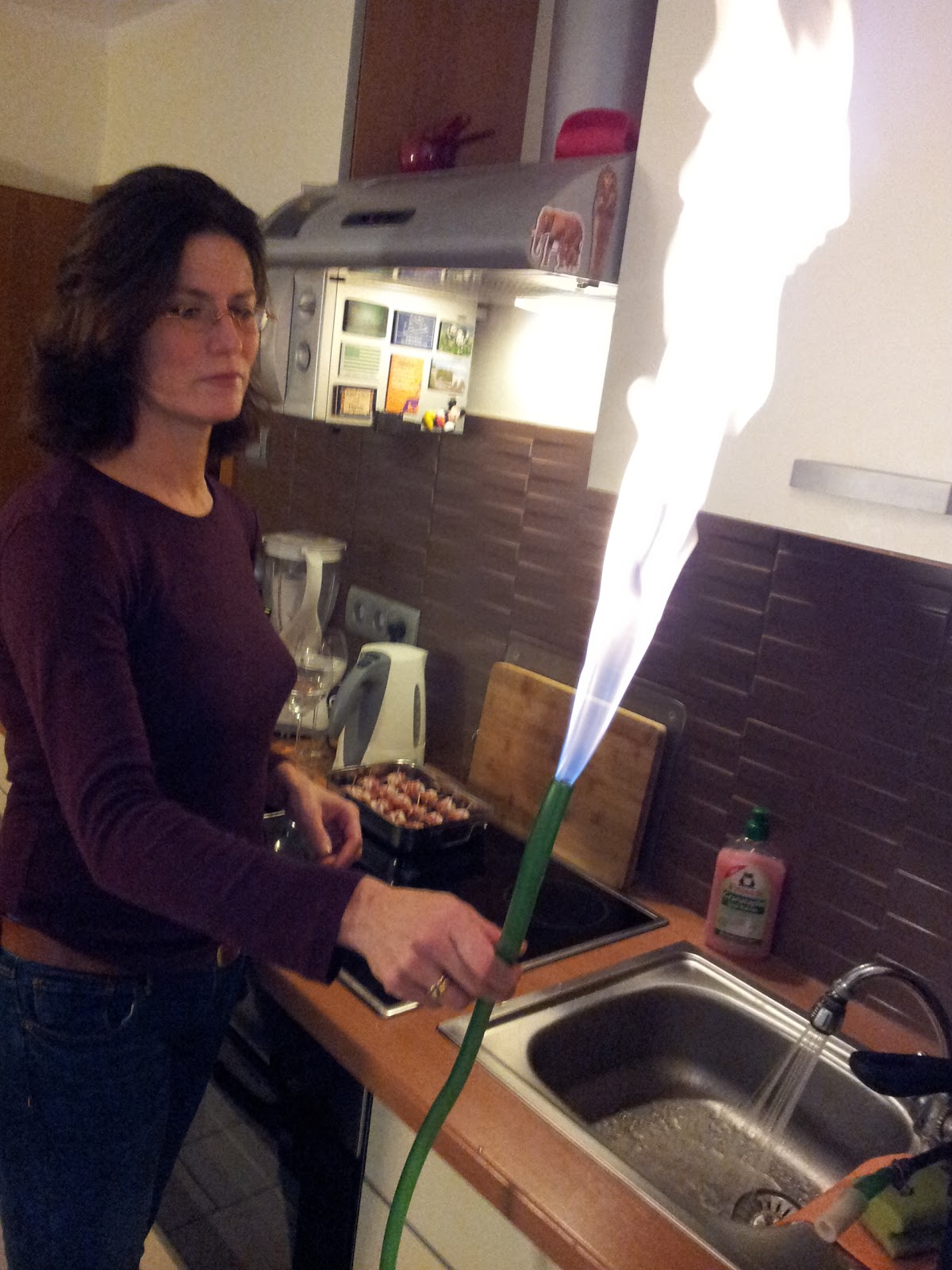
"And in the left corner, ladies and gentleman, uninvited methane flaming at a woman's sink in the middle of America from fracking (courtesy National Geographic). And in the right corner, ladies and gents, very happily desired methane flaming at a woman's sink in the middle of Germany -- from a kitchen garbage-via- Insinkerator fed biogas digester on our porch. courtesy of my wife Sybille Fruetel Culhane. Compare and contrast ... who will be the winner of the sustainability contest? Place your bets now!

This month the picture on the left -- of a woman igniting methane in her kitchen somewhere in the US -- appeared in National Geographic magazine.  Today, Christmas day 2012, (in what is apparently still a "world without end" -- sorry prophecy fans!)  I took this picture of my wife igniting methane in our kitchen in Germany.  The former represents a problem, the latter a solution. The former shows flames from a fossil gas  reserve, obtained by poisonous chemical fracking, the latter shows flames from a biological gas reserve on our porch, obtained by grinding our food waste with our Insinkerator in the kitchen sink and sending it to our biodigestor on the porch via a sump pump. The former is fuel with no future, the latter is fuel with no end, in a world without end, sustainability harvested, amen.

The question is, when will a major magazine or news outlet start showing images like the one from our kitchen with the  positive, wholesome message we small-scale biogas practitioners are sharing around the world about how methane can help us preserve our environments and civilizations? 

Why isn't the news getting out that women and children everywhere can immediately be spared the scourge of indoor air pollution and the world spared the scourges caused by deforestation, charcoal, oil and fossil based un-natural gas? Who among you is willing, this holiday season, to pick up this cross with me and bear witness to the miracle of microbial synergy that transforms all waste into rebirth and renewal and the possibility of a better life for all?
 To be fair, a great article on our work did come out a couple of years ago in Popular Science magazine


 and though the piece focused on work we were doing with biogas at an arts school  in the Mukuru slum of Nairobi, Kenya, the editor devoted his entire editorial to our concept of using the Insinkerator and other in-sink food waste grinders to turn kitchen scraps and plate scrapings into biogas, lauding the wonderful solution that we all have available to us for turning a problem (smelly garbage) into a solution (clean fuel and fertilizer). 
 But so far no magazine, newspaper or news show has done anything on what we at Solar CITIES feel is the real answer to this whole fracking/drilling/pipline debate: homescale and community scale biogas from kitchen, cafeteria, restaurant, grocery store and vegetable and meat market and slaughterhouse wastes. 
Grind it all up, put it in a tank that had some toilet wastes (humanure or animal manure)  introduced to it and keep the tank between 20 and 35 degrees C and it will make abundant clean methane every day, come rain or come shine, storm or calm, no matter the weather,  winter spring summer and fall. Keep feeding it ALL our organic wastes and it will keep making gas long after the cows come home.  Forever.  World without end. Amen.

 My wife and I cook on our home made biogas every day.  It comes from our two porch biodigesters which work all year round because they are heated by our bath and shower and dishwashing water.  Both digesters are made of recycled IBC tanks but the one on the right is a thousand liter IBC with 4 cm of styrofoam insulation around it held in place by black stretch wrap plastic (black so it will heat up the greenhouse in the sun) surrounded by the inexpensive (~ 250 euro) polycarbonate greenhouse panels, while the one on the left is a 700 liter IBC tank sitting in a 1000 liter IBC tank that had its top cut off.  The space between the 1000 liter tank and the 700 liter tank is filled with water that is connected to the solar hot water heater in the foreground. Then the 1000 liter tank is surrounded by 4 cm of styrofoam held in place by black stretch wrap (you know the kind they wrap luggage in at the airport, only black so it will get hot in the sun and thus help contain the heat inside the tanks since heat goes to cold and not vice versa).

 One of the digesters (on the right) is in a greenhouse, as I mentioned, the other (on the left) gets some of its  heat from the hand-made solar hot water panel in the center (decorated with the yellow National Geographic rectangle colors). 


The solar hot water heater is just an old radiator painted black in an insulated wooden box with a plate of glass on it.  It has a 12V water pump behind it that runs off of the 50 watt solar electric panel lying on the solar hot water heater. There is a thermostat in the box that turns on the pump whenever the heat gets to 40 C or higher and turns off when it drops below that. This pump circulates hot water to the 'water jacket' tank on the left.  But both the greenhouse digester and the water jacket digester get their primary heat from hot water feeding -- i.e., whenever we use our Insinkerator to grind up the kitchen waste that is our primary feedstock we use hot water while we are grinding, which is pumped with the ground up food scraps into the tanks.  They are also heated by our bath and shower and dishwasher hot water (yes, you can put soapy hot water into your biodigesters because the soaps, as long as they aren't specifically anti-bacterial, become additional food for the microbes in your digester, being made of glycerol and fatty acids and phosphates, all good food for microbes once they have done their cleaning work in the sink or bath). 

All of our nice warm greywater goes into the biodigester tanks which are filled with plastic bioblocks to ensure that the bacteria can form good biofilms throughout the tanks, at all the depths and temperatures and feedstock concentrations,  and so that they and the food particles don't get washed out every time we load the digesters with a hundred liters or so of  hot bath water.

We have a vacuum tube heat-pipe solar hot water system on our roof for our baths and dishwasher and clothes washer (it gets up past boiling on sunny days because vacuum tubes are so efficient, and even works on cloudy days) but though our bath water heat is "free" we feel it is a waste to stand under the shower and let that great hot water pass over our head and body for mere seconds before washing down the drain.  So much heat and energy investment lost -- until you hook it up to your biodigester and realize that the longer the shower you take the warmer you are making your biogas system bacteria. And that makes them HAPPY (while taking long hot showers or baths makes us happy, so it is a win win)!

 So we really have two solar hot water systems -- one for us domestically and the other our little hand made one to keep the water jacket warm on sunny days and help the bacteria along.


   Behind the yellow hand made solar hot water heater is the gas holder, made from a 300 liter garbage can upside down in a 500 liter rain water barrel with some pvc tubes around it to keep the gas holder from falling when it is full. Because the 300 liter barrel is taller than the 500 liter barrel it sits in (which is filled with water) we can't get all the gas out.  We lose 100 liters of dead space when the tank is "empty" so we are really only working with 200 liters of usable biogas a day.  That isn't so bad -- it still gives us more than a half hour of cooking gas every day from the previous days garbage, but if we were to start all over we'd try to find tanks of matching size (that isn't easy in Germany!) and we'd make them larger to store more gas (it is theoretically possible for a family of four to six people  to generate a cubic meter of biogas from their food and toilet wastes every day, which would give the use values indicated in the following picture:


Chinese Biogas manual from Knowledge Publications.com showing what can be done with 1 cubic meter (1000 liters) of biogas.
 Those values are the following:


1 cubic meter of biogas is equal to:

Illumination equaling that of a 60-100 watt bulb for 6 hours.
5.2 kg of CCl4 (Carbon tetrachloride)
0.7 kg petrol
can run a 1 horse-power motor for 2 hours
can generate 1.25 k electricity
can drive a 3-tonne lorry 2.8 km
can cook 3 meals for a family of 5-6


 On the coldest days this December, when the outside temp got below freezing, the hot water feeding from our grey water  kept things going.  Here you see the temp in the water jacket in the left tank.  The outside air was about 2 C and the bottom of the water jacket was 11.1 C while the water at the  top was 16.4 C. That's not all that bad considering things had dropped below freezing over night and the biogas bacteria keep working (albeit more slowly) at 15 C.

 The greenhouse biodigester did a bit better.  The water in there stayed over 20 C (and the air temp surrounding the greenhouse, though there was no sun, was near 3 C).


 Between the two digestors we keep getting our daily flame, day after day, year after year (our digestors have been running reliably for almost 4 years now!):


 So we can cook no matter what energy crises the rest of the world is experiencing. And if we need to we can use the methane we make to in turn make electricity by piping it into the carburetor of our 4 stroke generator.


 Biogas is a very safe fuel, which is why my wife feels confident holding the gas pipe and igniting it in the kitchen as we set up a picture intended to echo the famous one in National Geographic showing the tragedy of gas leaking into people's kitchens through fracking.  In our case we are delighted to have free fuel which we make ourselves along with rich fertilizer from our garbage (the biodigester eliminates the need to compost).


 The gas comes into our kitchen at a pressure we determine by placing bricks on the gas holder (for cooking we don't need any bricks at all because the weight of the plastic barrel is enough to push the gas to the stove once you have removed the usual restrictor pin from the stove).  "Brickage" is useful for running an electric generator on the gas, or a gas space heater, but isn't necessary for either the stove or the Dometic gas refrigerator we have, which uses a very small flame.


The fire produced by biogas is clean, odorless, blue and hot, even though it contains about 30 percent CO2 and 70% methane. The CO2 reduces the flashpoint and makes it safer to work with. There are trace amounts of Hydrogen Sulfide which we don't bother to filter out when we aren't using the generator (when we do, we simply put steel wool in the tube for the sulfur to interact with so it doesn't eat at the engine).  But we like having some H2S in the gas to give it that distinctive gas odor that would let us know if we left the gas on unlit.  Once ignited it has no odor at all.  Here my wife is cooking bacon covered dates today for our Christmas meal. There's nothing like cooking on gas -- clean, hot, delicious!


  When the picture below of the woman with the flaming sink first appeared in National Geographic it made the rounds in all of our facebook groups with the query: "What's wrong with this picture?".  The intent was to stimulate a debate about the merits and demerits of the world push to replace oil and coal with natural gas and to call attention to the severe environmental and social/health costs of chemical 'fracking'.   When the picture appeared on our Facebook Biogas Group "Solar CITIES Biogas Innoventors and Practitioners", I wrote the following response:
  " What's wrong with this picture? 
"  I'm going to express a very unpopular opinion here and get myself in trouble -- what I think is really wrong with this picture is that the woman isn't capturing a "free" source of relatively clean energy that is coming right out of her faucet. This image and ones like it are being used, in my opinion, to distract us from the real dangerous sources and uses of energy and their extraction. Methane is the most benign of our fossil fuels and once the infrastructure has been put in place, swtiching us from liquid petroleum products to gaseous ones, it will be easy to switch to biogas or hydrogen/biogas blends. Until that happens - until infrastructure and public awareness of the benefits of gaseous fuels in general and methane and hydrogen in particular -- are well in place we will continue to do unimaginable damage through the extraction, transport, refining and use of petroleum, coal and uranium. If I were this woman I'd be smiling from here to thursday, and would quickly hook up my faucet to a gas storage bag or an ARTI style floating tank.

 I would hook my faucet up to my own biogas digestor. Methane is lighter than air and outgasses from water. I would collect the water and pass it through a filter and drink it or cook with it -- once the methane has outgassed it is fine -- it is the same as using swamp or pond water, which has lots of methane bubbles dissolving in it, and filtering it. 

The only problem with fracking, in my opinion, is that the greedy profiteers are unregulated and irresponsible and use toxic chemicals to get the methane out. These heavier hydrocarbons poison the water. They don't need to do this though -- they do it because it is cheaper. But those insidious chemicals don't show up in pictures like this -- they are invisible. And we don't discuss them enough as the real problem with fracking. 

We make it an "either or" issue, turning environmentally minded people against a rapid conversion to natural gas which paves the way for a biogas or hydrogen future. This is dangerous to me, more dangerous than a few contaminated wells. There may not be any easy way to get to clean coal, but there are easy ways to get to clean gas.

 What I'm not too keen about reading the nat geo piece this month is that it talks about methane, whether coming from the thermokarst lakes explored by our friend Katey Walter Anthony in Alaska and Siberia, or from fracking, as a controversial "problem" but doesn't talk about biogas as long term and quick to reach solution and the transitional nature of fossil natural gas to get there.

 It doesn't talk about our own work with Katey on those flaming lakes harnessing the psychrophilic bacteria to replace fossil fuels. So yes, it is a dramatic photograph, but when I see it I see the wonderful flame of methane and think only of how quickly we can bring down the net carbon load in the atmosphere and the poisons and wars and terrorist threats from petroleum, coal and uranium. Please feel free to take me on about this, and share the debate with everyone you know. I think we need to push for safe fracking, compensate families that have had their water suppllies contaminated, pay the full costs of cleanup, and continue extracting natural gas in safe ways while turning all wastes into the real natural gas -- biogas. So... that's what's wrong with this picture as far as I'm concerned."
 
 In contrast to those now finding unintended  methane appearing  in their kitchen sinks, we love having truly natural gas in our kitchen.  It is there every day, and always will be because as long as we are alive we will have garbage and toilet wastes.  And both of these can and should go in the biodigester, returning all the nutrients that were in our food back to the soil through the liquid fertilizer that results while enabling us to capture the useful truly natural gas that the microbes release as they make the nutrient rich fertilizer.
If making your own methane is so simple, how come I haven't heard of this before?
Some people will say that the reason this simple solution to the fracking problem and our domestic energy woes isn't better known is because there is some kind of conspiracy against the autonomy that DIY or decentralized energy solutions like this food-and-toilet-waste-to-fuel-and-fertilizer technology provides. 
 
  If such a conspiracy exists then we are all part of it, all complicit in keeping silent about the "low hanging fruit" of energy production that anybody can do at home. You know what they say: "if you aren't part of the solution, you're part of the problem"

If there is a bigger conspiracy than the usual evil but banal twins of ignorance and club convergence ("we just do what the neighbors do, and they don't do biogas at home, so why would we?") it probably isn't the fault of big business or government. It could be a "conspiracy of the middle men" who are, as ever,  resistant to any changes (see my previous post "Is big oil against the develoopment of small scale renewable energy systems?").
 

 We talked about this with oil company execs who were our friends and band-mates  in Egypt. They agreed with our logic: With home and community scale biogas and solar technologies in place  we can stop subsidizing gas and electricity for the poor and middle class (and certainly the upper class).  Private companies and governments can sell their  fossil holdings to the highest bidder on the international market. The amounts they have available for sale at the higher price increase dramatically, easing tensions about shortages or unrest that drive investors away.  Our proposal to them was that we use public funding and private grants to help groups like Solar CITIES do the simple training and building that lets every family have the security of the amount of gas their garbage can produce (about 2 hours per day).  For-profit entities can rest easy  knowing that all consumers will then be willing to pay top price ( in the case of the poor if and when they have money, but in any event enlarging the consumer base) for extra gas that they want for  luxury uses (cooking for big parties, taking long hot showers, running air conditioners and refrigerators and plasma TV screens etc.) The lions share of the gas can go to industry and business who have the money to pay full market prices but need never fear costly and destabilizing shortages again.
 Tiered pricing is already a reality and the top tiers are  where utilities make their real money, not from the poor. The subsidies that are in place around the world  to keep the poor from rioting are a net loss to society and to the companies. No oil company wants their pipelines bombed by people who are in a rage. And many executives and policy makers really do want to help make energy affordable for the masses. So  they and governments feel obliged to take losses to profits just to make sure that low income people are able to squeak by while unwittingly creating perverse disincentives for society to create higher efficiencies (see Jevon's Energy Efficiency Paradox for more on that!).
Our solution is a win win -- garbage produced methane won't enable factories or truck fleets to operate, and these are the areas where the big companies can always sell petroleum based fuels at top dollar. Biogas at our level just enables the "other 90%" to pursue a dignified and more secure life, and enables subsidy transfer or removal while enabling the poor and lower income/middle income people to eliminate the  grave public health problems produced by toilet and food wastes and while enabling them to have enough gas to get through the week and through disasters or crises when supply shortages are inevitable .

 So I think the problem -- the reason we aren't seeing more pictures like the ones from my home --  isn't interference from  the big companies or  governments.  I think it is the ignorance and mythology that has infected  the rest of us. We, ourselves,  are actually the ones keeping these solutions from wider acceptance through belief in our own conspiracy theories and the  inadvertant fear mongering and laziness they create.
 Once we accept our own responsibilities for sharing the good news -- this new gospel of this very old natural technology, we can truly sing with John Lennon "So this is Christmas, and look what we've done, another year over and a new one just begun... have a very merry Christmas, and a happy new year; let's hope its a good one... without any fear..."
 War is over... if you want it!
God bless us, everyone. Merry Christmas.   


Thursday, November 1, 2012

Is 'big oil' against the development of small scale renewable energy systems?


 This being election time in the Unites States,  I was complaining to my social media friends  that any candidate who is primarily sponsored by companies whose profits come from the extraction and sale of fossil fuels would not be likely to create a business environment favorable to those of us in the decentralized energy/renewable energy sector.  I went so far as to suggest that an administration backed by big oil would have a negative effect on small scale producers of clean energy.

A friend of mine who works with oil companies in Africa wrote me the following response on facebook recently,

"...to believe that "big oil" even cares the least little about you starting up a new business in bio-gas or any other energy is pretty inflated thinking as I see it.  Unless you think that you are going to have access to at least $500 million in venture capital funding for your start-up, I guarantee you that no one in "big oil" will give a damn, until you get large enough to show a profit of at least $50MM per year and do so for a couple of years.  Further, at that point, they will then just want to buy you out. I have seen several very large, multi-million dollar bio-gas projects in the USA recently and they are not being shut down, in the least. Big oil does not hate competition, it just wants to be sure that there is a way for them to buy into the game, once someone shows that it is viable."
 I can't disagree with those statements when it comes to large multi-million dollar bio-gas projects.

Big dollar companies tend to work things out, B2B, with other other big dollar companies.

 But I was talking about small scale biogas, about home scale biogas. I was speaking of encouragement for truly small businesses, not the multi million dollar businesses which one of the candidates may continue to  call "small business" but which most of us who earn under 250,000 dollars a year would never recognize as fitting the definition of small.  I'm speaking about E.F. Schumacher style "small is beautiful" small businesses.

But even there, if we are talking about the well educated heads of these big corporations, I can't really disagree with the 'no need to worry' scenario.

My friend and his company work on big and small enviro tech contracts in Chad and Libya with big oil companies like Esso and have been successful in getting them to work on win win solutions for waste management that now involve composting/arable land restoration and wetland restoration. In future I'm quite confident they will be successful in getting their oil company partners and African government partners to enable their company to do significant waste-to-biogas transformation work that will benefit Chad and her multinational partners.
 
 I don't doubt this for a second. The business plan will allow the big players to buy into the game once it has been shown to be  viable. Biogas will become just another part of the energy portfolio of companies and this is a good thing.

 Similarly my friends in Big Oil in Egypt (whose business heads and engineers I used to  meet when some of us played together in a rock/country band in the Sinai and in Cairo) were of course never threatened by the do it yourself solar and biogas work we were doing in the slums and informal areas of Cairo. They applauded it and probably could have been convinced to support it if we had stayed longer.

My friend is  right that the educated heads of fair playing companies are not involved in any conspiracy to squash little NGOs doing cute work to help the desperately poor.  We have faced no resistance  doing household biogas in areas of great need where most well off people really would prefer not to go anyway.

We field workers are the in the trenches folks that do the social outreach work that gives sponsoring companies a warm and fuzzy feeling.  And as I mentioned, big oil, as far as I an see, has  no issue with BIG installations in Germany or the US or elsewhere; when there is profit to be made they are usually partners and eventually will buy out any serious competition.

The problem is that what current policy and business practice will NOT do is create favorable conditions for disaggregated, decentralized, distributed generation solutions to our problems.

 Leadership by people involved with big oil or big government or big corporations seem to have an active aversion to models that do not allow for easy conglomeration, mergers, acquisition and ultimately command and control.  This is the essence of being big and getting bigger.  Centralization is the logic of power.  It is why we rightly fear empires and fear the systems that socialism and communism seem to inevitably create,  and it is why we created the American Capitalist system as a foundation for our experiment in a civilization that fosters freedom and allows for all people to have a shot at  life, liberty and the pursuit of happiness.

The point of good governance in America was always merely to bust the inevitable formation of monopoly power which is the natural tendency of wealth -- that is the paradox of the capitalist free market system; one of its famous contradictions. Capitalism  needs steerage to prevent it from its own excesses. We love capitalism because it provides a better path to freedom given that human nature has never shown itself capable of real socialist or communist behavior in the 'good' sense of those much maligned terms. No socialist or communist experiment has ever succeeded, so we vilify these terms which now describe only the failed attempts which caused so much misery.

Capitalism succeeds by accepting human nature as it is, but its success requires constant oversight.

 All systems tend to corruption in time because of cronyism, tribalism, in-group and out-group isms, but socialism and communism go bad quicker. Capitalism can reinvent itself in a million ways and stay vibrant if we observe the principles of fair play, open access, constantly relevelled playing fields and competition.

Small biogas systems in developing countries are no competition at all, they are mere relief systems for people dying from the inefficiencies of poorly thought out technologies and resource strategies. Both governments and corporations will support these little efforts without worry.

Big biogas systems in developed countries are part of evolving energy portfolios. Where they run into trouble is in the resource access area -- each garbage mafia has their own claim to waste material and tipping fees for landfills, trucking fees and other rents make change difficult. It is actually the littler players in these fields that impede broader big scale biogas penetration -- people want to protect jobs and profits and their territories, and these are not the big companies who could actually care less if the landfill shuts down or the garbage workers have fewer runs to make and need to lay off workers.

But what it appears big corporations will not easily tolerate are small businesses that could be potential game changers in the very nature of how energy is created and delivered.

And usually it is not the heads of these companies, who have diverse portfolios of investment anyway, and would change their strategy at the next whiff of profit ("screw oil as our commodity", says BP, relabeled 'Beyond Petroleum', "now lets corner the biogas market or solar market, or sell metered transactions or whatever can pull in profits"). The problem is usually middle management, folks in the hierarchy still clawing their way up the ladder.  These people, living in a state of constant anxiety,  usually have the ability to say 'no' to anything that will affect their promised path to the good life of Reilly. They are the gate keepers prohibiting real change.

The truly wealthy, the real 'big' guys,  are pretty immune to the effects of game changers; they actually get excited by the new game.

But their underlings want to keep systems rigid on the chance that they can join the ranks of the super wealthy and then relax and even perchance become generous -- once they are secure at the top of the pecking order.

So my observation is that when we talk about "big oil"  blocking progress in renewable energy and stymieing small business and start-ups from creating and effectively deploying solutions to climate change we aren't really talking about the wealthiest 1%.  And thus we keep targeting the wrong area and wonder why we aren't seeing the change we desire. My observation is that when we find our efforts to expand the use of decentralized, distributed generation of power from waste materials and forms of solar energy that are available to everybody somehow meeting resistance and getting blocked , we are dealing with folks in medium power  positions reacting with fear.

I have a friend, for example, who is trying to start a home biogas company, building backyard digestors that are simple and low cost and turn kitchen wastes into clean energy and fertilizer.  His business model is similar to that of another friend of mine in Kenya, but where the latter is succeeding and getting a lot of support,  local politics in the US has gotten in the way of his growth. The permit givers became with-holders. The gate keepers shut him down through all sorts of ridiculous hurdles and disincentives and discouragements.

 It wasn't the big oil players who shut down home biogas this round, it was the little politicians and regulators.  The problem is that these middleware folks take their marching orders from their perception of what big oil wants. Or what they are afraid they don't want.  Often they really don't know because they are in the pecking order on a needs to know basis.

Because of the nature of hierarchical  systems  they don't really get to sit in on the deeper more philosophical board meeting discussions and strategic planning meetings that concern long term futures. Ironically we academics and foundation people and service company leaders like my friend in Africa and even some or us in the NGO world often have more access to top business and government leaders than people working in those systems.

The middle men get in the middle and muck things up.  They feel they have struggled to get in line and get on what they hope will a reliable conveyor belt to the big time, and they are going to fight tooth and nail to preserve the status quo as they understand it.  But make no mistake -- they aren't big oil.  They aren't big anything. They may work for big companies but they are really just the cogs and wheels in a vast machine that even their superiors would like to find a way to change.  The problem is that there are just too many vested interests, and until all the key joints in this ungainly system are lubricated and feel they can be reconfigured without threat, they aren't going to favor innovation. Certainly not if involves systemic change that derails their conveyor to the top.

 Because of these realities I think it is urgent that we have political leadership that sends the SIGNAL to the gate keepers at various levels that it is perfectly okay and even desired to change the nature of the game.

We need presidents of both countries and companies to tell the world, the nation and all employees that we want to play  by the original fair rules of the free market and that we mean it this time.

We need to say "all energy options are on the table, no negative externalities or cheating allowed, you can't spew your toxins into the public commons, you have to pay all clean up and remediation costs yourselves, you have to allow free enterprise at all levels, no collusion, no back room deals, no turning the other way and allowing people to suffer so you can get richer. "

With the rules of fair play clear (as in 'main street and wall street have to play by the same rules' and 'pollution can no longer be your path to profit' and 'full cost accounting -- no un-costed residuals of production') middleware folks will see that the only way to stay on the conveyor is to adopt the new game and abandon the old one, because the conveyor will have clearly changed direction.

When I was at the Energy Round Table in Aspen with business and government and military leaders during the Shell Oil Spill (Shell was there too, along with EPA director Lisa Jackson) we heard from the corporations about the desperate need for clear signals of where policy was going to take us.

 They said, "if Washington would definitively say what it was going to do in terms of carbon trading, we would be able to make projections based on that and we'd all be happy. But you leave us in an uncertain landscape and that uncertainty makes planning impossible. Of course we resist changes in this environment. Signal to us and make clear that spills and exhausts and carbon and millirads of radiation and whatever will cost this much or that much, and that subsidies will be increased or reduced by this much or that much, and fines will cost this or that much, and Pigouvian taxes this or that much and we will respond. "

The business leaders told us "We don't want to damage our environment, but we have to compete with other countries that are playing by different rules and we are stuck. Make international agreements, get cooperation and tell us where the energy landscape is going and business will respond. Right now the waters are too murky."

And why are they murky? In large part because people and groups in the middle are mucking things up until they can be guaranteed what they feel is there share of the spoils. So they are spoilers of game changes they aren't really privvy too and both top level and bottom level game changers they don't have access to.

 Former Senator Paul Simon and I talked a couple of times in Syria when he was there promoting his book "Tapped Out: The coming water crisis" and I showed him a model but functioning regenerative unitary fuel cell. He said, "I wish more young people like you who know something about technology and its implications would come to us in Washington. All we get are these lobbyists clamoring for their piece of the pie. If you want change you have to come to us and get your ideas in the mix too."

 He told me that the lobbyists frequently had their own agendas and the implication was that often they don't even do a good job of representing the industries they supposedly are lobbying for. A lot of folks are just lobbying for themselves, and that may be why American companies have been so often sideswiped by leaner, faster competitors, like the Japanese auto industry and the Korean steel industry and other more modernized, cleaner, more efficient producers.

 I remember reading the vision of the young Ford -- our generation's Ford, not his ancestor -- speaking of his vision for the company making the best and most efficient cars. But he wasn't allowed to run his company toward that end. Similarly, GM spent billions on the best electric cars on the market and were defeated not because corporate leadership didn't want it or government didn't want it but because of the disruptive impact on all the parts suppliers, the gas station owning companies, and other middle ground players. Lobbyists thinking they are being loyal to their corporate heads but never really understanding the dynamics of Schumpeter's Creative Destruction (perhaps willfully because they are worried they'll get destroyed) make deals with mid-level politicians in Congress or the Senate and they all tie the hands of presidents -- both the President of the United States and the presidents of our best companies. 

 The heads of oil companies, I maintain, aren't worried about a new world of decentralized energy. They will adapt. They  will make money regardless. They will, as my friend says, buy up battery factories, charging stations, local component manufacturers... at that level it is all a game. They aren't threatened. But the status quo is.

The status quo is created through a perception of how stable the fortunes of the upper middle class and the lower upper class are and will be within a given set of rules.  Only government can state the rules in such a way that every business must comply. That is why we pool our resources and make governments, otherwise the tendency is always for big fish to get bigger and bigger and swallow up the small fry.  This stifles innovation and progress. So we build appropriately sized governments to take down the biggest most rapacious fish and reintroduce lean competitiveness to the system. You want small government, you gotta downsize big business. Then they will be on par.  As long as we have ungainly big businesses filled with middleware that is poorly connected the the thriving heartbeat of innovation, we need counter-weights in government, checks and balances to a system that on both sides has grown to powerful. We are in quite a fix, but we can untangle this if we understand where the worries are and acknowledge the fears of folks in insecure but promising positions on the conveyor belt who unfortunately can control some of the valves and pumps feeding the heart.

  For small biogas to thrive, and for any small scale renewables to thrive, said the leaders at the Aspen Energy Forum, we not only need clear signals for planning to assuage the fears of people trying to plan in an uncertain market, we also need to reconceive energy using the information technology business model.

They called for ET to be like IT (energy tech like info tech).

 One of my contributions was to champion the role of bricoleurs, tinkerers in energy production, using my early experience as a Ham Radio operator (KC6MBN is my handle) to inform energy -- i.e. we buy parts and assemble energy systems at home or at the community level; everything is modular and plug and play.

This was also the vision of the leaders at the HVAC and energy conference hosted by Irene Stillings  at the California Center for Sustainable Energy in San Diego -- they said, "we need to appliancize all renewable energy -- the same way you buy a toaster or a refrigerator or a dish washer, you should be able to buy off the shelf energy components for your home -- solar panels for electricity and heated water and air, biogas digestors, heat pumps, efficient heat exchangers, wind mills, whatever. Everything should be a module you buy and plug into the house."

And this was Amory Lovin's path that he spoke about when I met him, his hypercar concept where the car itself produces energy for the house and vice versa is part of this new modularity with consumer goods taking on the role of dis-aggregate energy production.

So the visions are out there, at the top levels, at the bottom levels... Somewhere in between things get lost. I attribute that to an environment of fear and suspicion among the ranks of the middle men. We aren't getting clear signals from the top and the upper middle is wallowing in worry.  And they are blocking.

That is where we need strong leadership -- a vision clearly expressed that signals to people in the middle "its gonna be okay; we are going to phase out fossil fuel combustion as rapidly as possible but we are going to give you support for all of your creative ideas to replace them. And please note, my fellow Americans -- phasing out combustion doesn't mean we are going to throw you out of work. We have oil and coal and fossil gas in America and we will use them, we just aren't going to burn them. We will use them in Fuel Cells like the hydrocarbon transforming Franklin fuel cell which emits nothing but water and CO2 which can be recaptured and used for biological plant growth. We can turn them into graphite and carbon nanotubes and build up a better infrastructure of roads and bridges and materials and rockets and automobiles. Carbon is an essential building block -- too  important to let go up in smoke. We will research nuclear fusion and deploy fission and fusion in space exploration and space mining, but we won't need it here on earth where it can damage cell organelles. We will transform all wastes into new materials and into clean energy. No meaningful jobs will be lost, no sustainable profits will be lost. We are in this together and we all want the same things : prosperity, equality, a healthy environment for our children and the chance to pursue our own happiness. "

" All options to make that dream a reality will be on the table and we will be your public servants in upholding the laws that protect our citizens and guarantee your rights."

 That is the speech I'm waiting to hear from somebody... anybody. And it is for that vision that I cast my vote.

Saturday, October 13, 2012

Using inexpensive 2 pin Infra-red transmitters and receivers with Arduino

Solar CITIES is moving into environmental sensing training in developing countries and impoverished areas in developed countries.  That means besides teaching folks how to build their own biogas and solar and other renewable energy and water and waste systems, we are increasingly going to integrate training in... environmental robotics.

We realize that, as Paul McCartney famously sang, "you used to say live and let live, you know you did, you know you did; but in this ever changing world in which we live in, makes you give it a cry... say live and let die!" And we don't like that (though we love the song and the movie; as long as it is fiction...)

There is talk about the "47%" by one candidate and the "30%" by his vice-candidate, and it isn't nice talk.  There are promises being made  of 12 million new jobs in 4 years by the pair of them, but it isn't realistic talk. The fact is that the micro-controller revolution is enabling artificial intelligence to be embedded in everything.  Computer programs and robotic machines will replace most jobs.  That isn't a bad thing, since most jobs leave much to be desired, and many are degrading for any sentient being. But it does create a problem for people whose skills are being outsourced not just to other countries but now to other beings. Non-human beings. Non-biological beings. AI empowered, environmental sensing machines.

At Solar CITIES we embrace new technologies. But we want to make sure that everybody gets a fair shot at learning how to creatively work with these new technologies and these new silicon based beings so that nobody from the carbon based life form camp is left behind who doesn't want to be.

  Environmental technologies, including solar, biogas, wind and other energy technologies, and various water and waste management and food production technologies, are being automated. That is a wonderful development which should increase their effectiveness and cut down on their costs so they can be deployed everywhere.  And the key to improving both our technologies and our  environments is good environmental sensing.

We and our robots need to be better aware of our surroundings, and everybody who wants to needs to be able to design, build, install, troubleshoot and repair environmental sensing and manipulation technologies that can make their environment better.

Enter the Arduino

Since the release of the open source Arduino micro-controller and Integrated Development Environment (IDE, the software to control the micro-controller) embedded computing, sensing and robotics have suddenly become understandable and affordable for everyone.  An Arduino Uno controller, used now with various sensors around the world to monitor temperature, pH,  pressure, proximity of objects, light levels, colors and a host of other parameters that once demanded dedicated expensive equipment, costs only $30. The software is FREE. Tutorials on how to use it are also free, with a huge and generous open source community posting every day.

The other vital piece of the puzzle is using inexpensive sensors.  And the fact is that their cost is coming down all the time.

Basic Environmental Sensing 101

Most larger organisms on this planet use light as their principle means of interacting with their environment. Some use light and heat, but heat is often detected as a form of light (longer wavelengths in the electromagnetic spectrum than the ones we call "visible light") so it amounts to almost the same thing.

There are other ways of detecting one's surroundings -- hearing is another, depending on pressure waves (i.e. sound waves), and we all know that bats and cetaceans (dolphins, whales, porpoises) use sonar as does the Navy.

Then there is touch, and taste and smell (the latter two involving chemical gradients).

Now we are equipping our machines and our devices and all of our systems with different variations of these 5 senses so that they can become aware of their environments and report to us data about our changing world as well as control actuators that can change the environment (think of turning on heaters or cooling systems, blowers, pumps, irrigation systems, nutrient loading systems, cleaning systems etc.).

The simplest system to start with, to get involved in environmental sensing technology we believe is to start with light.  With simple eyes.  And the least expensive of those is probably the Infra-Red emitter and receiver.
One sends out a beam of invisible infra-red light, which bounces off an object and reflects back to be picked up by the other one, a receiver.  This is the sonar that bats and dolphins do, and you can do it too, for very little money.

The simplest IR sensor: A pair of 2 pin IR diodes

In this post I would like to give you an introduction to the idea of using very low cost Infra-red sensors to measure distance or detect objects or avoid collisions.  Generally people tend to spend between 10 and 20 dollars for Infrared range finders like the excellent Sharp IR range finder series (I'm experimenting with the Sharp 2D120X for close range detection; it goes from 4 to 30 cm).  But even that can really add up if you are trying to detect objects from many angles or are using many of them.

A cheaper alternative is to use simple  IR components, i.e. a simple IR transmitter and a simple IR receiver.  You can find many tutorials on this; the problem is that most demand the use of a 3 pin receiver, and in some areas (like where we live) the local stores don't always carry them.

Here is a great tutorial,  for example,  from Garage lab on setting up a simple IR transceiver with arduino that uses a 3 pin receiver:  http://garagelab.com/profiles/blogs/tutorial-arduino-ir-sender-and-receiver

You'll find a lot of these as you hunt around. The problem is that you don't find much about using the really inexpensive  two pin infrared  receivers that we find in most places.

Because of this lack of information I thought I would post something quick here to help those struggling with this.

What we are experimenting with now is using the IR transceiver 2 pin pair sold at Conrad Electronics.
We are using an LPT 80 A Receiver for 98 cents, and a IRL 80 A Transmitter for 85 cents. These are both two pin IR diodes.

Here is a picture of a basic test design to see the signal in the serial monitor:


This is a very simple set up: The IRL 80 A IR sender (glowing blue at bottom right) has its long lead connected to arduino 5, the short lead to ground. Behind it is the LPT 80 A IR receiver (hard to see because clear) with its long lead connected to 5V and short lead connected to both A1 on Arduino and to a 10 K resistor that goes to ground. The closer the sender and receiver are, given that we made the sender shorter than the receiver so they don't block, the better they work, but this is hard on a bread board. Better to make a little pcb and snug them right up to each other. 

 The schematic we used came from the generosity of Robotronics, reproduced below:


The code is very basic to read the changing signal on the serial monitor.

// Pin 13 has an LED connected on most Arduino boards.
int led = 12;
int IRSled = 5;
int IRRled = A1;
int val;

// the setup routine runs once when you press reset:
void setup() {

Serial.begin(9600);
// initialize the digital pin as an output.
pinMode(led, OUTPUT);
pinMode(IRSled, OUTPUT); //IRS is InfraRedSender
pinMode(IRRled, INPUT); // initialize the infrared receiver
}

// the loop routine runs over and over again forever:
void loop() {

digitalWrite(led, LOW); // turn the LED off  (HIGH is the voltage level)
digitalWrite(IRSled, HIGH);

analogRead(IRRled);

val = analogRead(IRRled);
 if (val <= 300) digitalWrite(led, HIGH);

Serial.print(val);
Serial.print(" ");
Serial.println();
delay(10);
}

If you want to see this set up in action giving a robotic car the ability to avoid objects, check out Spark-fun's ProtoSnap MiniBot kit ($79) which is basically a tiny arduino with a usb converter board and a motor controller board using similar two pin IR transceiver pairs for collision detection.  It turns whenever it encounters an object on either side of it, as if it had eyes on the side of its head like an ungulate.

Here is mine:

The bottom line is that if we are going to be able to preserve our environment in a cost effective way, we need to enlist the help of environmental sensing technologies.  The idea of giving our homes, farms, gardens, offices, and in fact every object or location we value their own five senses -- eyes, ears, noses, tongues, fingers and sensitive skin -- is not at all far fetched.  The idea that we can all learn how to create and work with environmental sensing robotics is not far fetched either.

We hope you will join us in making a world where robots don't replace humans but give us all the chance for a more dignified meaningful, fun and healthy, sustainable life.

Look for more introductions to the world of environmental sensing technologies that you can build yourself here in our Solar CITIES blog and in our workshops!


..........
For more on environmental sensing robots check out this BBC Future article on a hybrid electronic-organic robot  that uses "cyberplasm" for sensing water pollution:

http://www.bbc.com/future/story/20121010-sink-or-swim-for-biohybrid-robot

Friday, July 20, 2012

Uniting the Avengers: More synergistic possibilities for Google Science Fair finailists to come together to save the world...

It's that time of the year again. Tomorrow morning I fly from  Dusseldorf to San Francisco to be a judge in the annual Google Science Fair, where we will be honoring the work of 15 extraordinary young people from around the world and rewarding one of them with a coveted $50,000 award.

Last month I had the honor of helping judge the Scientific American Science in Action award finalists, another set of 15 young people who dedicated their research and efforts and budding scientific acumen toward finding solutions to challenging environmental, health and social problems.

We ultimately selected two very deserving  14 year old boys from Swaziland, Africa, who came up with a scalable yet inexpensive hydroponics system for their homeland, and these two boys are also entrants in the general Google Science Fair.

During the judging process I wrote a blog post about a fantasy I had for finding a way to reward all these great young people so they could continue to work together to "save the world". In effect I wanted to explore the idea of creating a kind of "Marvel Team-Up" uniting these internationally dispersed kids into a kind of "youth Avengers" whose special talents and projects could be put together synergistically to create a whole much greater than the sum of its parts.

I described my own ideas for how each Science in Action kid's project could fit like a puzzle piece into a holistic "best practice model."

Now I would like to take the opportunity before flying to meet the Google Science Fair finalists to do the same thing with their projects -- a possible "neural network" for synergy, a first stab at finding some connections that could lead to positive unintended consequences.

How they might fit together:

I start my journey of connections on the far right side of this "map of the Google Science Fair finalists".

Raghavendra Ramachanderan, 17, has discovered a way to win energy back from spent fuel through the process of "Visible Light Deoxygenation".  The idea is that, for example, a liquid fuel like hexane (a hydrocarbon) can be oxidized through burning or through a fuel cell to create work or electricity, and then the spent fuel reconstituted through catalyst mediated exposure to sunlight.  We can describe this as a kind of "solar reforming" of burned fuel.  By carrying the process out on glucose and turning it into hexane, Raghavendra demonstrated the possibility of taking this radical process for energy conservation further.  His conclusion, " The success of this experiment will show that fuel can be used repeatedly, since converting used fuel to fuel again using sunlight, behaves like a system where sunlight is trapped into molecules of fuel, which is released upon burning them."

So Raghavendra is working on solving our energy problem, helping ensure that we never run out of fuel, even when the oil runs out.

 Meanwhile, nearbye,  Rohit Fenn, 16, has re-visited a technology that hasn't changed much since it was designed over 300 years ago: the flush toilet, invented by John Harrington in 1596.  Rohit lamented the fact that in much of India today not only is sanitation poor and power lacking but clean water is scarce, so simply flushing an average of 72 liters of drinking quality water  per day per household could be considered criminally irresponsible.

He also noted that many of the urban and rural poor can't even begin to consider upgrading from disease carrying pit latrines to hygienic toilets because the water resources simply don't exist. Either the water itself is unavailable or the electric power needed to pump it is lacking.

His solution: to invent a  simple foot-pedal powered vacuum pump design that any plumber could build out of local materials and get the same efficiency per flush using only half the water.


Luckily, Raghavendra and Rohit live in the same city so theoretically  they could get together, but in an urban agglomeration as large as Bangalore, with over 8.5 million citizens,  it is unlikely they would ever meet. Fortunately they will meet this weekend at Googleplex in Moutain View California half a world away, and have the chance to bring their solutions together for all of us.


It makes sense: if, for example,  we built a demonstration eco-home as a best practice model and installed Rohit's new toilet design, we would radically reduce our water consumption.  But we would still need energy to pump the water to the holding tank so we could flush. And that is where Raghavendra's invention comes in.

Many households throughout the world (and certainly in India where electric infrastructure is spotty or lacking or subject to interruptions) rely on a gas or diesel generator for either primary or backup electricity.  But fuel is expensive. And when the fuel is all used up, not only do their lights go out, but taps run dry and the toilets don't flush. 

 I experienced this difficulty in the Guatemala City slum of Meskital when staying with a Maya Quiche friend -- there was a city wide blackout that lasted in this impoverished neighborhood for an entire week.  With 8 people staying in the same tiny apartment and only one small bathroom things got difficult needless to say.  Since I was staying on the top floor near the unfinished roof (where I was installing a 400 Watt Air403 Wind generator as a gift to the family) I solved my own problem by getting two paint buckets, filling one with leaf and grass clippings snipped from weeds along the road and using the other as a composting toilet that I only had to empty into a ditch in a vacant lot once a week.  The others weren't yet adapted to this solution so they had the hardship of walking to a public toilet.  The home bathroom, which was useless and backed up and smelling, had to be simply locked until the electricity was restored a week later. 


Having gone through this experience I can immediately see how Raghavendra and Rohit's innovations could help in situations like this.  With only half the water needed for toilets a one time pumping event could fill the roof tank and it would last twice as long.  Meanwhile, the spent fuel from the generator (assuming it was collected appropriately) could be recycled using a catalyst in sunlight back into fuel -- or, probably more realistically, glucose containing food wastes could be sunlight reformed into liquid fuels like hexane for combustion in the generator.


So this is an example of synergies in science and action with just the first two finalists. It will be great to observe them meeting and interacting.

 But let's continue our journey across the map.

Moving north to Lucknow, India, we meet Sumit Singh, 14, who created a system for "Verticle Multi-Level Farming to Increase Crop Yields - An Affordable and Feasible Design".  Sumit is familiar to readers of our blog because his project was also a finalist in the Scientific American Science in Action award, and is now up for consideration in the Google Science Fair too.
Using Google Sketchup and a brilliant application of vector geometry in the virtual world and then building a real-world prototype from common bamboo and mud bricks, Sumit made it possible to radically improve food crop yields in constrained spaces such as rooftop gardens.  He demonstrated the proper horizontal and vertical spacing to make maximum use of the sunlight available and realized a design that would use gravity to use limited quantities of water most efficiently.

When I think back to my week in the Meskital slums of Guatemala putting up the wind-mill generator, I wish we had Sumit's solution for rooftop agriculture.  I can envision, in our best-practice model eco-home, having Sumit's Verticle Multi-Level urban farming solution on the roof beneath a 2000 liter water storage tank. Using fuel created from waste starch using Raghavendra's solar catalysed deoxygenation reaction, we would pump water to fill the tank and recharge batteries for electric lights. The water would then flow down through drip irrigation into Sumit's agricultural platform towers.  Then it would make its way down pipes to a toilet tank in the home above Rohit's super low-flush vacuum toilet and on its way to an underground biodigester that would in turn produce cooking fuel for the kitchen and fertilizer for Sumit's rooftop garden design. A truly closed recycling system!


But we need a way to make the small scale agriculture even more efficient and cost-effective -- and applicable to villagers in the most remote and poorest areas too.  


So we continue our journey westward to find Sakhiwe Shongwe, 14, and Bonkhe Mahlalela, 14, from Swaziland in southern Africa.  Sakhiwe and Bonkhe will also be familiar to readers of our blog; like Sumit they were finalists in the Science in Action award, and, in fact they were the award winners.
They won their $50,000 prize for their project, "Unique Simplified Hydroponic Methods; Can The Method be Adapted for Poor Swazi Subsistence Farmers?".

Their innovative idea was to  develop "a Unique Simplified Hydroponic Methods (USHM) (which concentrates on using available village waste materials) that will allow poor Swazi subsistence farmers to grow their crops and vegetables in very large quantities within limited space without using soil as growing medium." 

Take Sakhiwe and Bonkhe's soil-less growing medium, made essentially from trash, and combine it with Sumit's vertical growing platforms and you have a no till, water conservative farming solution for all seasons that even begins to address our urban and rural waste problems. 

Can't wait to see the friendships that develope there!

So let us continue our voyage:

We head almost due North as the migratory bird flies and reach the Ukraine where Alexey Kozlov, 13, and Milena Klimenko, 13, have created the "My Green City" project, focusing on the "study of the effects of vehicle exhaust gases upon the ecology of a large city in real life conditions".

Alexey and Milena and their team (including Mykyta Gordiyenko who was born 2.5 months too late to be officially registered in the group but who nontheless took all the measurements with his Google One Phone!) would contribute much more to our best practice eco-home than a mere awareness that fossil fuel burning cars, buses and trucks create air pollution.  Using GPS data and a program they created in the Python language, along with data display code they generated in JavaScript, CSS and HTML, they were able to take time and location tagged data using a pocket size Carbon Monoxide monitor  and put it up on an interactive Open Street Map that they made publically available.

What they have created should and would be an essential part of every community and neighborhood and would certainly be included in our eco-home.  They have implemented an ability to map out and localize exactly where toxins are accumulating in our immediate environment, correlating the levels of pollution with street intersections, sidewalk and parking lot design, and vegetation. Their work has great planning and policy implications and for our purposes gives us an ability to visualize what is going on in the community.  This is particularly important when it concerns problems caused by outside agents, because no matter how ecologically friendly we hope to make our own homes or communities, if people or practices (like idling trucks or buses) and contaminating where we live and threatening our children, all of our own attempts to provide a healthy environment can be in vain.

By giving us a way to map the spatial and temporal irregularities of pollution, Alexey and Milena and co. give us the chance to spot the trouble spots and take action.

And while we are on the subject of data display and its power to help us pinpoint issues that can then be targeted, every scientist knows that the right kind of graphical presentation can make a world of difference in figuring out how to solve complex problems.  Hans Rosling has shown with "gapminder" that the way we visualize the world's data has profound implications for our ability to affect the health and wealth of nations.

So for our eco-home demonstration synergy we  need  team members who can help us create an inexpensive way to visualize spatial information such as that produced by Alexey and Milena, and a way to transmit building and construction  information for doing the kind of hydroponics that Sakhiwe and Bonkhe and Sumit have innovated, and the type of toilet that Rohit has designed.

Wouldn't it be easier if we could walk through an interactive 3D model before trying to build anything in the real world?  Raghavendra, we remember,  has  himself created a brilliant molecular model animation of the novel deoxygenation process he is working on -- what if we could see all of this in real 3D!?

This is what Melvin Zammit, 18, from Kirkop, Malta brings to the table.  He has created a working prototype of an LED based 3D system that relies on the principle of persistence of vision (POV) and spinning layers of light  to create a floating 3D image projection  that can be walked around, requiring no glasses. It can  eventually can be developed to create "realistic volumetric displays".

Once the stuff of science fiction, Melvin's invention suggests a near future in which visitors to our eco-home can discuss how to build environmetnal technologies or view the results of mapped pollution monitoring in real time and as if in real life. And because the LEDs can be programmed to simulate almost anything, Melvin's contribution would enable us to make certain invisible processes, such as those going on inside the body or in the worlds of microbiology and nanotechnology, to finally be visible to everybody.

Speaking of the invisible world of microbiology, over in Spain, three enterprising students who could definitely benefit from Melvin's technology  have embarked on a study that has implications not just for how we see the nano-world in a drop of water, but how we measure the health and cleanliness of water.  Just as our Ukrainian friends have been helping us visualize air pollution in Kiev through a publically available OpenStreetMap project, Ivan Hervias Rodriguez 17, Marcos Ochoa 16 and Sergio Pascual 15, from Logrono on the Iberian peninsula, are mapping out "The Hidden Life of Water" and publishing their findings (photographic, video, text and graphs)  in an on-line database. So far they have created and cataloged over 50,000 pictures and movies, giving a first hand look at the invisible world within water.

What is most important about their work from our point of view is what it means to our ability to determine whether water is clean or not and what we should do about it.  The students came up with four water type classifications:  Level I: clean water; Level II: water slightly contaminated; Level III: water that is moderately contaminated and Level IV: water that is heavily contaminated. They not only mapped these types of water regionally, using standard measurements of key parameters for contamination (pH, conductivity, temperature, BOD (biological oxygen demand), and presence of nitrites and nitrates and ions of calcium, but then correlated these water types with the consortia of microorganisms found there.

What is emerging is a sense of what a "healthy" ecology for clean water is.  Normally we tend to think that "the only good water is dead water".  All sources of water are suspected of containing pathogens and the way we treat it is to sterilize it, "disinfecting" it of all living beings whether they are beneficial or not.  We boil it, pour toxic chlorine into it, expose it to UV radiation of dose it with ozone, all in attempt to kill whatever might be there, and we also filter it to keep even the tiniest organism out of what we drink and wash with.  All of these measures to kill "La Vida Oculta de Agua" are expensive, time and energy intensive, and many create ancillary health problems (such as the tri-halomethane carcinogens that result from an interaction between chlorine and organic matter in the water). 

But what if we could simply determine when "living water" -- water that still has microorganisms in it -- is healthy to drink? For many communities in developing countries that can't afford the chemicals or energy or systems to purify water and who are risking the terrible consequences of deforestation and indoor air pollution trying to fetch and use fuel to boil water, the ability to simply determine which water was safe to drink and which wasn't could save money, effort and lives.

And taking this idea further, what if it was possible to create a "probiotic" inoculant that would allow a natural water ecosystem to evolve that was self regulating and safe to drink and bathe in and cook with.  The John Todd Living Machine for water purification points in this direction as does the "Schmutzdecke slow sand filter" concept. But what we really need is some way to assay water sources to know how healthy they are, and identify remediations not necessarily based on killing whats in the water, but on replacing the "bad guys" with "good guys".

 With their database and diagnostic tools, these students from Spain make it possible to get to this point.  Eventually people should be able to ascertain quickly whether a water source is potable or not, or useful for cooking or bathing or washing.  People should be able to determine if the proper species composition for health and self regulation is possible, much as we use keystone species of macrofauna to determine the health of rain forests, coral reefs and savannah ecosystems.

You would never declare a forest or coral reef "clean" or "healthy" by applauding the ABSENCE of life forms, yet this is what we do with water.    Ivan, Sergio and Marcos work gives us a chance to look at water in a new way and finally see just who and what we are dealing with in there so we can better know which organisms to target for support or destruction. It permits a much more nuanced approach to water treatment and their expertise would make a nice fit for our eco-home demonstration -- they could look at the water being pumped into the rooftop tank and at everystep of its journey, from the hydroponic rooftop garden down to the sinks and showers and toilets and on to the biodigester and back up to the garden, determine where it could best contribute to the overall health of the system and where it could be tapped for human consumption.  With the proper technological enhancements, the residents could visualize what was going on in the water in 3D in front of them and easily respond when the ecology got out of balance, instead of bombarding their water with chemicals.

Then our ecohome would start concerning itself with how to heat the water -- whether for boiling or bathing, and how to supply electricity to the  water  pumps  and to lights when making fuel isn't practical or is undesirable. 

For that we turn to the work of Yassine Bouanane, 17 from Laval, Canada. 
Yassine has developed an innovative  low cost solar tracking mechanism based on the embedded computing power now available through the open source Arduino microcontroller platform.  It uses two servos to increase the electrical output of a photovoltaic panel by an incredible 36% meaning that, for example, a single 100 Watt panel that would normally produce perhaps 1/2 kWH during an average day could produce nearly .7 kWH during the same time, reducing the cost associated with "going solar", particularly for people who are low income (the cost of the Arduino and servos is considerably less than the cost of an 36 watt panel, for example). The same principle, with more robust hardware, could also be applied to solar thermal tracking for heating water.   Using servos connected basically to gimbles holding the solar panel, Yassine's code enables what has become essentially a "robotic solar panel" to do as the Beatles sing and "follow the sun".

In the true spirit of the open source community, Yassine has generously  created a website with his schematics and Arduino C code available for download for free so that anybody can replicate his work. He writes,  
"Optipan.com est un site internet ayant pour but d'aider des personnes vivant dans des régions pauvres ou éloignées et qui disposent de panneaux photovoltaïques en leur offrant un système qui permet d'orienter leurs panneaux photovoltaïques vers le soleil."
Translated into English this says,

"Optipan.com is an internet site having as its aim the goal of helping people living in poor regions or in remote locations who want to use solar panels by offering them a way of orienting the photovoltaics toward the sun".

Where many students are using similar Ardunio based robotics to create revolving turrets to track targets and shoot things, Yassine has turned his skills toward a more wholesome and important target -- shooting for a clean energy future for all.

His system would make a valuable  contribution to our eco-home demonstration and has implications not only for efficient photovoltaics but creating heliostats that can track the sun and concentrate it for water purification! Because even with a sophisticated understanding of the microbial treasures in water, we need to make sure that disease organisms do not infect the residents of our model eco-village, and concentrated sunlight is a great way to distill water and destroy germs.

But what happens when people do get sick?

It turns out that not far south from Yassine, another Google Science Fair finalist is also using low cost microcontroller circuits to solve problems.  Catherine Wong, 16, from Morristown USA, who was also a Science in Action finalist,  designed a cell-phone compatible, bluetooth enabled electrocardiograph (EKG) prototype that was capable of transmitting an EKG image over the cell phone network for remote examination. Her goal is to ensure that people experiencing poverty and often far from medical services can use their own already purchased phone technology to gather important data about their health and get it to professionals without incurring the costs and dangers of either docotor or patient having to travel.  Her dream is to make things that work for those of us the least well off and in her references she cites one of my most influential and favorite works, "Design for the other 90%":
Chau, R. (2006). Design for the other 90%: Internet Village Motoman network. Retrieved October 5, 2010, from Smithsonian Institution website: http://other90.cooperhewitt.org/‌Design/‌internet-village-motoman-network

With Catherine's technology and java program on-hand at our eco-home demonstration we can site our best practice model away from city services and medical services and feel much more secure that we have a place that is safe to raise our children and take care of our elderly and loved ones.

So with this team of youthful superhero avengers on our side we are moving rapidly toward a world where we can take care of most existential issues ourselves, with low cost devices that we can often build ourselves, and visualize our environmental and personal health data ourselves and  can telecommunicate with experts when necessary.

What we still need is a way to cut down on the costs of accessing experts, whether we are talking about doctors or environmental scientists or educators.  As Marx pointed out in the labor value theory of capitalism, it is the cost of labor that really makes the economy work; the problem is that the poor often remain poor because they can't afford quality expertise.  This is true for engineering and it is also true for education.

What is needed is a way to use inexpensive AI to help us advise, consult and teach.  And this is what Martin Schneider, 14 from Dresher USA and Joshua Li, 14 from Ambler USA are doing with thier "Can You Beat Bob?" project.

Martin and Joshua have captured the spirit of the age -- the Zeitgeist, if you will -- and are keenly aware that "educational video games have emerged as a new medium for teaching core concepts and supplementing existing curriculum".  What they bring to this emerging field is empirical evidence that a virtual competitor (who they named "Bob") could significantly increase the time fourth-graders in an elementary school engaged in productive math games.

With their help and their awareness that what they demonstrated through some rather good science can be applied to gaming that teaches science and history, we can go a step further in realizing what I've been calling "a sustainable development simulator" where people can turn their own homes and communities into sustainable development demonstrations by first "playing their way to success" in a gaming simulation and then taking the STEM skills they learn into the real world for application.

What often holds people back from reifying their desire to apply concept to the real world, however, is a feeling that they can't do it without an "expert" with them.  By having virtual experts available tirelessly at all times to guide and motivate people learning real life skills we radically increase the likelihood that they will be able to use what they learn in a gaming or educational situation in their own lives.

Now while we are on the topic of the benefits of applied artificial intelligence, we come to the work of Brittany Wenger, 17, moving south  from Martin and Joshua down to  Lakewood Ranch, USA.

In effect what Brittany is doing is creating and training that "medical expert"  that poor people and most of us couldn't afford to consult with for the early detection of Breast Cancer. Like Catherine, Brittany is keenly aware that the costs of health care exceed the ability of the afflicted to pay and with 1 out of every 8 women getting breast cancer urgent solutions are needed.  Personally motivated by the suffering cancer caused in her own family she dedicated herself to making diagnosis faster, less invasive and cheaper as well as more effective.

 In Brittany's experiments she developed a custom-crafted neural network in Java that could learn to recognize the difference between malignant and benign cancer samples obtained using a simple Fine Needle Aspirates (FNAs), the least invasive biopsy.  She writes, "

Artificial neural networks detect patterns too complex to be recognized by humans and can be applied to breast mass malignancy classification when evaluating Fine Needle Aspirates (FNAs).

By letting her "medical Bob" AI to do the prescreening, the need for doctors to do more invasive and expensive procedures can be diminished. And by opening up the learning to "the cloud" Brittany has been able to validate her approach with 7.6 million trials using existing dataset instances, showing the power of open-source data approaches and cloud computing to solve big problems. Unlike commercial products which lack certain capacities she says "the network has been published in the cloud, allowing for global submissions and benefit". And the benefits of opening things up to world are that her predictive success was 97.4% .  With more samples we  "may achieve perfection" she says and "maybe ready to diagnose actual patients."

Once again, with this tool as part of our toolkit, the best practice model for sustainable living gets a step closer to being realized -- using Yassine's solar tracker to help provide the necessary electricity for running a computer and internet satellite connection (we brought such equipment to the remotest part of Nepal in our recent "last mile technology" expedition with Alton Byers and Chris Rainier) people can now access an artificial diagnostic expert from anywhere and at low or no cost, and in this case the AI is capable of things no human expert could do.

As we continue west  on to Piano USA  in the middle of the United States, we meet Kimberley Yu, 16, and Phillip Yu, 14. This brother sister team has taken on the challenge of finding a cure to Frontotemporal dementia (FTD), a fatal neurodegenerative disease akin to Alzheimer's that afflicts a quarter of a million Americans but currently has no effective treatments.  Similar to Brittany, the Yu's passion for solving this problem comes from a sad personal experience - a devastating form of dementia affected their great grandfather in rural China.  So once again we have young people inspired to solve problems on behalf of "the other 90%" with solutions that can be applied anywhere.

The Yus have done ground breaking original research that has opened up new avenues of study and treatment by actually identifying which specific proteins (FUS)  and pathways (NF-kB)  lead to the chronic inflammation that results in frontotemporal dementia. With their discoveries targeted drugs and therapies can now be developed that goes right to the source of the problem and corrects it rather than having to rely on a shotgun approach that is expensive, time consuming, filled with dangers of side effects and ultimately perhaps useless.  In effect the Yus are creating a map for the pathways that lead to cellular abnormalities. 

With such a team on our team we have in our problem solving community a couple of people who as young siblings were "always curious about science" and now know how to take issues that look to the experts like they have no solution and then work with the right methodology and insight to put their finger on the answer.

Moving on to San Diego we come to Jonah Kohn,  14 whose project "Good Vibrations" "combines science and music to try to help people.  The goal of my device", he says, "is to improve the quality of life for people with hearing loss, especially severe hearing loss".  Using the concept of "multi-frequency tactile sound" which he learned about through bone conduction of his guitar strings via his teeth, he went on to investigate "what haven't reseraches done?" and realized that current work on frequency discrimination has focused on speech which has a limited range. Noting that though cochlear implants have "eight to twenty four channels" they "don't help as much with music because the frequencies tend to be different than for speech" he worked on a device that could use sensory information from the fingers to compensate for information the ears couldn't distinguish.  By dividing the sound spectrum into multiple frequency ranges and using vibrating speakers to apply those ranges through multiple contacts to a user's body, he was able to demonstrate that tone discrimination, pitch discrimination and volume hearing were all significantly improved  (36 to 52 % ) among cochlear implant subjects under the age of 50 (after which tactile sensitivity diminishes dramatically).  Interestingly, normal-range hearing subjects experienced almost no benefit from his device as the brain seems to ignore the redundant information coming in from other sensory organs.

As a musician I can attest to the importance of being able to perceive the richness of this artform in creating human well-being and couldn't imagine not being able to listen to music.  For our sustainable living team to have somebody on board like Jonah who thinks not just about the needs of the "other 90%" but of that percentage of people suffering the deprivation of this important sense -- hearing  -- gives us the chance for true equity and compassion for our fellows, a prerequisite for a sustainable civilization.  What is more, the ability to break physical phenomena like music down into constituent frequencies and then create devices that can help different brains reconstitute that data into a whole from different sensory pathways has important implications for whole-brain holistic learning and multiple intelligences and works nicely with the 3D data visualization of Melvin with his spinning LED layers  and the mapping of air pollutants by Alexey and Milena. They should find some great synergies discussing different forms of data visualization and how best to present information to our brains.

As we move up the coast to Los Gatos California we meet Sabera Talukder, 16, who was also  a finalist in the Google Science in Action contest.

Sabera's "low cost solution to clean drinking water", "Pani Purification" (Pani is Hindi for water) adds another piece to the puzzle for providing best practice infrastructure for our model sustainable home and community.  A Bengali-American teenager, she made a summer trip to her father's village in Bangladesh and came home determined to help solve the unfortunate water problems plaguing the people in the area.

While other girls her age were working on putting together the right accessories for their wardrobe, Sabera was working on putting together an effective solution to water contamination using Jute Bag and Copper Mesh fileters, solar battery powered UV lights and activated carbon.  Simple but effective solutions like painting tubing white to reflect the UV light and increase its efficiency were implemented.  Flow control  via pressure sensitive valves conserved energy so that she could use a very small and inexpensive PV panel to trickle charge a normal car battery and get effective results.

Sabera's attention to the details of how to create a system that locals could build out of ubiquitous and cheap materials rather than expensive imports makes her system a nice addition to the others cited above.  Her criteria should be in the handbook for every would-be engineer hoping to engage in development work:

The Criteria:
 The apparatus must be portable.
-It must be made of cheap materials.
-It must cost under 25$.
-It must be self sufficient.
-It must be durable.
-The materials must be locally available.
-It must be easy to fix if problems arise.
-It must be able to weather different climates.
-Local villagers must be able to maintain and operate it.
-It must be easy to deploy, and accessible for everyone.

 In addition to building and testing the prototype, she ran tests to prove the efficacy of the system, running separate and combined UVc and Activated Carbon treatments on known pathogens in the three major shape groups  like Rhodospirillum rubrum (spiral shaped) , Bacillus subtilis (rod shaped)  and Mircococcus luteus (sphere shaped).

With Sabera on our team we can much better protect the health of our families; combined with the know-how of Ivan, Marcos and Sergio we some powerful answers emerging   to the question "how can we ensure that everybody has safe clean water to drink and use and return to our environment?"

The final stop on our journey West takes us to Tigard USA where we meet Yamini Naidu, 17. 
Yamini's work synergizes nicely with that of Melvin and Raghavaendra.  Where Melvin creates floating 3D images through light interference patterns and Rhaghavendra used 3D animation to model the deoxygenation reaction driven by sunlight that he is studying, Yamini creaed a "homology model of a human receptor protein using a computer modeling program". The goal?
To go "from models to medications: identification of medication leads for treating methamphetamine addiction".

It is all fine and good for us to try to pool all the talent we find at the Google Science Fair to create a best practice model eutopia that can provide clean, abundant energy, food and water and eliminate our wastes, and that allows us to monitor our health in youth and old age, visualize data so that we can end environmental threats and disease threats and ensure that all people can enjoy the benefits of life and music and art and civilization and the company of loved ones until the end of our days. But if we truly are going to make a better world, we also have to use today's tools to solve yesterdays self-inflicted problems, often born out of a deep dissatisfaction with the status quo.

Drug addiction is a terrible social problem that we can hope living in a sustainable community that is back in touch with nature and guided with intelligence will prevent.  But what do we do with the millions of people who are already addicted? What about those who chose to drop out and now can't find their way back in?

Yamini's computational chemistry work toward a rational drug design approach helps us answer that question. She discovered two novel allosteric binding sites and "put her creativity to the test" to design novel chemical compounds (called YTN) to interact with those sites and displace METH. The TAAR1 receptor she has identified is also associated with Diabetes, Schizophrenia, Depression, Alzheimer's Disease and stroke, so there are promising synergies between Yamini and Kimberly and Philip Yu that we can anticipate. Meanwhile, her recognition of the potential for the TAAR1 to be used in the creation of a biosensor binding to toxic compound leading to "the devlopment of efficient methods to treat environmental pollution" that can be "done through in silico modeling analysis" gives her nice resonance with the environmental sensing work her fellow finalists are doing in the Ukraine and in Spain.

 One can also hear her discussing the possibility for virtual screening of 3D homology models related to the receptors she is studying with Brittany, exploring how computer programs can do the jobs that human experts once did, but with greater speed and accuracy, and talking to Martin and Joshua about developing computer games that, rather than addicting kids, help kids get off of real drug addictions by coming up with virtual solutions during "in silico" experimentation that can be applied "in vivo".

Motivated by the loss of her uncle due to a stroke, and recognizing that Meth users also suffer strokes, she is hopeful that her research will also help provide insight "in the treatment of strokes whose etiology is still unknown".  But when not engaged in her medical research, she trains in a form of  classical Indian dance, using this skill and art "to help the community by participating  in performances to help raise funds for various causes sponsored by local charitable and cultural organizations."

This desire to use art and music to help others creates a nice synergy with the goals of Jonah and indeed is a thread that binds all of these extraordinary young people, who are as multi-dimensional as one can imagine, reflecting not just good STEM education (Science Technology, Engineering and Math) but the right variant on what we call STEAM education (Science, Technology, Engineering ART and Math, or Science, Technology, Edutainment, Art and Music).

Yamini's personal statement seems to be applicable to all the contestants: "an aspiration to use science for the benefit of humanity, linking together... civic affairs with science innovation [with the] goal... to give back to the community because the community has given me so many oppportunities... asking not what your country can do for you, but what you can do for your country."

These are an incredible group of young people, and it will be fascinating to see how they interact and share ideas.

I can only hope that one day we, as a society, can provide more opportunities for these high caliber minds and hearts to come together and share their ideas and outlooks and ultimately put them into synergistic practice, creating an implementation space we can all turn to,  lighting a path for the rest of us to get out of the darkness of environmental destruction, poverty and disease.

We hear the song that reminds us to believe that "the children are our future".  Properly nurtured and supported and encouraged to work together, these children certainly are!