Solar Power isn't Feasible!

Solar Power isn't Feasible!
This cartoon was on the cover of the book "SolarGas" by David Hoye. It echoes the Sharp Solar slogan "Last time I checked nobody owned the sun!"

Tuesday, February 12, 2008

Ecological Rationality and the Probabilistic Revoltuion: Simple Heuristics that can make Us Smart

(Photo: Solar CITIES team leader Hana Fathy and colleague Adham Fawzy, a teacher at the Zabaleen school, sit in front of their recently completed "solar-hot-water-animal-shelter" system on Adham's roof. Behind them to the right is the previous goat shelter.)

(Photo: Solar CITIES team leader Hana Fathy, seeking shade beneath the animal shelter's solar roof, smiles as he tests the hot water from the SOLAR CITIES hybrid water/shelter system, which provides rooftop cold and hot water storage for giving water to the animals and for cleaning the enclosures of the goats, chickens, rabbits and ducks that live on this urban agriculture space, provides essential cool shading for the animals so they don't overheat or dehydrate, as well as providing domestic hot water for the household to bathe and shower and wash clothes in, and cold water storage to get through days when the city water supply is cut).

In "Simple Heuristics that Make Us Smart", Gerd Gigerenzer and Peter M. Todd talk about "the demise of the dream of certainty and the rise of a calculus of uncertainty" that precipated "the probabilistic revolution". Their book goes on to address a second revolution that can be considered an outgrowth or consequence of probability theory -- the notion of "bounded rationality" (which they call "ecological rationality -- rationality that is defined by its fit with reality") The proposition their book asks us to contemplate is that we replace "the image of an omniscient mind computing intricate probabilities and utilities with that of a bounded mind reaching into an adaptive toolbox filled with fast and frugal heuristics."

As I read the first chapter of their book I am reminded of my recent experience in the slums and informal areas of Cairo clambering onto rooftops with my Solar CITIES team and local stakeholders to see whether and where we can build solar hot water systems. I noticed that many people I work with are quickly overwhelmed by the number of variables the non-uniform environments in the "incremental housing sector" present, and that we need to develop decision makers who, to quote Gigerenzer and Todd, "are not paralyzed by the need for vast amounts of knowledge or extensive computational power".

Such decision makers, I believe, are made, not born. I believe this because in the emergent field of "guerilla solar" (informal installations of renewable energy systems by "non-experts") I have made myself into such a decision maker. Where others look at the complex roof topography of inner city Cairo's urban poor and get stymied, I see a landscape of unique opportunities. Often my small team will call me in to help them make the critical decision for them and will marvel at the confidence with which I make decisions for which there is no precedent. I often marvel at myself! When they ask me, "are you sure?" I will say, "absolutely not, but I've got a good hunch that this will work, and a better hunch that the risk is low, so I say let's give it a go!". Then I step back and wonder how I arrived at such a conclusion and am able to state my awareness of its UNCERTAINTY with a confidence and aplomb that makes others decide to go along with my suggestion!

I am realizing now that my broad experience and years of trial and error have given me my own sets of "fast and frugal heuristics" and a neat adaptive toolbox.

Of course we expect that of so-called "experts", and there is an assumption that my pending Ph.D. title and my educational history (Harvard, UCLA) give me leverage over uncertainty (the assumption being that I have considered many of the options in some kind of exhaustive search for competency and truth). But inside my head, exploring the mechanics of my heuristic toolkit, I am convinced that the way I make decisions can be just as well taught to neophytes so that they can overcome their paralysis is decision making for development initiatives that are unfamiliar.

I think we need such heuristics because there are very few true "experts" in the field of sustainable development, and those who do exist usually cost far too much for the local NGOs and poor communities who need them most. Even expert "volunteers" usually demand to be housed and fed in the more expensive areas outside the poverty stricken areas that need the most help, and cannot stay the amount of time that is truly necessary to get uncommon initiatives, such as community led (as opposed to institution led) renewable energy projects and integrated industrial ecology projects off the ground.

My experiences working on sustainable development projects in Indonesia, Latin America, Inner City Los Angeles and the Middle East/North Africa over the past 20 years tell me that we are going to have to resign ourselves to the fact that most of the people who will need to lead and run such projects will have to be people with very little experience and most likely little confidence in the outcome of what many in the community see as "exogenous" or "exotic" enterprises.

But should we be able to identify and codify some of the nuances of what Gigerenzer and Todd call (and title their book) "Simple Heuristics That Make Us Smart" we might be able to give enthusiastic local stakeholders a much better chance at making changes that stick and sustain.

An example is warranted here: We had promised Adham Fawzy, one of the Zabaleen recycling school's teachers, that we would build a solar hot water system on his roof to compensate him for all the effort and time he volunteered when we were developing our "do it yourself domestic hot water systems". The problem we faced when we got up on his roof to determine its suitability, was that the neighbor's wall cast a shadow on the lower half of the panels at the only location that received continuous sunlight during the required hours of 10 and 4. The question then became "is it worth the extra labor and investment to raise the panels and thus both the hot and cold water tanks an extra meter to get them into continuous sunlight, or should we abandon this roof and seek a better candidate?"

We could have asked Adham if his family's marginal willingness to pay for the convenience of solar hot water was equal to the cost of the extra materials and labor, but we had already determined that average WTP was less that 100 LE (20 dollars) for the community as a whole, and this would never cover what we needed.

An economic heuristic (the one most people tend to apply) would have led to abandonment of the project. In fact most development initiatives, for all the sophistication of their models, basically revolve around a simple economic heuristic -- let us say a "simplistic" economic heuristic -- that ignores long term costs and externalities. People simply figure "nobody is willing to pay for solar hot water in these communities, so the project is unsustainable and thus it will fail."

Another issue that plagued Adham's family's roof and made it an unlikely place for a solar installation was that it was filled with animals. Adham pointed to all the rabbits, ducks, chickens, and goats and said "the goats will undoubtedly climb up and jump on the solar panels, breaking the glass. So the system won't last."

Untroubled (for reason's I can't quite pin down) I suggested a different heuristic. I asked Adham's family what they used the roof for, that is, what the roof's real value was to the family. Adham's father came up and said "we get extra income from the animals and they are like an insurance policy for us" (this is a truth of many poor families in cities who migrated from the rural countryside, and hearkens back to Chayanov's theories of the peasant economy).

So I asked, "would it be an advantage to have a supply of running water on the roof, instead of having to carry water up from the ground floor, so you could nourish the animals conveniently, particularly in the hot summers?" He said, "yes, we worry the animals can die of thirst in the hot summer." I asked, "does the city often cut your water supply in the summer?" He replied, "yes, and it makes things very bad for us as well as the animals."
"So would a roof top cold water storage tank as well as supply be helpful to you"
The answer was affirmative.
Then the father smiled as if a light had gone on in his head. He said, pointing to the two 180x80cm solar hot water panels we had been trying to find a placement for, "I wonder ("ya rait") if we couldn't use these as the roof of an animal shelter. We could raise them up on a brick wall a meter off the ground so they could get full sun, and that wall would prevent the goats from jumping on them. At the same time, we could build a brick box to hold the water tanks and that could be both the back wall of the goat shelter and the inside could be a rabbit hutch."
Once he had articulated this integrated vision of "solar-hot-water-system-as-animal-shelter-and-watering-device" the rest of the assembled friends and family members began to offer ideas of support:
"In the summer, the solar collectors would not only keep the sun off the animals underneath, but would probably cool them too, because the heat would be transferred into the water instead of to the air beneath the collectors, right? Usually, when we make a tin roof over the animals it gives them shade but the whole area heats up. But if the heat is moving with the water up into the storage tank..."

The frugal heuristic that liberated the community and led to acceptance of the solar project (and willingness to invest in it and maintain/sustain it) was, "if there is an alternative use to which any new system can be put that is within the domain of experience of the local stakeholders and satisfied a culturally established need, make that link and then see how the new system can add value to what is already part of the incremental housing plan of the local people."

Emboldened by this and other successes in the Zabaleen community, we took our idea to a meeting of the local environmental NGOs and community members at the Aga Khan Trust for Culture in Darb El Ahmar, where the discussion centered on why the rooftop gardening projects had all failed. After two hours of very fruitful discussion, we started applying this simpler heuristic ("don't dwell on the multiple factors that led to failure, and what doesn't work; figure out instead how rooftop gardens can integrate with the real and perceived needs of the stakeholders, and how they might satisfy multiple needs if integrated with a larger ecological system". This is the "ecological rationality" approach championed by Gigerenzer and Todd -- "rationality that is defined by its fit with reality".

(Photo: Samiya and Sou'ad, members of the Darb Shuglan/Darb El Ahmar local environmental committee, Samiya's children and Solar CITIES coordinator Mahmoud Dardir observe the integrated solar hot water/rooftop gardening system -- a combined initiative between Solar CITIES and the AKTC environmental NGO that provides rooftop stored hot and cold water for domestic household use and urban agriculture at the same time.)


What most poor people don't want is some pie in the sky idea that appeals to would-be do-gooders trying to "fight global warming" and "beautify the slum" according to the needs and standards of the well-to-do. The reality we must fit into is that of the daily struggle to make ends meet in the ghetto, and to live with uncertainty every day. Hell, the probabilistic revolution doesn't need to take place among those who live with uncertainty -- they already have the fast and frugal heuristics they need to eke out a living in their marginal environment. If those heuristics lead them to reject pretty but economically unfeasible things such as solar panels and roof top gardens, then we must accept the compromise solutions their heuristic has provided, regardless of what our "sophisticated" calculations of the long term rationality of their practices might be. We can't judge people's behavior by our calculations of outcomes that might occur if they lived in OUR MODEL of the world. As Bardhan and Udry state in "Development Microeconomics" (p. 5)

"In view of the empirical anomalies and the internal contradictions of the model of the hyper-rational economic man, many economists follow Simon (1957) in assuming bounded rationality with full recognition of the costs of observation, communication, and computation. Others go beyond this and admit that economic agents' behaviour is sometimes difficult or impossible to rationalize in terms of any well-defined deductive model; they fall back upon inductive means of reasoning and learning. People are supposed to have working hypotheses about the problems they are dealing with, and it is assumed that in their learning process they constantly update and adapt. Whether this process ultimately converges to rationality depends, even in the favourable case of the same situation repeated sufficiently often, on the characteristics of the decision problem or the game... Development economics if full of examples of how apparently irrational behaviour may be successfully explained as an outcome of more complex exercises in rationality, particularly with deeper probes into the nature of the feasibility constraints or the preference patterns."

The authors also point out (p. 4) that when dealing with "choice under uncertainty" people "are more averse to losses than they are attracted to same-size gains". Such "loss-aversion" explains a lot of the reluctance of the poor to invest in "new" ideas.

Keeping these ideas in mind, what we concluded in our multi-stake-holder meeting was that if we were to COMBINE roof top gardening with roof top water storage and "simultaneous-solar-heating-and-sun-shelter" installations (provides cold and hot water all year round; keeps the roof cooler in the summer) and see it all as part of a gradual move toward energy/food/economic independence (combined with roof top biogas production following the Indian ARTI model for utilizing and creating compost with urban waste , with small scale wind energy and photovoltaic technology for disaster preparedness and insurance against rising energy and food costs), we could generate more ideas and greater acceptance and stakeholder commitment. We weren't trying any more to introduce rooftop gardens or solar energy. No. We were trying to help a community get on its feet and get sustainable "by any means necessary".

Where my confidence for making decisions these days in the face of uncertainty in Cairo comes from is that I DO NOT see myself as a proselytizer of solar energy or of earthy crunchy environmental stuff. I DO see myself as an overall solutions provider, and as somebody who no longer sees things as they are labelled, but as they can be utilized.

And this is an expertise that the Zabaleen and the local craftspeople of Cairo have in abundance. This is a trait that exists in most communities who are faced with survival under conditions of poverty. There is usually an abundance of "satisficers" and "optimizers" who do the best they can with what they have. They are already using fast and frugal simple heuristics that make them smart. What they often lack is merely the link. And since most development experts look at the technologies we bring in as "pre-purposed objects" instead of mere pieces to an evolving puzzle, I believe that many development initiatives fail.

Right now, according to my preliminary dissertation survey results, very few people in urban poverty in Cairo are going to demand "solar hot water" per se. They are adept at heating their water using the stove and have adjusted to the inconvenience and are unwilling to pay more than they are paying now (their own labor is in greater supply than their income, and is discounted on a daily level). While they almost all recognize the long term advantages of SHW, they cannot justify the expense. So an attempt to introduce unsubsidized solar energy to the slums WILL fail if that is what we say we want to deliver.

But if we are delivering a concept of integrated industrial ecology -- if we are introducing flexible, modular, changeable solution sets to a multiplicity of local concerns ("all this and world war too?!" to quote the album title) -- then we can build confidence in and familiarity with each new innovative idea, and impart this heuristic -- again, already available at the local level -- to the task of conceiving environmental technology endeavors.

The brilliant Mauro Cherubini at the EPFL in Switzerland challenged me to come up with ways of conducting lasting and impactful education for sustainable development (much in the way that the Cooper Hewitt Museum challenged designers to "design for the other 90%") and I haven't answered him yet because I'm still kicking the idea around. But this is one possible salvo that comes from reading the literature and combining it with my recent personal experiences in Cairo:

Design an educational program that forces us to conceive of multiple uses for every object, and to look for novel ways to put them together to solve other problems. Get garbage recyclers, survivors of poverty, craftspeople and artists to be participants in every development training team to share their unique perspectives. Have academics and students play video games like "Return to Mysterious Island" where the whole idea of the game is figuring out ways to combine and uncombine the objects you find on the island to solve problems. Most importantly for THIS GENERATION OF LEARNERS: Design a game in which you have to do the same sort of object-deconstruction-reconstruction-problem-solving exercises but in REAL (though virtually represented!) locations in the poverty stricken areas of the world using simulations of real objects and technologies and materials (see our "SOLAR CITIES ARG" for an example) and use digital earth technology to make such simulations available to a global connected group of "players"/"problem solvers"/"engineers"/"policy-makers"/"stakeholders" so they can combine their collective intelligence and get real solutions out there, even if they can't physically visit the locations or volunteer their time.

It may be that the simple heuristics we need to make us smart about sustainable development can be rapidly learned in such contexts of mutual respect and playful collaboration, and can lead to more rapid deployment of solution sets. The probabilistic revolution makes it foolish to say anything with any dream of certainty. But such an approach may, at the very least, turn out to be more probable than our previous approaches to development!

Monday, February 11, 2008

Africa: The Dark Continent?

A recent newspaper article states that the South African government knew they were going to experience shortfalls in electricity supply sometime around 2007. Now, at the beginning of 2008, the predicitions have come to roost: South Africa - often considered the most productive and stable of the African economies as well as the linchpin and yardstick for progress elsewhere in the beleagured continent - is in turmoil. The lights have gone out and power has repeatedly failed, making South Africa literally the darkest place on what was once called (usually for perjorative reasons) "TheDark Continent". The culprit is a practice known as "load levelling" - something utilities have to do to keep the grid from collapsing entirely: they must shut off supply to various areas on a rotating basis to keep demand in tune with supply. We did it in Los Angeles during the period of "Rolling Blackouts" at the end of the last century and beginning of the millenium (only later did we learn that the blackouts were mostly the result of Dick Cheney's Enron corporation selling California's cheaper electricity for a higher rate in other states!)

The results in South Africa are worse than what we experienced in California:With restaurants, shops and industries foundering for lack of electricity, inoperable fuel pumps and traffic lights stalling traffic, and city services crippled, South African commerce and tourism is grinding to a halt (not least of which because of the fear of rampant instability and safety threats in a country that already has a reputation for high rates of violent crime and a 26% (?) unemployment rate. Think of the Elizabeth Shue thriller "The Trigger Effect" set in Johannesburg...

But there may be a light at the end of the tunnel, figuratively and literally: The South African government has pledged to immediately subsidize the purchase and installation of solar hot water systems (since electric heating of water can consume a full third of the electricity needed for a household) and to start putting in photovoltaic electric systems. This is what we call "load shaving" -- removing some of the load on the electric power plants by replacing it with decentralized sources of energy -- solar energy is particularly well suited for load shaving because it shines most during the times when the most energy hungry appliances are used (air conditioners for example) and electricity is needed (daytime industrial production, daytime traffic and office lights etc), and the heat and light it provides for water and electricity can be thermally, chemically or gravitationally stored to offset demand during cloudy days and at night.

Perhaps the city of Cairo Egypt in North Africa, which has also predicted shortfalls of electricity in the next few years, can learn from its antipodal neighbor in the southern part of the continent, and start an agressive campaign to get renewable energy in place before the crisis hits. We at Solar CITIES, who are already building solar hot water systems in the inner city areas of Cairo and training local people in the arts and sciences of renewable energy, wouldn't mind at all getting a little "before the fact" assistance from the government and international donors. We often say we must learn from history, but as my professor Ed Soja (UCLA Urban Planning) might say, "that would privilege time over space". Let us now say "we must learn from current events, from what is happening here and now in another PLACE not too far away. And let us apply those lessons, to keep Africa from becoming "The Dark Continent".

Monday, December 3, 2007

Collective Intelligence, the Joy of Networking and how "The Random Walk" leads to

Please excuse the long-winded title; I just finished reading Voltaire's "Candide" twice for the third time (!) the -- the first time was in French Class at Dobbs Ferry High School as an independent study for our unsung hero history teacher, Jerry Hafner, who believed that self-directed study was more effective than state framework based curricula, and the second and third time was over the past few months doing a simultaneous reading in French and Arabic, in a dual language book I found in an obscure Cairo bookstore called "Madboulis" on Talat Harb street. And the thing about long-winded titles is that they were the norm during the 18th century, and I have fallen in love with the amount of information about a chapter they packed in.

My mentor at UCLA, Professor Susanna Hecht, was passionate about travelogues and literature from the age of discovery and enlightenment, and gave us the opportunity for a lot of self-directed study, particularly of utopian literature and the works of explorers -- the writings of everyone from Campanella ("City of the Sun" ) and Bacon ("A New Atlantis") to Defoe ("Robinson Crusoe", which I also recently read in Arabic in a recently re-published bi-lingual book from Madboulis, proving it still has international appeal) and Alexander von Humboldt, and her own personal favorite, Euclides da Cunha, whose 19th century prose about the lost edens of Amazonia she has recently translated in her latest book.

Such literary voyages into the minds and spaces occupied by great ideas of social and landscape tranformation in an age of wonder have an impact on the student, and ci could not remain unaffected. So forgive me if it colors my writing style!

What is more, in this new age of discovery and enlightenment, opened up by the world wide web, the dense writitng style of our forebears, who were true explorers, not armchair explorers,mind you, and wrote centuries before the advent o the tehcnologies that now make us all "windows explorers", is incredibly useful, and should make a comeback.

It is useful for us "windows explorers" because of the historically recent evolution of the AI hypo-organisms called "web-bots" or "search-bots" who spend their time indefatigably hunting and gathering in hyperspace. They are the true "windows explorers". The web bots slavishly devoted to their "Googling" search engine using masters, are connection freaks. In their digital DNA is a program that compels them to make associations and relentlessly look for patterns of recognition in the vast sea of information that would overload the human mind. The web-bots in Google are the virtual Zabaleen of the internet, scouring through the garbage and flotsam and jetsam of hundreds of millions of loquacious human beings and mining that mountain for useful combinations of materials.

So in my mind the web bots in the serach engines of today are in some ways the equivalents of the humble servants of the great explorers of yesteryear. They are the natives of cyberspace, helping the 21st century's neuromantic equivalents of Alexander von Humboldt and Bonpland. They are the servants you never read about, those hardy souls who led the way through caves and mountain passes and river fords, who carried and preserved all the specimens of plants and animals and human bones on tortuous jungle paths, who identified species new to European minds and translated encounters with "savages" into friendly cross-cultural conversations.

Given their programmed desire to help us make our discoveries, I try now to write deliberately for THEM. I try to write in a style that might alienate many readers grown up in an era of short "sound-bites" and watered-down, sensationalized headlines, yes. But I am doing it with a purpose.

I learned the style from a great journalist, my father, John Culhane, who, after years of winning prizes as a hard-copy writer for the Chicago Daily News, Newsweek, the New York Times Magazine and Reader's Digest, among so many other publications, became fascinated by the power of hypertext before there was an internet to put it in. My Dad wrote increasingly in a style that felt like "James Joyce's "stream of consciousness" meets the annotated bibliography". It all seemed to start when he gave a keynote speech to my high school rotary club called "Only Connect" with the message that we were all participants in "The Great Conversation" and all we had to do was connect the dots that people were leaving behind in their writings and discussions. In this way, he told us, humanity advances.

John Culhane was ahead of his time for many years until the world-wide web and hypertext suddenly became a user-friendly phenomenon. Now, as he writes his memoirs and puts them on the web, you see how you can unpack his densely imbricated thought streams and mine them for gems of insight to fit your own discoveries (singing "Hi Ho, Hi Ho" on your way back from the mine!)

Having come of age in the time of hypertext and web bots, I am deliberately writing in a more or less 18th - 19th century style (hybridized with the newly evolved style of John Culhane), a style packed with information which was necessary perhaps in an earlier age when printing was so expensive and labor-intensive, being hand-set type; the more you could pack in a small space the better.

I am, you see, deliberately writing for the search engines, not for the "everyman" or the "everyreader" , because my target audience are the windows explorers (and those "firefoxes" who are roaming the forests of information hunting down their word-prey) who are interested in helping construction a new "eu-topia". I am trying to find the time to hyperlink everything I write together so that a user's random walk through Google might serendipitously lead to a discovery useful FOR THEM, or at least a chance to lend their piece to the evolving puzzle of enlightenment in an age threatened by climate change, toxicity, radioactivity and disease.

This inchoate (and, I admit, sometimes "incoherent" :)) writing style is all about keywords and hyperlinks, and increasing the statistical likelihood that like-minds will stumble upon useful information contained here-in (I am also encouraged by re-reading the works of Buckminster Fuller, who, in a pre-hypertext age, also packed information into his works, using unusual concatenations and word play to trigger associations in the minds of readers sympathetic to his desire to engineer and better world through design revolutions. Only connect!)

The right key words might put a google searching world-changer in touch with a concept buried somewhere in my experiences that could lead to their next "Aha!" or "Eureka" moment. Since I don't believe that my own little inventions and innovations will be able to solve problems fast enough or well enough to get us through the nightmare of Global Warming and Social Upheaval on our collective horizon, I am making a bid for the power of collective intelligence to solve our global problems, and trying hard to play my tiny part. Perhaps something I say or write or do has a message for you. I don't know!

I do know, however, from following the work of my robotocist friends Nicolaus Correll, Jim Pugh and Chris Cianci at the EPFL in Switzerland, that Swarm Theory and investigations into the behavior of insects (which my Harvard professor E.O. Wilson got me excited about when I took his sociobiology class back in 1980!) are demonstrating the power of the "random walk" to produce efficient outcomes when coupled with the right search engine logic and the proper networks for interconnectivity.
The whole is greater than the sum of its parts.

And today, to finish my meandering story, was a kind of proof of the concept: A man from Guernsey, England who had spent time in Africa named Marcel Lenormand stumbled upon a post I wrote about our problems trying to build a solar tracker in Egypt and offered his help to find a solution. He then left a very encouraging comment on our latest post about our discoveries concerning do-it-yourself solar collectors using open plastic barrels and float valves. Clicking on his name in Google brought up a comment he had left for another organization, concerning his discovery of a revolutionary urban bio-gas solution created by the Appropriate Rural Technology Institute in India.

(Useful construction details found here).

What Marcel could never have known is that Solar CITIES has been in deep conversation with the Zabaleen garbage community in the ghettos of Cairo, searching for ways to turn the city's organic waste into biogas, and assessing the potential for an urban bio-gas revolution. We had been looking at rural solutions and attending conferences on biogas, but nobody had come up with a system appropriate for the densely crowded urban situation. And yet, thanks to a random walk following Marcel's comment threads on the web, we found the very solution we are looking for!


(These pigs beneath Romani's house in the urban poor community of Manshiyat Nasser's Zabaleen Christians could provide the gas they need to produce heat for cooking and bathing and for generating electricity, like in the Mel Gibson /Tina Turner movie "Mad Max: Beyond Thunderdome")

And that is how collective intelligence and random walks can affect development, if we all, like responsible ants, leave the right trail of where we have been and the ground we have covered. In this way, we fulfill Abraham Lincoln's message: "If we could first know where we have been, and wither we are tending, we would better know what to do, and how to go about it."

Sunday, December 2, 2007

Finally -- A Hand-Made Solar System Prototype that Really Works -- in Cairo Winters Too!

We did it: A do-it-yourself solar hot water prototype built from local and recycled materials that we can train others to replicate and mass produce!


This is the final version of our hand-made solar hot water systems for the Zabaleen community in Muqattam, Manshiyat Nasser (without the sytrofoam insulation on the hot water tank, showing how we wrapped a second 200 liter surfactant barrel (originally from Saudi Arabia, containing Sodium Lauryl Ether Sulfate, a.k.a. shampoo) with mylar (from the inside of potato chips bags and from sheets sold by street vendors at Attaba metro station), then bubble wrap (purchased at Moskee, near Attaba) then mylar. The final step was to build a 3 cm styrofoam box around the barrel, glued together with spray foam insulation.

This system heats up all 200 liters to at least 40 degrees on most winter days (except days of full cloud cover). The secret is in the placement of the float valve and the hot and cold water inlets and outlets. We place the Zahran floar valve 37 cm from the top of the tank and the hot water outlet (to the house) at 25 cm below the top (this allows the float valve to open and close as water is drained from the barrel, replacing it with the same amount of water from the blue cold water barrel top left).

Meanwhile, the hot water inlet to the panels is located 20 cm from the bottom of the tank, 10 cm above the cold water outlet to the panels (which is at 10 cm) . This is the Palestinian system we observed in Palestine, applied to our plastic barrel system.

The height of the brick column supporting the cold water barrel is 170 cm, and the height of the brick column supporting the hot water barrel is 115 cm, just above the top of the panels themselves.

The "secret" to our do-it-yourself solar hot water systems is our use of the Zahran Float Valve, created by Egyptian inventor Magdy Zahran, who has become a good friend.

Below you see the cold water tank, the hot water tank, then both tanks together:


T.H. Culhane had a hunch that toilet bowl flush float valves would enable the use of unsealed tanks in solar hot water systems and hunted around Cairo for one that could be used in a big tank. He stumbled upon a shop on Fagala street (Kamal Sediki Street) where all the plumbing suppliers are, and inquired of the shop keeper if he had any float valves suitable for a 200 liter tank. The man not only pulled the float valve (called a "Zahran Owama") off the shelf but asked T.H. if he would like to discuss his solar hot water project with the inventor himself, Magdy Zahran. He said, "he lives around the corner and I can call him."

Magdy Zahran took us to his factory and even brought us on Egyptian Satellite TV on a show called "The Missing Link" ("Al-Halaqa Mafquda") about local inventors to introduce our "Double Whammy" (Two Owama) Solar Hot water system using Zahran float valves and Zahran plastic input-output fittings, as shown here:

The use of these Zahran products is an innovation that enables us to radically cut costs and use relatively inexpensive and stable recycled plastic water barrels that are available all over the world, instead of using expensive steel tanks and expensive metal plumbing fixtures.

This is helping us bring costs down to a level the urban poor can afford.

Most families in our study area rely on water from a single standpipe at the entrance to their houses, and have few or no pipes running water to the rest of the house.


In our project we run three pipes -- a cold water supply pipe from the standpipe to the roof to fill the cold water barrel when there is water available, a cold water supply pipe to the bathrooms and kitchen in the house from a T where a pipe from the cold water barrel feeds into the bottom of the hot water barrel, and a hot water pipe from the top of the hot water barrel (that is to say, from the outlet 25 cm from the top of the barrel) to the house.

Needless to say, we put check valves on all our pipelines, to keep water from backflowing into the system. This adds to our costs but improves reliability (note that check valves can fail, so be sure and place them where they can be easily replaced).

This is what most families in our study area currently use to heat their bathing water (and they must store their water in numerous barrels and buckets as depicted). Our system gives them hassle free rooftop storage (200 liters cold, 200 liters hot) and provides adequate water pressure.


These are the kinds of bathrooms our beneficiaries currently have:

This is Talaat conducting our "hot water service and demand survey" for my UCLA Ph.D. Dissertation in Urban Planning, from which we determine who he beneficiaries of our US AID small infrastructure grant for solar roof construction:

Two of the children in the room, when initially asked what problems they had with hot water provision, said without prompting, "we learned in school that one day Egypt could be like Germany and use solar hot water systems, but we don't know when or how..."

Isn't that funny? "One day" a sunny land like Egypt will use solar energy like they do in cloudy, rainy Germany!? And here we are in the 11th hour at 5 minutes to midnight...

Fortunately this family will have a Solar CITIES hand made solar hot water system -- which they will help build -- by Christmas!


And here I am, blessed by having the chance to play Santa Claus to this Coptic Christian Zabaleen family:


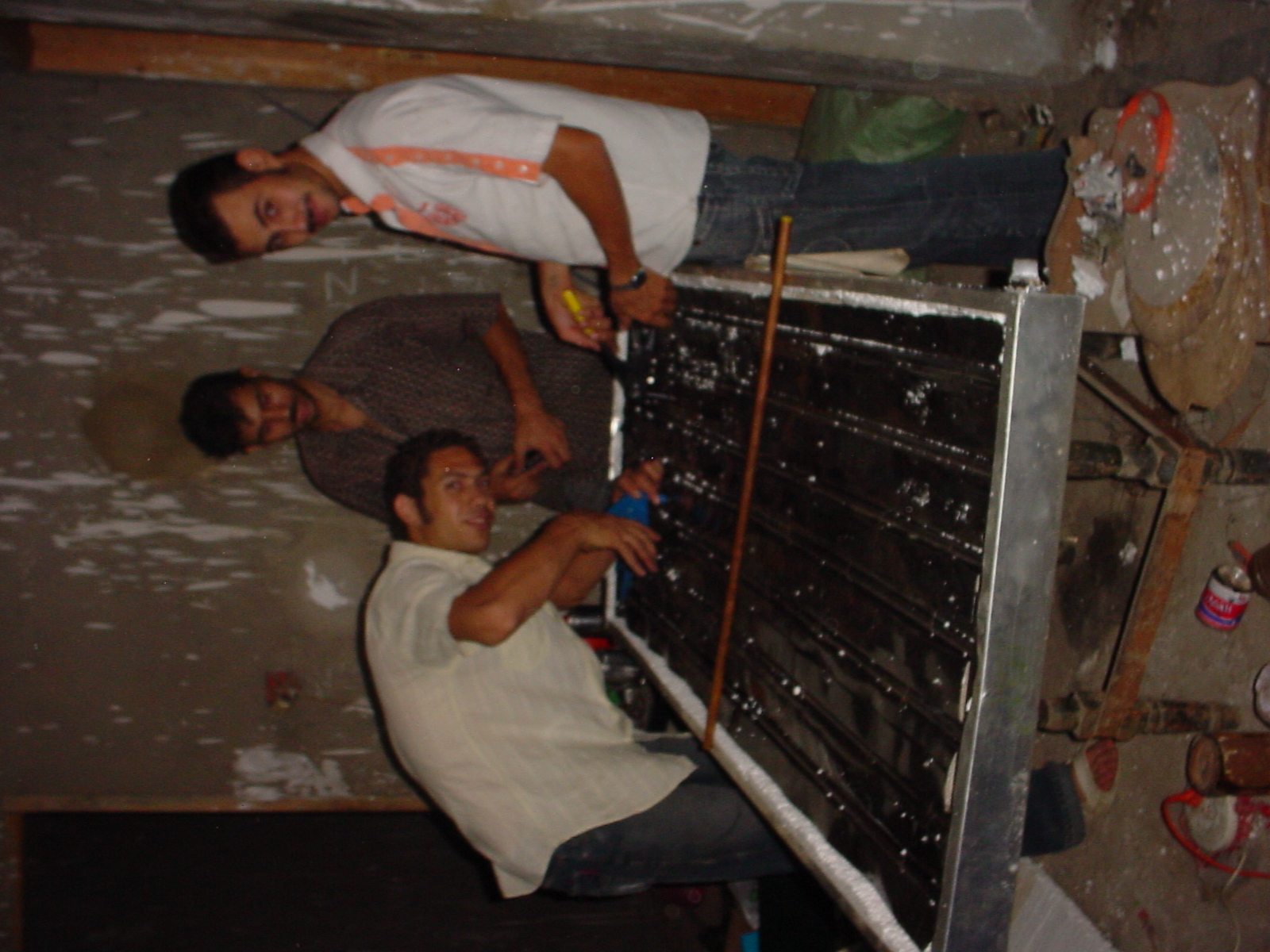
And finally, here are some pictures of Solar CITIES field coordinator Hanna Fathy and his brothers Ayman and Romani and friend Hani building the system that will go on their roof:


Saturday, December 1, 2007

In search of an all plastic solar hot water system for domestic hot water


"As Providence would have it", in a recent ichat with Andy Posner, between Essen, Germany and Providence, Rhode Island, talking about the potential for building a solar hot water system entirely out of plastic to grace the roofs of the Zabaleen plastic recyclers in the slums of Cairo, we stumbled upon this diagram from a paper by J. Razavia, M. R. RiaziCorresponding Author Contact Information, E-mail The Corresponding Author, b and M. Mahmoodia entitled "Rate of heat transfer in polypropylene tubes in solar water heaters" (Solar Energy Volume 74, Issue 6, June 2003, Pages 441-445). Razavi and Mahmoodi are doing their research in Tehran, Iran, while Mahmoodi collaborates from Kuwait, and they are proving that while the world is villifying Iranian energy scientists for pursuing nuclear power and Kuwaiti scientists for a monotheistic devotion to oil, some of the most innovative and hopeful work in renewable energy is being done in these two unlikely nations.

We at Solar CITIES want to applaud Razavi, Riazi and Mahmoodi, and thank them for providing yet another clue as to how we can improve our Zabaleen plastic systems.

We already proved we could use recycled 200 liter plastic surfactant barrels for both the cold water and hot water storage tanks in our systems, locally made Zahran plastic seals and fittings for tank connections and polypropylene pipes and fittings for all our plumbing work. And this past fall we proved we could make the boxes that house the absorber plates and copper pipes in our collectors out of recycled plastic shopping bags -- the same bags you see littering the streets of Cairo, jokingly called "the national bird of Egypt" because there are more of them flying around the few nature reserves than actual wild-life.

We found that the Egyptian Plastics Recycling company "PrimaPlast" purchases the bags that the Zabaleen gather, clean and shred, and melt them into panels 3 meters by 1.5 meters by 1 cm.


We purchase the panels directly from deputy chairman Rafik Nasralla at the factory in Madinat El-Badr, cut them up and make them into boxes and now we no longer have to use aluminum sheet (energy intensive and wasteful) or wood (in scarce supply in a desert country) for our boxes.

The next hurdle was to be "how do we replace the copper in the systems"? Copper is the most expensive part of our hand-made solar hot water systems, accounting for roughly 90 dollars per panel (180 dollars for a two panel system).

We were aware that solar pool heating systems use unglazed polypropylene, but thought that the polypropylene wouldn't perform well under glass and/or might not put out the kind of temperatures we need for DHW (domestic hot water). But we hadn't tried it, preferring to wait until the community accepted our systems before trying out another dubious innovation.

Gene Lin, our infrastructure engineering colleague at US AID who helped us get the $25,000 grant we are using to build over 30 solar roofs in the slums of Cairo, suggested we use steel pipe instead of copper, and we have had plans to build such a system. Now, thanks to Razavi, Riazi and Mahmood's work, we may be able to leapfrog that decision and go right to polypropylene for the heating collector system itself.

The authors say, " [Riazi and Razavi, 1997] compared the performance of polypropylene tubes with steel tubes through a set of experiments. It was found that polypropylene tubes may increase water temperature by 10 °C more than steel tubes, and as a result it was recommended that use of polypropylene tubes in solar water heating systems is preferable over steel tubes."

Their data is displayed as follows (Tin is the city water temp flowing in, To is the temperature going to the hot water tank, V is the velocity or flow rate in millliters per second)

Table 1. Set of experimental data Image

Note that at a flow rate of 15 milliliters per second we get an average output temp of 44.4 degrees (a nice temperature for a hot bath), definitely enough to fill a 10 liter bathing bucket in a little over 10 minutes. This means that over 5 hours of good sun, or 300 minutes, you could easily thermosiphon fill our whole 200 liter tank and then some!

Note also that, according to their diagram and calculations we eliminate the need for aluminum or tin absorber plates (in our current design, based on the solar collectors we observed at the Wadi Foods factory in Noubariya, we use 7 16 mm copper pipes in a grid 80 cm x 180 cm and fill the spaces between them with aluminum strips made into absorber fins that grab the copper pipes. This costs nearly 16 dollars per unit and takes time and labor to bend and tie the fins onto the pipes. In the Iranian/Kuwaiti system they use a densely packed grid of 36 plastic pipes, obviating the need for aluminum altogether:

"n is the number of tubes, â„“ and d are the length and inside diameter of tubes. In our calculations n=36, d=1.9 cm and â„“=200 cm (Ai=42,955 cm2)."

This not only saves money for aluminum, but does away with the need for the cost and mess of black paint, and the potential for galvanic corrosion wherever the aluminum and copper touch and there is no paint separating them. It also eliminates the problem of getting good heat transfer by trying to get the absorber fins to touch the copper.

All in all the Razavi, Riazi and Mahmood experiments hold great promise toward reaching our holy grail of an all plastic solar hot water system.

If their data holds in our field tests this January we will have taken yet another step closer to bringing do-it-yourself renewable energy systems to the urban poor!

(Final note: there is a flaw in the diagram from Razavi et al's paper reprinted above: Please note that the arrows for numbers 1 and 2, main water supply and hot water outlet for use, are reversed; the main water supply arrow should be going INTO the tank, and the hot water OUTLET should be flowing out of the tank. Furthermore, according to our experiments and experience in Palestine, #3, the hot water inlet from the collector to tank, should ideally not be .28 m from the top of the tank, as shown in the diagram, but approximately .28 m from the bottom of the tank, just above #4, the cold water outlet from the tank to the collector. This, we have found, gives maximum performance in the winter months.)

Andy Posner's "Two Way Street" and how video games could help us rethink "poverty, pollution and prosperity"...


Andy Posner was discussing with his thesis advisor, Professor Kurt Teichert at Brown University, how to create what Andy calls (in anticipation of his forthcoming book of the same title) "The Two Way Street: Rethinking Poverty, Pollution and Prosperity" and was kind enough to publish some of the results of that discussion as a comment on our last post on the "Zeitgeist Conspiracy". Andy suggested that our conception of creating a Solar CITIES Alternate Reality game could indeed really help get "average people" (meaning, I think, the average of the small fraction of the elite who make up the so called "first world") to invest time and energy and ideas in helping close the gap between US (the privileged few, which I guarantee includes YOU since you are able to read this) and THEM ("the other 90%" who have no access to such delightful things as computers and internet service and, oh yes, let us not forget, clean water, electricity and heating and cooling).

Andy closed with a vision of making sure that the "serious games" we intend to create remain "open source" in such a way that we end up delivering what he calls "open-source development" and "open-source poverty alleviation". A beautiful notion, especially coupled with his ideas on rethinking poverty, pollution and prosperity by making the "open-source" applications (and here I may be putting words in his mouth) "open-ended". That would be his "two-way street" to my way of thinking. Open-source, open-ended apps. Open-source because they are freely available and endlessly "moddable" (I know, you want me to say "modifiable", but all game "modders" know that a new lexicon is evolving for these exciting times), open-ENDED because there is no final product, just a continuous evolution of local solutions that adapt to the changing circumstances of the "end-user". The end-user becomes the "open-ended" user, and this is vital in a time of rampant climate change, which, we are coming to understand, is unlikely to end in our lifetimes or those of our immediate descendants (recreating the slowly changing biosphere with its long cycles that permit the stable persistence of delicate organisms is likely to take a long long time -- we are now living in the punctuation mark of what Harvard Professor Stephen Jay Gould used to tell us was a long history of "punctuated equilibrium"! )

So now the question becomes, how do we get on Posner's "Two Way Street"? What is the on-ramp?

In one sense, the open-source tools are already there. We talked in our last post about the folks over at Digital Urban using the game engines of Half-Life 2 (Valve's Steam Source SDK) and Elder Scrolls: Oblivion and Second Life and Google Earth and Sketchup and Studio 3DMax to begin creating interactive urban planning environments. One could also make a bid for using the masterful physics engine that undergirds Unreal Tournament 3. But there are other game engines (and the games that ride on them) that are entering the mainstream that could be steered onto this "two way street" and help us rethink poverty, pollution and prosperity.


One is the German award-winning game "Crazy Machines II". It is an outgrowth of such popular children's education titles as "The Incredible Machine" and it's offspring series, including competing games such as "Genius" and "Physikus" (subtitle "Save the World!) and "Incredible Challenge"; today is indeed time of incredible challenges that require incredible machines, co-developed by every stakeholder. Now that they have released "Crazy Machines - The Inventor's Workshop" the question is "can real inventions -- important life-saving inventions -- come out of these virtual workshops?"


These games all contain physics engines that enable kids to build "crazy machines" and other Rube Goldberg style devices (conceiving a better mousetrap) and then allow the player to model the behavior of that system in real time, to see if what was in the imagination can be transformed into reality. Well... virtual reality, that is!

Still, since the mathematical, physical laws built into the software are the same laws the universe uses in reality, the resulting models are pretty effective predictors of what would happen in the real world. And there is no reason to believe that a well designed game using a robust physics engine should have any less predictive power than, say, the $12,000 thermodynamics program our friend and colleague, Dr. Kurt Lund out in San Diego, has used to help us figure out some of our solar configurations using recycled plastic coke bottles for application in the ghettos of Cairo.

The barrier is in getting these tools redesigned so that we can drive them on to Andy Posner's "two way street" and use them to rethink poverty, pollution and prosperity. And this is the challenge to all those of us who have the luxury of owning and using and understanding computers and their massive computational power: if you aren't willing to get off your duff and come out to the land of the "other 90%" and help out, at least get involved modding the software that exists so that we can drive it on the new information superhighway that can connect and inform us all.

The transaction costs of modding such "open-source/open-ended" software solutions is astonishingly low and the benefits are blissfully high.

Let's get to work: This is a call to all computer users to start modding, and thereby helping us all rethink the three P's!

Friday, November 30, 2007

The "Zeitgeist Conspiracy" and how it affects the use of solar energy

What's wrong with this picture?It astonishes us here at Solar CITIES how difficult it is to overcome inertia and lassitude when it comes to moving toward sustainability. We aren't pointing any fingers; We are astonished by ourselves. We also too often take what seems to be the "easy route" and cause long term problems for ourselves. So we need a new way to think about problem solving, or at least a way to make "making an extra effort" somehow seem fun and "worth it".

We'll come back to what's wrong with the picture above in a moment. First, a short diatribe on what we call "The Zeitgeist Conspiracy"

When we went to see Leonard DiCaprio's milestone film "The 11th Hour: 5 minutes to midnight" in Munich (Southern Germany) last week and discovered it was only playing at one theater and only at 10 in the morning, and then discovered, when we tried to take our family members to it this week in Essen (Northern Germany) that it wasn't playing at all, forcing us to drive all the way to Dusseldorf where, again, it is only in one theatre and only at odd hours, we almost gave up. You should have heard the arguments against "wasting our time going all the way there (45 minutes away), wasting gas driving there... oh the cost and inconvenience of it all..." -- yet we DID happily travel all the way there last year to see Tom Cruise in Stephen Spielberg's "War of the Worlds", making a fun "trip day" of it, and that movie has little redeeming to say for it except for Morgan Freeman's delightful narration, reminding us that even the humblest and most maligned of God's creation, large and small, have an important role in the health of the biosphere. But I'm sure that point was lost on most movie goers.

"The 11th hour", on the other hand, is of enormous import, much like Al Gore's brilliant "An Inconvenient Truth", and DiCaprio does a great job of pointing out not only the problems and the urgency of stopping climate change in this 11th hour, but of calling our attention to the marvelous ideas and technologies out there that can be immediately implemented, even at this late hour, to save the day. Much as the simple microorganisms save the day in The War of the Worlds, during this war to save the world, the movie tells us, everything from fungi to bacteria to the rest of us "little people" among the 6.5 billion humans in the world can work with Gaia's ecosystem to bring her back to health. It is a feel good movie when all is said and done.

So why the reluctance to make the effort to see it? And what does that have to do with what's wrong with the picture shown above?

It is something we call "The Zeitgeist Conspiracy". As far as conspiracy theories go, ours is pretty mild and sensible and shies away from pointing the finger at anyone (wouldn't want people who do bad things to think of themselves as "bad people" now would we? Wouldn't be very Christian-like, and we are struggling every day to "love our enemies" and "love our neighbors as ourselves" so that we can cut this Gordian knot of resistance to positive change.)

So what is the Zeitgeist Conspiracy? We define it as a group of people all breathing and co-tainting the same bad air together (in-spiring, re-spiring, CON-spiring) trapped in a fairly rigid if semipermeable bubble called "the spirit of our times" (in German "Zeitgeist"). When you con-spire that spirit, you become part of the con-spirit, see? And thus, you are part of the Zeitgeist "con-spir-acy". Is that too much of a stretch? Too much linguistic leger-de-main?

Let me try to put it differently, drawing on the work of science writer Phillip Ball in his masterful opus "Critical Mass": like typical herd animals, humans conspire to maintain the status quo until enough of them change direction, and a new wind blows. Then they jump aboard the bandwagon. And we haven't reached that critical mass yet, so most of us are stuck. We look around us and say, "if I make that much effort to see DiCaprio's movie (which is not in the interests of the special interests that conspire to keep it from effective mass distribution), will I appear like a hero to my family and friends, or like a granola eating, behrenstock sandal wearing, earthy crunchy fool? Is it sexy enough yet to be the guy who went to all that trouble to be part of a cause that our majority leaders still haven't sanctioned? Is this how I want to, as Irving Goffman put it, make my "presentation of self in every day life?" Is this , as Eric Bern would have put it in "Games People Play" and "What do you Say After you Say Hello", the "T-shirt you would like to wear that tells people who you are?"

For most of us the answer is sadly "no". We are risk averse characters and we mostly follow the pack unless we feel we can get real social recognition for our extra efforts. Until then, unless the few percent of people who have the power to make certain things relatively "effortless" make the transaction costs of doing something new or different painless, only the "early adopters" or "lighthouse customers" (as Everett M. Rogers would call them in his "diffusion of innovations theory") will "cross the chasm" (as Geoffrey Moore would call it in his model). The rest of us will hold back until... until 5... 4... 3... 2... 1 minute to midnight? Until "after midnight", when we "let it all hang down"?

To paraphrase the Eric Clapton song, baby, it ain't gonna be "all peaches and cream" after midnight. No sir. We're going to have to "stimulate some action" NOW, at 5 minutes to midnight and counting, during the 11th hour; Ain't gonna wait for "The Midnight Hour", cause that's when the whole world comes tumbling down. Uh-huh. That's whataymsayn! Word.

But how do we get out of being part of this horrible, time lagging, procrastinating Zeitgeist conspiracy? And what does it have to do with the picture above?

Let's answer the second answer first ("and the last shall be first and the first shall be last...")

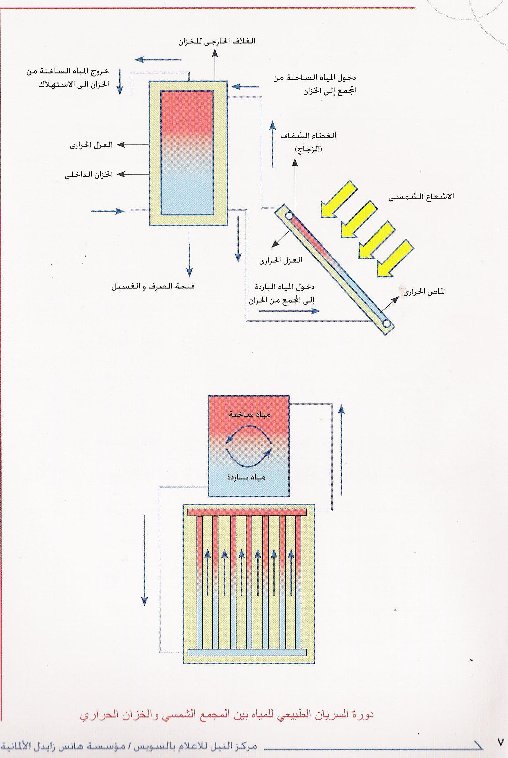
The picture above is remarkable because it contains misinformation that radically affects the performance of thermosiphoning solar hot water systems, and it seems nobody thought to test it. The picture is printed in a booklet that the wonderful Hans Seidel Stiftung (a German foundation) publishes and makes available to help people in Egypt learn how to make solar hot water systems. The fact that they have gone to the trouble of not only printing and distributing these great informational booklets but of supporting workshops in the Suez area to train locals how to create home-made domestic solar hot water systems is more than laudable. The Hans Seidel Foundation is one of the best organizations out there, working on everything from solar technology implementation to biogas production from waste.


We applaud everything the Hans Seidel Stiftung does, and their booklets have helped us convince all sorts of stakeholders in the local community to work with us on our Solar CITIES project.

What is a shame (and we have witnessed it all over Egypt with other foundations projects as well, including our own) is that they are all subject to the curse of what UCLA Professor Susanna Hecht used to call "RECEIVED WISDOM" in her development classes.

Instead of relentlessly beta testing ideas locally, and involving local wisdom and experience (what Dr. Hecht called "metis", from the Greek), we almost always apply "techne" (codified "one size fits all" knowledge) and that techne all too often reflects certain historical contingencies and market compromises. It has become "commodified".

There is often, of course, a good reason for this: testing and modifying things locally takes time and energy and money and patience and cultural understanding. It is reasonable to expect that people will try to avoid "reinventing the wheel" if they can, but what is the great shame that reflects the "zeitgeist conspiracy" is how many times we have seen a failing to rethink things that have to do with local solutions for decentralized energy and food production.

Whereas people will obsess with endlessly checking and redesigning entertainment media, for example, incessantly improving every new iteration of a computer program and inviting a host of world-wide "beta testers" to enthusiastically check for bugs and report problems, this same passion for redesign is almost never occurring with renewable energy systems, electric cars, or other examples of "appropriate technology".

How many times have you agreed to "send a report to Microsoft" to help them with the computer errors that crashed the computer program you were working on? You have become part of an army of unpaid testers -- worse, you are paying for the privilege of spending your time and labor helping to improve THEIR products. But at the same time, you would probably consider it absurd to spend hours of your day or night trying to help us all improve the quality of information and product relating to things that, if we put our collective intelligence to work on them, could stop the scourge of global warming and biodiversity loss.

The diagram in the Hans Seidel Stiftung book is a case in point. Egyptians had been telling me for the past several years that "solar energy systems are great in the summer, but they don't work in the winter." My experience with solar hot water in Germany and the U.S. contradicted this complaint, so I didn't take it seriously. I chalked it up to "the ignorance of the locals". And, optimistically, I went ahead and built several solar hot water systems out of local materials with the locals, according to plans like the ones reproduced in the booklet. Of course the systems worked, and to prove a point, I gathered a crowd during the winter and turned on the faucet and showed that, yes, they produce hot water in the winter months.

Case closed?

Hardly. In our western arrogance we forget to consider the usefulness of our technology to fit into the daily consumption patterns of the local people. Sure, we demonstrated that solar hot water systems designed as in the diagram can deliver hot water in the winter. But we never took the time to measure exactly how much or to make it a priority to redesign the system to suit the real on the ground conditions. We relied on received wisdom.

It wasn't until my wife and I actually moved into the slums of Darb El Ahmar into a building recently renovated by the AKTC and built one of our "hand made solar hot water systems" on the roof of our apartment and decided to stay during the cold winter that we learned, by living as a local, what the problems with the design were.

In short, the systems depicted in the diagram, which can easily heat 200 liters of water using a two panel setup (each panel being 180 x 80 cm) during the summer, only heats about 25 liters during some winter days. That was fine for our demonstrations, because we simply turned on the faucet and let people stick their hands in the piping hot water that gathers at the top of the tank (see the diagram) and didn't use more than 25 liters. But when you are actually using it to bathe every day, you quickly run out of hot water.

The locals said, "you see, told you so, solar hot water doesn't work in the winter." And all we could do was hem and haw and talk about reduced consumption patterns in the winter and "yeah maybe solar is just a preheater in the winter... blah blah blah." Internet searches didn't help -- most diagrams show the cold water outlet at the bottom of the tank and hot water inlet at the top and suppose that the water will circulate (see the circular arrows?) until the whole tank is hot. But our field experience showed us that that isn't really going on. Hot water does a terrible job of heating by convection, and most of these diagrams must be based on the use of a circulation pump, because in the winter with the shorter hours of thermosiphoning, circulation doesn't see to be happening at all, particularly not in the vertical tanks we are forced to use for cost reasons in developing countries (note that commercial suppliers of thermosiphoning SHW systems use horizontal tanks and boast about the improved circulation/mixing capacity). So we felt stuck, demonstrating to the locals that in a vertical tank there is a dramatic thermocline in the winter -- water at 50 degrees C at the top of the tank, water at 25 degrees less than 15 cm underneath it, with a sharp difference in the layers that you can feel when you stick your hand in the tank (we use open tanks for demonstrations).
Use up the 25 liters or so of hot water and then you have to grin and bear the 175 or so liters of cold water in the winter. Or so we thought.

Then we remembered our trip to Palestine.

The beauty of traveling around the world to areas where refugees are trying to solve problems without much help and in the face of great adversity is that you begin to pick up bits and pieces of effective local knowledge -- what Dr. Susanna Hecht called "metis" - that can radically affect the globalized "techne" and thus improve its local application.

We had learned from the Palestinians that in households that have no constant water supply one should put a cold water feed-in tank to maintain pressure. We learned this by walking down one of the streets that separates West and East Jerusalem and noticing that you could tell which houses were Israeli and which were Palestinian by looking at the solar collectors on the roofs: Israeli houses tend to have one tank systems (with horizontal tanks) while Palestinian houses tend to have two tank systems (with vertical tanks). Palestinian families whose roofs I climbed onto told me that they need two tanks because they have unreliable water pressure, and often the water is cut. Thus they have a cold water tank feeding into the hot water storage tank connected to the solar hot water system.

We had learned to adopt this system in Darb El Ahmar and Manshiyat Nasser because water pressure is nil to nonexistent during much of the week and water is often cut outright. But it wasn't until we re-examined close up photographs we took of the roofs of Palestinian homes that we realized they had also solved our problem with the winter-time low performance of the vertical tank solar hot water system. We originally thought it was just poor design (weren't they following the diagrams we send them from the West? Was it ignorance?) but came to realize that it was the hard won experience of trial and error that led the Palestinians to place the hot water inlet NEAR THE BOTTOM OF THE TANK, JUST ABOVE THE COLD WATER OUTLET. Our prejudices (not believing the locals could know better than the published diagrams) blinded us from taking the risk that would have solved our problem a long time ago.
But once we started living like the locals, in the slums, and dealt with the problem of taking a hot shower every day in the winter, we suddenly realized we would have to experiment too. Fortunately, we had the Palestinian model to go by, and it was simply a matter of giving it a try.

We went from this:

To this:


It cost time and money, yes, because it meant we had to build another system for comparison with the standard system. But once it was built (on Solar CITIES field coordinator Hanna Fathy's house in the Zabaleen area) its performance exceeded our expectations: 200 liters of hot water on a variably cloudy day that only produced about 20 liters in the system with the hot water inlet placed at the top as in the diagram!

We also made modifications that no system we have ever seen in the world has: we listened to the advice of Plastics recycler Walid Sabry, whose mother and sisters sit in piles of medical waste all day, often pulling needles from used syringes and separating bloody bandages from medical bottles, risking hepatitis infections. Walid had asked, sensibly "why can't we use plastic barrels with loose fitting tops for both the hot and cold water barrels?". When "experts" from development agencies and universities told us the hot water would melt the barrels, we decide to honor Walid's skepticism and that of local Beduoin friends who regularly boil water in used PET plastic bottles over an open flame (because many plastics melting temp is over 140 degrees, and won't melt as long as the container is filled with water -- water can't rise above 100 degrees until all has turned to vapor). In fact, the plastic barrels are great for hot water storage in a solar system (only in gas and electric systems does the heating element get hot enough to melt the plastic). And a whole lot cheaper.

As for the loosly fitting top issue: I came up with my own innovations: I figured out how to use the Magdy Zahran barrel float valve in both tanks, setting them up like toilet bowls so that they automatically stop filling when they are full, and solved that problem. Now that Magdy Zahran, Egypt's premier plumbing inventor, and I are good friends I realize I should have been talking to local inventors all the time, instead of trying so hard to find "foreign experts" to help solve these problems.

A combination of local metis and globalized techne is one of the solutions to our global warming dilemma, and one must be respectful and humble and willing to attempt some real "bricolage" trying to fit the two together to fit the circumstances. That much is sure.

But now, how do we stop participating in the Zeitgeist Conspiracy? Not everybody is an "early adopter" much less an inventor or innovator. Not many people can afford to spend the time, money or energy painstakingly trying to improve things in the real world. It would take a lot of incentive, for example to get most of us to get up off our butts and start tinkering with our automobiles to make them run on alcohol or biogas or electricity (though it really isn't hard to do!) much less go to a third world country and live in the slums and try to design a better heating system.

So how can the majority of us defeat the Zeitgeist conspiracy?

My answer is to start taking the public's willingess to beta test software seriously. Now that computer game engines for video games are open source or cheaply available (such as the Steam Source SDK physics engines for Half Life 2 or the SDK for Elder Scrolls Oblivion) I suggest we follow the lead of the Digital Urban group and start modeling real time physics and engineering problems on our computers in a realistic and fun simulation environment of real ghettoes and rural areas. It doesn't have to be that tough -- already there are huge numbers of gaming fans who enthusiastically spend long hours "modding" their favorite games. Tutorials are readily available. And even Popular Science this month has an article called "The Hard Science of Video Games", explaining how computer game software development kits (SDK's) are among the most important tools for data visualization and experimentation on the market.

Since computer models can now make realistic predictions of the effects of temperature and density and mass and volume on fluids and gases and can use them to model the effects of things like climate change, why not create virtual Darb El Ahmars and Manshiyat Nassers, literally create Digital Urban Slums, replete with rats and open sewers and inadequate plumbing. Why not do it as an Alternate Reality game, and let players build solar hot water systems and other industrial ecology systems on the roofs (as we are trying to do at Solar CITIES) and try out various designs and "play" through them and see which work and which don't? Make it part of the ARG gaming experience, and then report back to those of us in the field who are responsible for building the real things?

What is wrong with reinventing the wheel, or baking a better cake or building a better mousetrap? And now that we have the internet connecting all our virtual and real life experiments and each other, can't we all breath a better air together -- a different sort of Con-Spiracy, in which we connect to form a new "Spirit of the Time"? Now that would be a positive sort of Zeitgeist Conspiracy...