Solar Power isn't Feasible!

Solar Power isn't Feasible!
This cartoon was on the cover of the book "SolarGas" by David Hoye. It echoes the Sharp Solar slogan "Last time I checked nobody owned the sun!"

Sunday, December 28, 2008

Solar Powered Public Baths in Historic Cairo


Solar Powered Public Baths and

Early Co-Generation in Cairo: 
Using otherwise "waste(d) heat" to heat the famous Arabian public baths
 
(Excerpted from Chapter 3 of T.H. Culhane's Thesis: "Getting into Hot Water")


 ”What watery glory it all was: To be steamed, scrubbed, rinsed and scented according to medieval Cairos public-bathhouse ritual was to be cleansed like nowhere else on earth...There are still in Cairo half a dozen traditional hammams  that have been busy washing bodies for centuries...”
Feeney, J.,The Joys of the Bath, Aramco World 2004, online at http://www.saudiaramcoworld.com/issue/200402/the.joys.of.the.bath.htm.
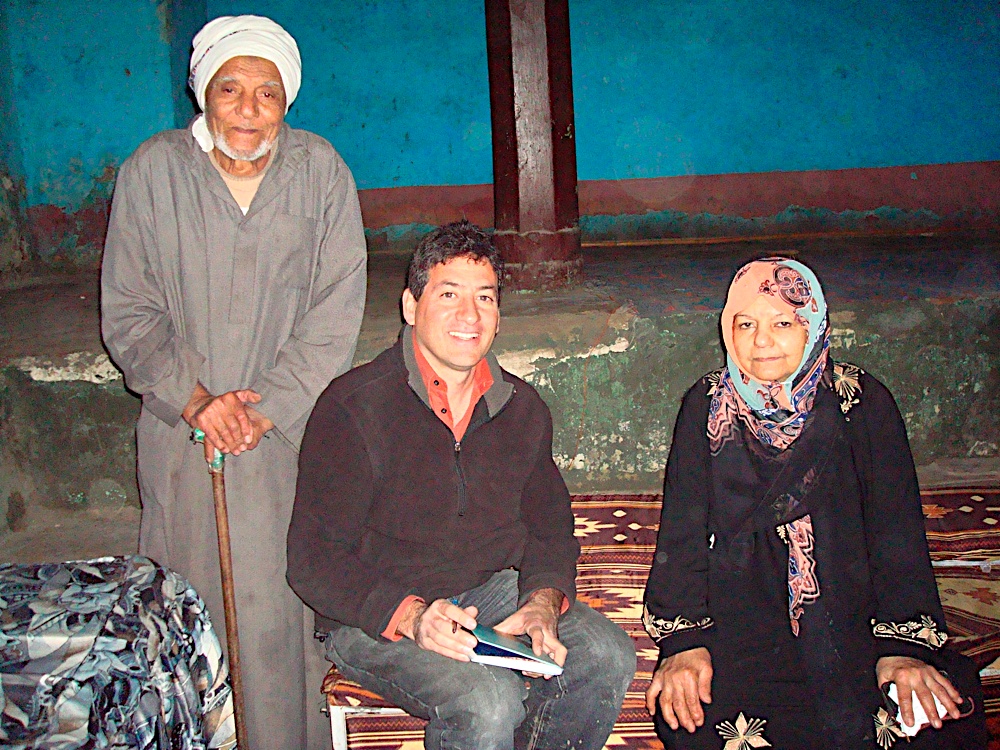
Solar CITIES co-founder T.H. Culhane sits discusses solar hot water options with Umm Omar and her brother, who are from the original Islamic Wahi (Oases) groups who recycled waste paper for co-generation of cooking heat and public bath heating before turning the trade over to the Coptic Zabaleen. Umm Omar owns one of the last surviving public baths in historic Cairo and would like to revive it as an environmentally friendly health spa for the community if she can secure funding for a large enough solar hot water system.  Solar CITIES provided her with a small 200 liter demonstration system, but it needs to be ten times that size to make the business viable.


It is not that there is no tradition of creating designs in the built environment of Cairo to maximize the efficiency of material values to create human use values. In the particular case of hot water demand there is a time honored tradition, going back a century, in which the trash recycling community gathered  waste paper from all over the city to distribute as fuel. Since Cairo, like many arid land cities, lacks  wood resources, the recycling of wood products predates the urban recycling revolutions appearing in the west.

The trash recyclers would sort and deliver waste paper and wood scraps to the Fava bean
merchants, who built their ovens next to the public baths.


As legendary educational reformer and environmental advocate, Dr. Laila Iskander, who has devoted more than a quarter century to championing the rights of Cairo's Zabaleen told UCLA's visiting Urban Planning group in 2006,  "Recycling has a long history in Egypt.  Nothing went to waste. The ubiquitous Egyptian food, ful (made of fava beans) requires low heat, but traditionally there was no firewood and no oil, so cooks burned wastepaper for low grade heat, then used the waste heat to heat the water for public baths. Profit from recycling drove the market. "


The bean merchants and the public bath owners and the trash recyclers developed a unique symbiosis for co-generation.  They  built extensive networks of copper pipes and heat exchangers that carried the waste heat from the daily bean cooking into elevated 2000 liter cisterns that supplied the baths with hot water.

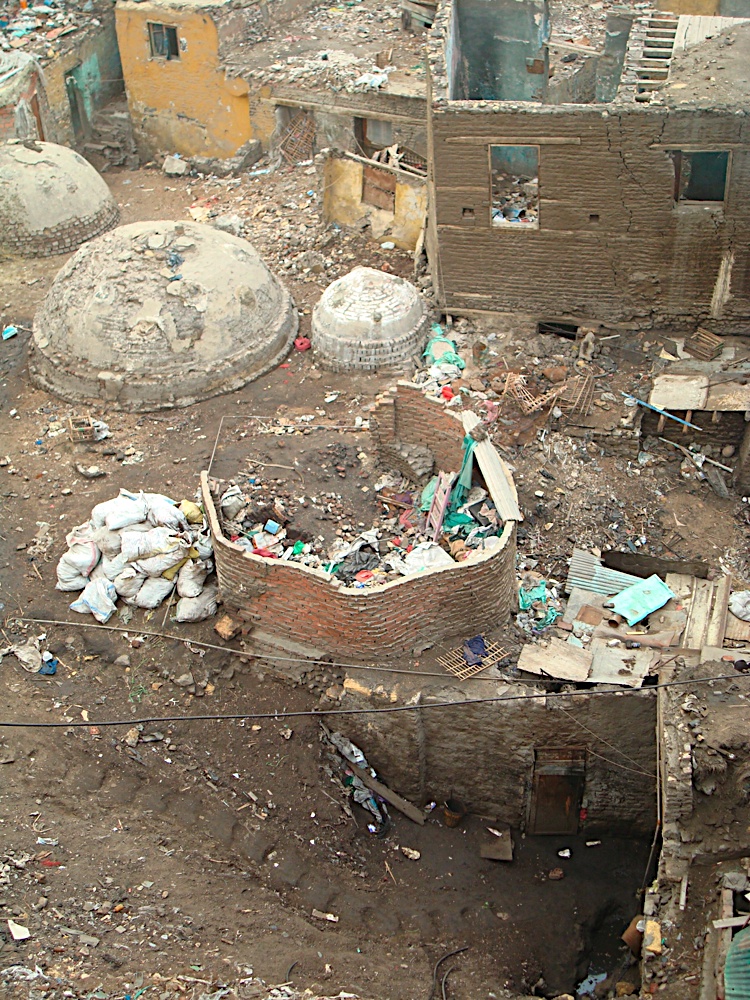
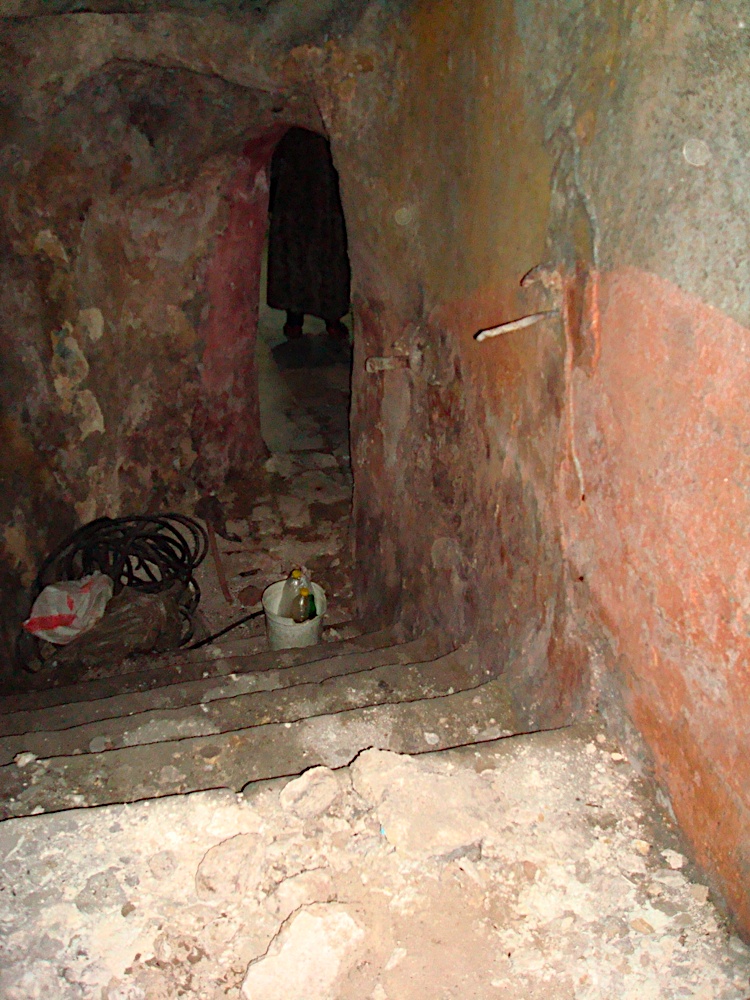
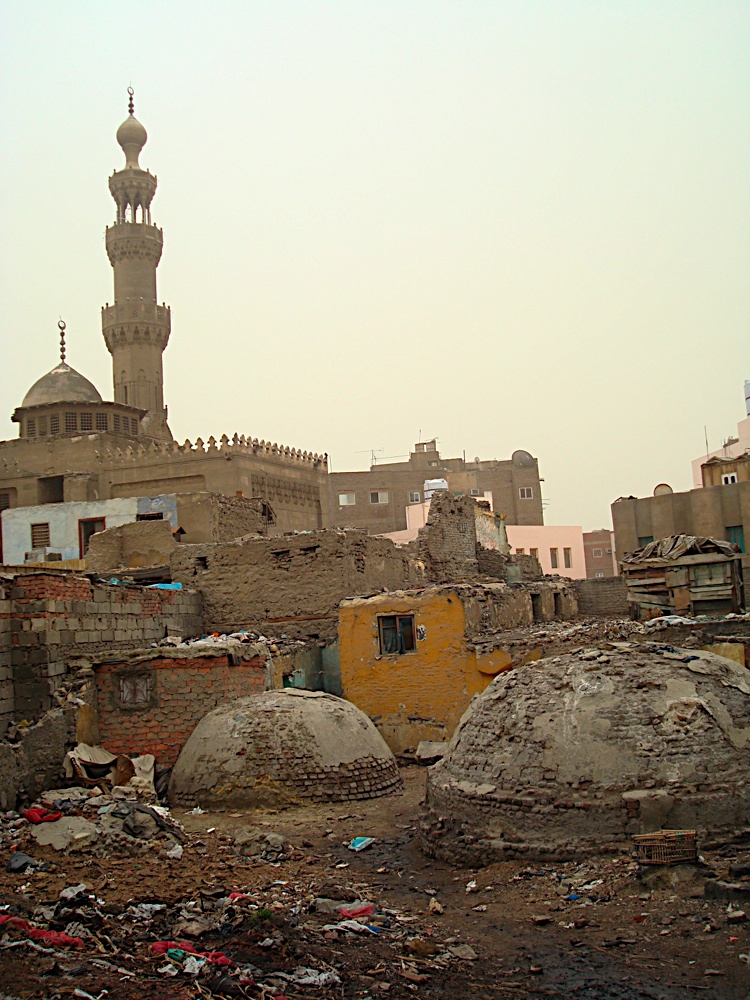
 The site of the bean cookery (the door in the stone wall)  and the remains of the heat exchanger (the round wall)  that once powered the baths. The domes are the lighted roofs of the public bath, with colored glass inlays.
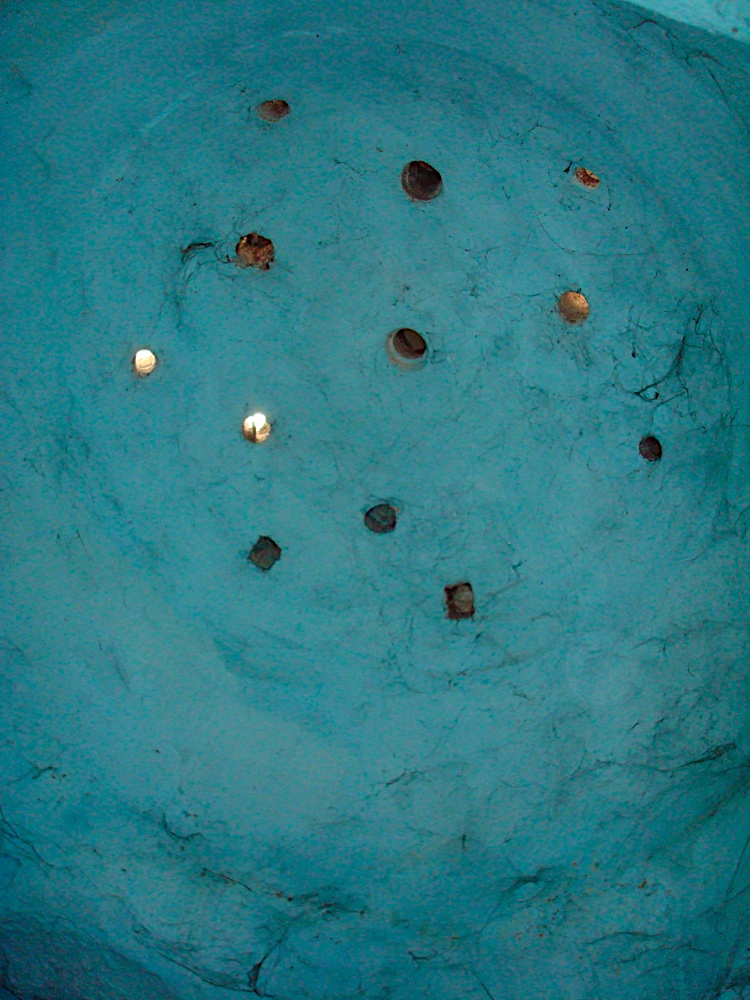
The dome from the inside, showing the marvelous traditional way to introduce natural lighting and to recycle glass bottles.
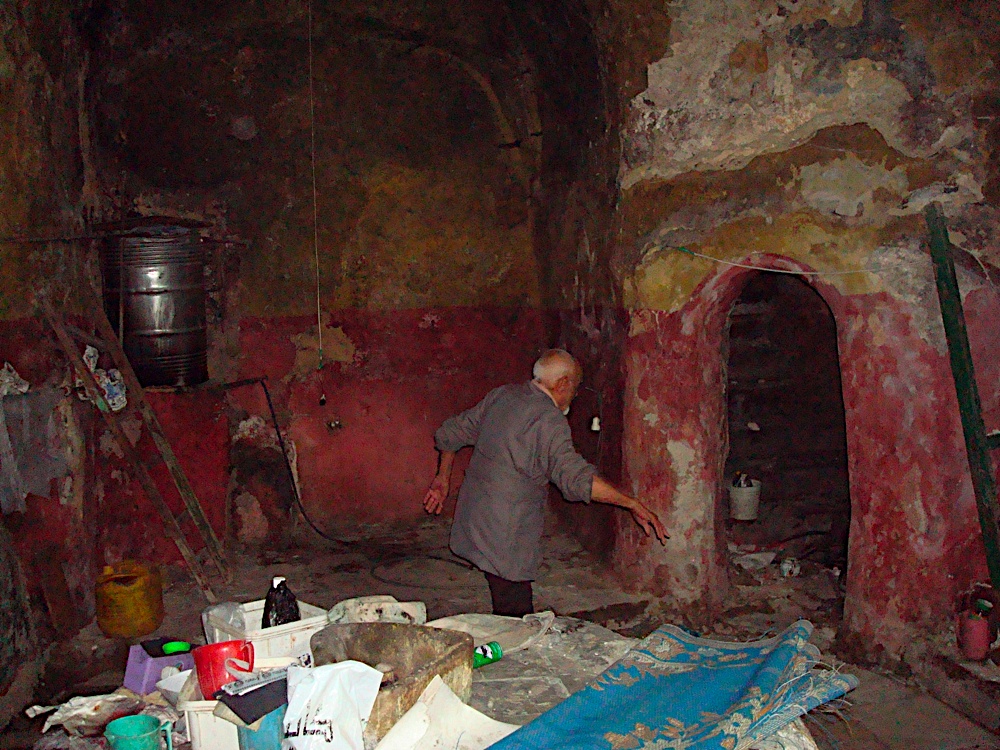
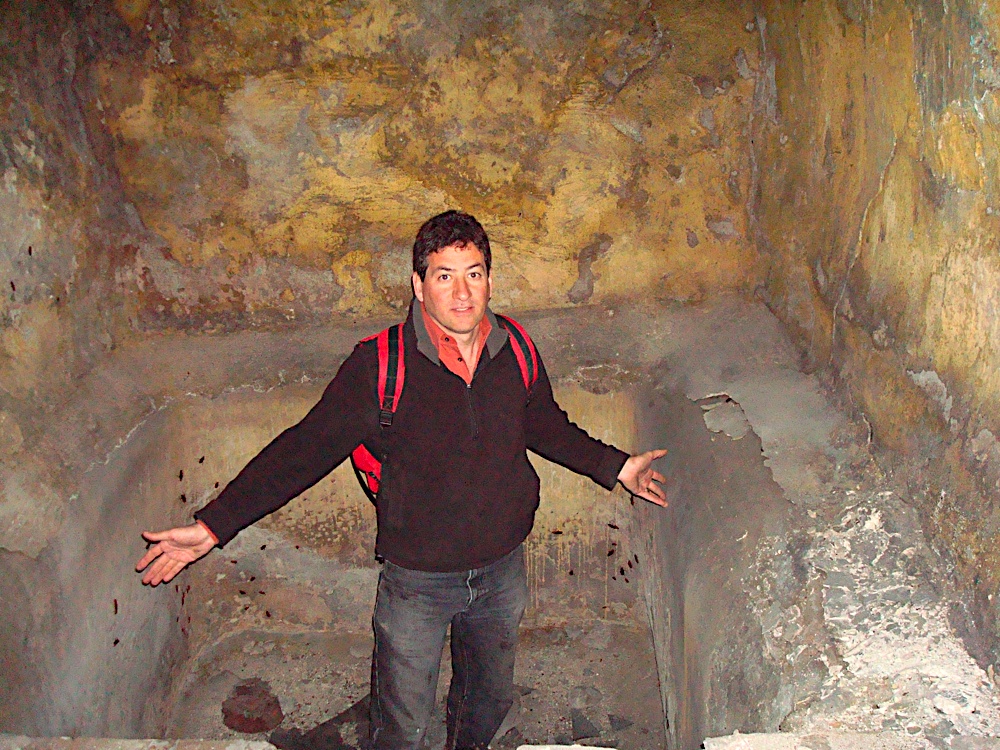
The 2000 liter cistern that once supplied the bath with all its hot water, heated by the bean cookery.  To fill this with hot water today would require 10 Solar CITIES solar hot water systems. Since the materials to build each system costs about 500 dollars, we estimate would need a grant of merely $ 5000 dollars to provide the daily running-cost free pre-heating that could help revive the bath. Additional costs would be incurred for construction, installation, hiring labor, running pipes and improving insulation. We would also want to install an instant on-demand condensing bio-gas backup system for cloudy winter days.   With $10,000 we estimate we could pretty much cover everything.
The view from the water tank to the domes of the bath, showing the distance we would need to run pipes.

Half a century ago, inner city Cairo still had over 300 of these bean-cooking/public bath installations. In the time of the Mamluks it was said that a resident could visit a different bath every day.  It is ironic to anybody who has had to suffer through the infamous ”black cloud” month that has poisoned the air
of Cairo since the late 1990s that it was an environmental clean air ordinance that led to the demise
of the waste-paper-bean-cooking-public bath infrastructure. Waste paper burning was considered to
produce too much smoke for the inner city and the large bean cookeries were shut down.

As "natural" gas canisters became available the bean sellers dispersed, setting up a multitude of decentralized cookeries.  The giant heat exchangers that served the baths fell into disrepair. Meanwhile, another move toward  decentralization, with the provision of white goods as solutions for water heating, drove people who  could afford it to abandon the practice of attending the public baths and to begin bathing at home.
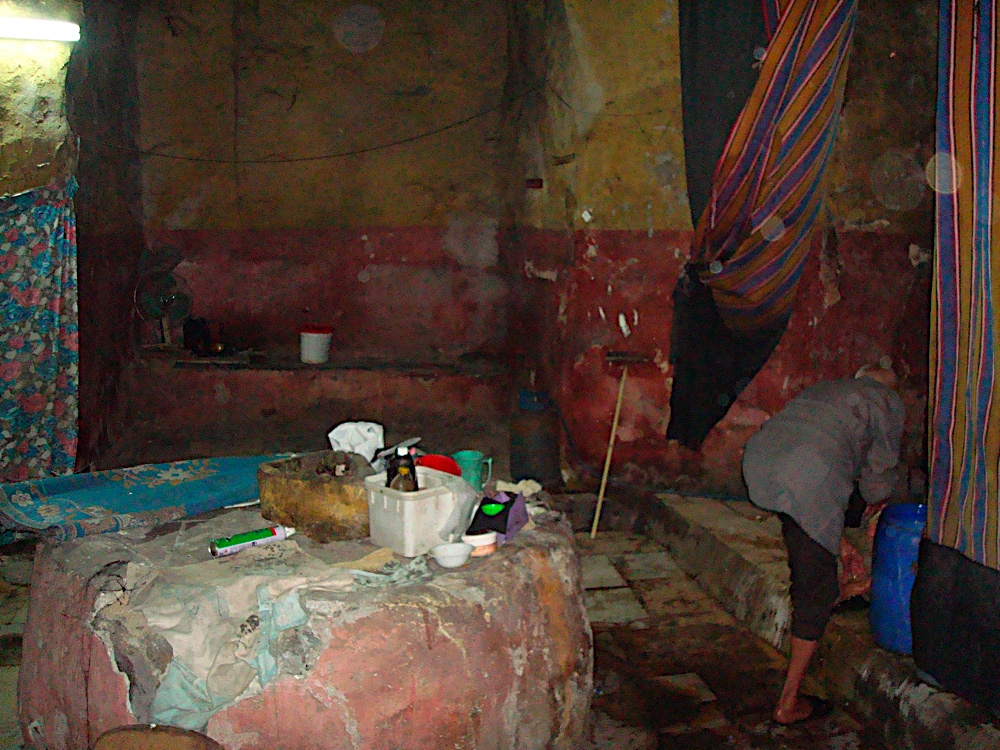


This wasn’t inevitable however, as public baths and private baths were not always perceived as substitute goods. Doris Behrens-Aboseif writes in ”Islamic Architecture in Cairo: An Introduction” (Behrens-Abouseif 1989) that during the Ottoman era

”Provision of private houses with hammams did not, however, diminish the role that public baths had played in Egypt since Roman times and whose functions were far wider than hygiene. Their primary aspect was social, particularly the women’s baths, which were comparable to clubs. Women in particular enjoyed the opportunities the hammams offered to gather, away from their houses, and their only opportunity to go out without their husbands. Marriages were often arranged in the hammams where the matchmakers went to look for potential brides... Ibn al-Hajj criticized women’s visits to hammams, saying they merely led women to show off their clothes and jewelry, adding that such female gatherings were harmful. On the other hand, in the tale of Abu Sir and Abu Qir in the Arabian Nights, is the comment ”Your city is not perfect unless it has a hammam”. Ibn Khaldun wrote that hammams are a mark of highly civilized cities, since luxury reveals wealth and prosperity.” (p. 42). 

At the time the baths also were believed to be able to cure diseases and served medical functions and were considered ”lucrative businesses.” It is unclear whether the loss of the public baths has more to do with them competing with home bathing, which, given the statistics we’ve revealed in our study, seems unlikely, or whether they shut down because of rising fuel costs, a drop in the standard of living of the potential clients and a resurgence of fundamentalism that revived Ibn al-Hajj’s fears of the baths being immoral. We do know that at least one of the remaining public baths in Darb Al Ahmar was shut down recently because of alleged homosexual behavior (one of the tragedies of intolerance) in an environment no longer considered "family friendly". 
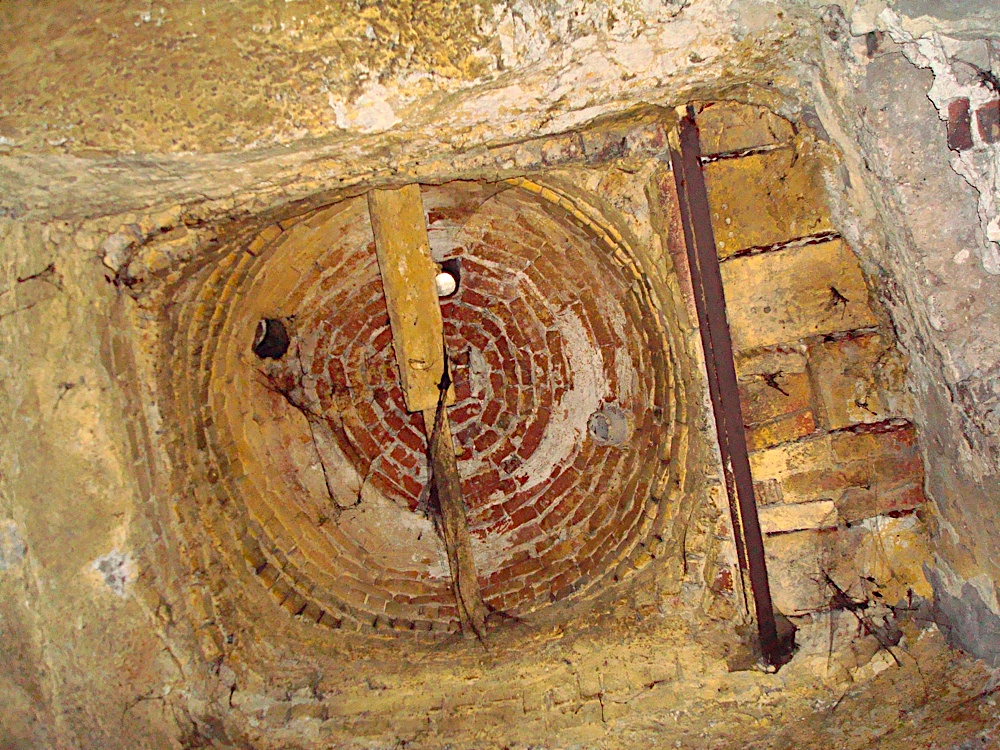


Nonetheless, the combination of falling demand and rising fuel costs for heating large quantities of water led the baths themselves to fall into disrepair. Today there are only two baths remaining open in the Darb Al Ahmar area; one of them is a block down in the Abu Hureyba district on the street where I live.
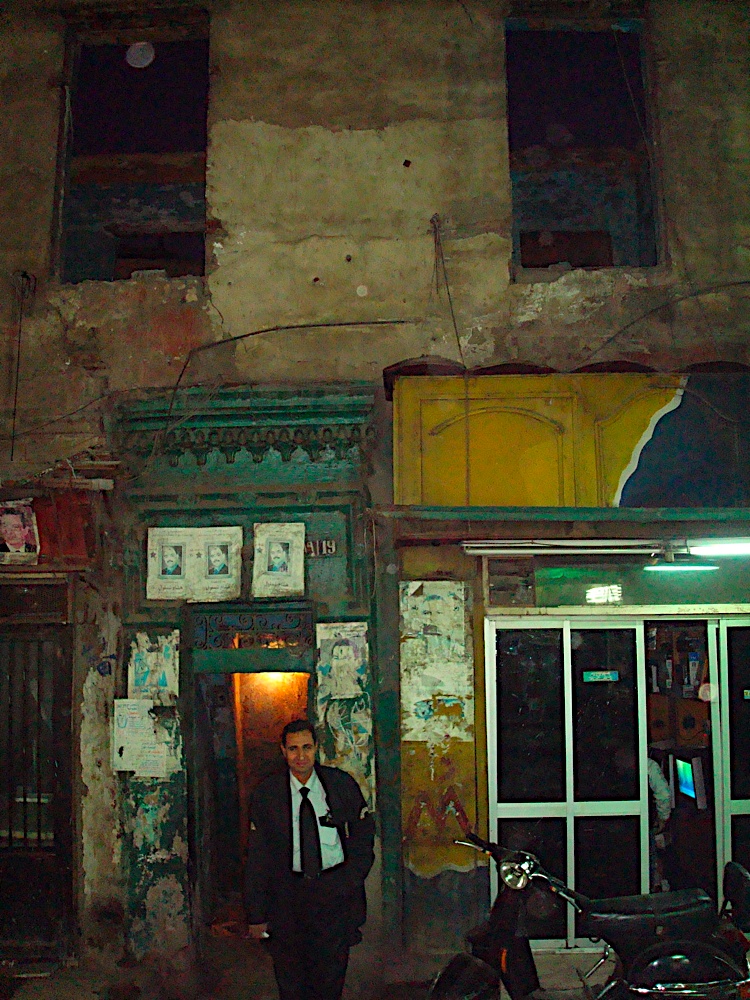
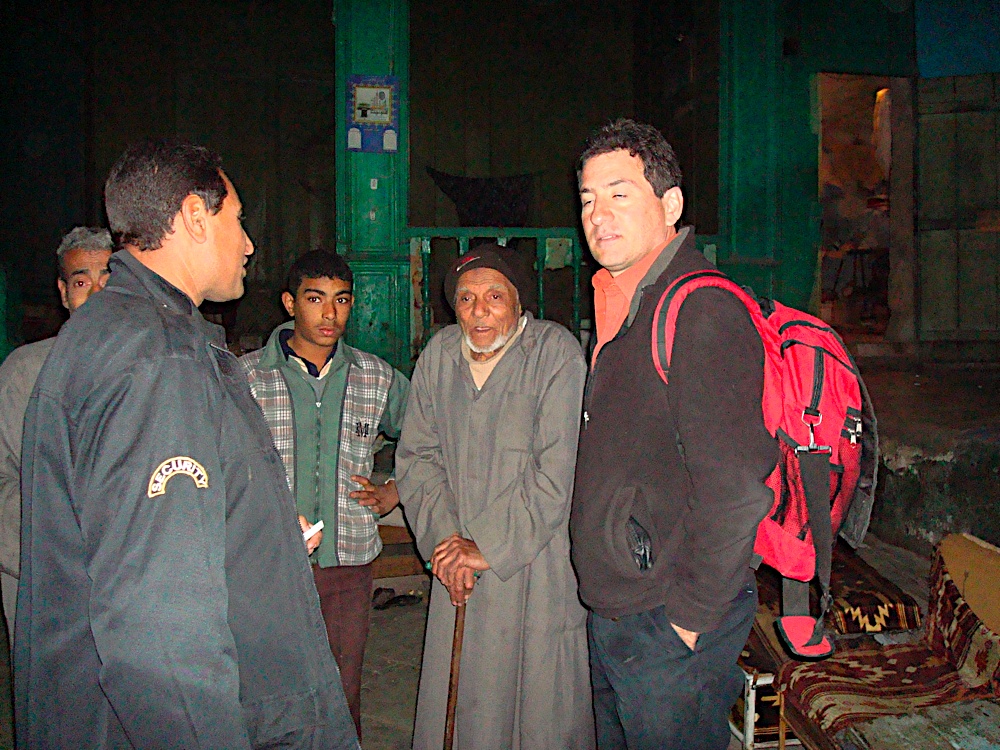

 Aga Khan Security Guard and Darb Al Ahmar resident, Karam, who is also a certified plumber and has helped Solar CITIES build its systems, introduced us to the public bath owners, who are friends of his, saying "we must bring solar hot water to our neighborhood and use it to revive the bath tradition that I enjoyed as a child!
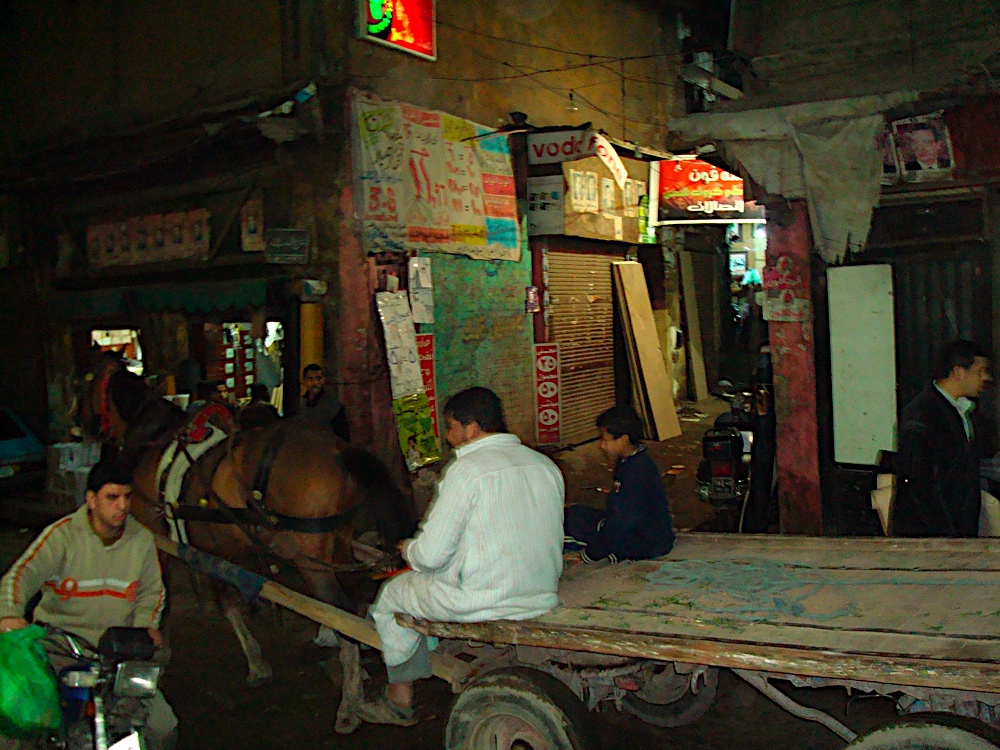
Umm Omar, the owner of the Darb Al Ahmar Street public bath,  told me her family are Wahis, the original Muslim trash recyclers from the oases who started gathering waste paper for heating beans and water over a century ago, and then contracted with the Zabaleen to provide the paper when the Copts migrated to the city several generations later. Rather than helping these enterprising families continue their ancient traditions by helping them implement ways to provide clean inexpensive heat, the municipality in recent years simply prohibited them from engaging in their cogeneration activities, citing ’environmental standards’. Today, mostly using gas bottles (though I have observed a fuel oil burner in the bath as well), they can afford to heat only one tub.
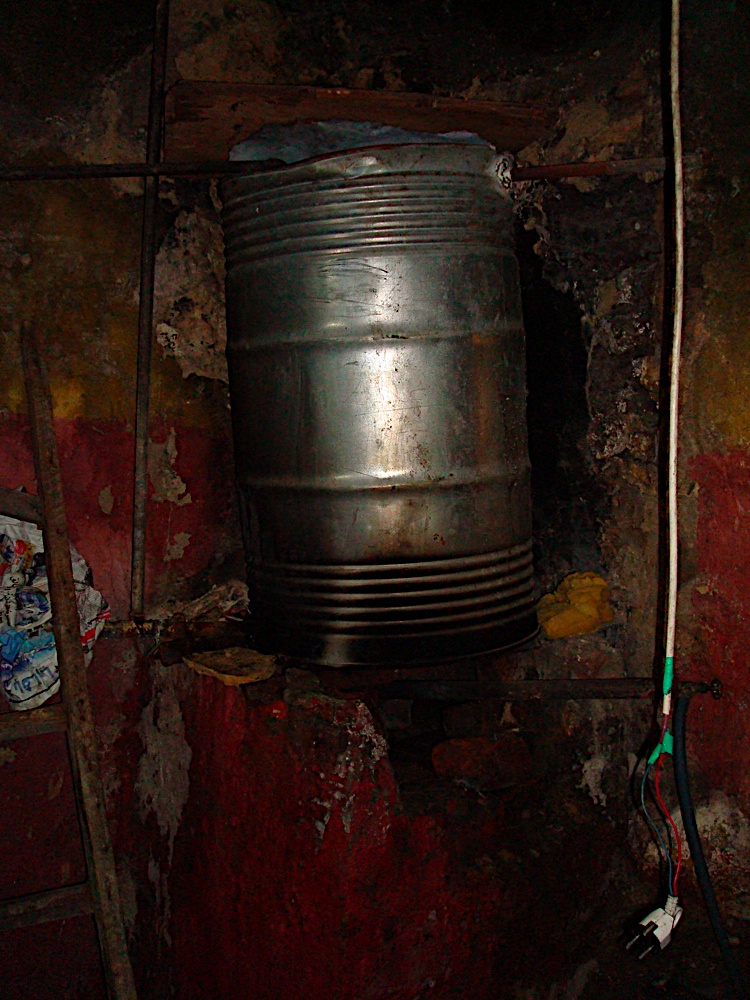
 (Picture depicts the current dangerous, unhealthy and expensive way (oil and gas, sometimes scrap materials)  that the public bath heats the small quantities of water they can now afford to  use for their diminished clientele. Solar CITIES wants to raise funds to replace this system with a safe, clean and inflation resistant solar hot water system, built by the community)

They only open for a few hours a day. They say they cannot cover their operating costs and may be forced to close. Residents surrounding the bath talk about their fond memories of being able to take long hot baths; mothers talk about being able to wash a large group of children all at once, rather than slaving away for hours preparing small quantities of bath water.  But "environmental laws" dis-articulated from policies to integrate new environmental technologies, prevent the re-emergence of the old co-generation traditions.
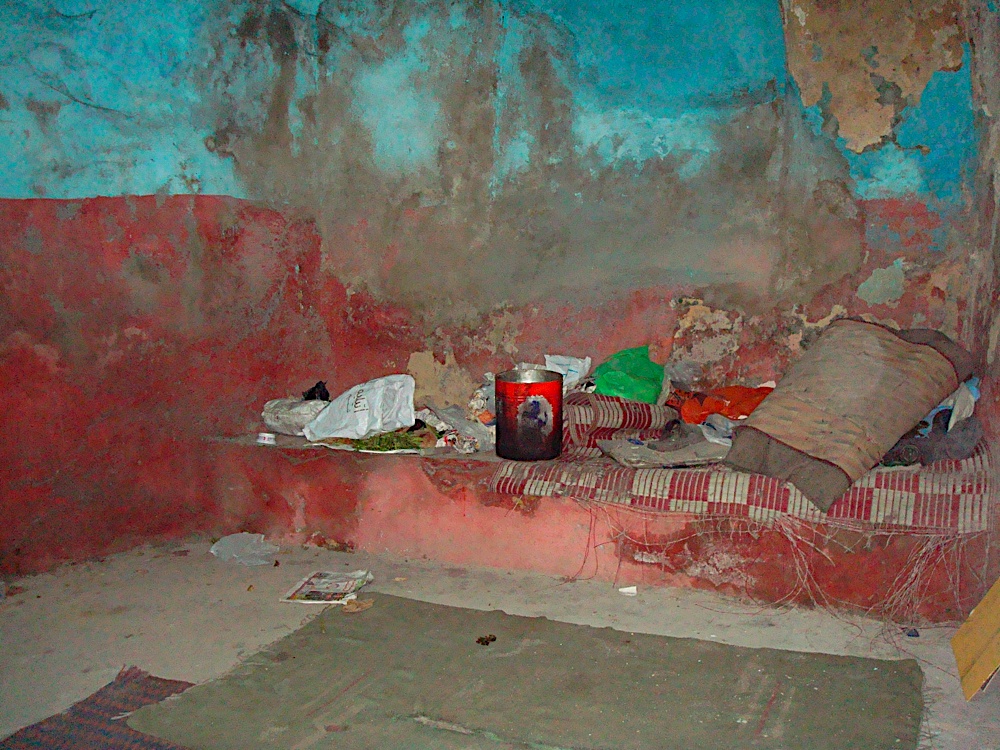
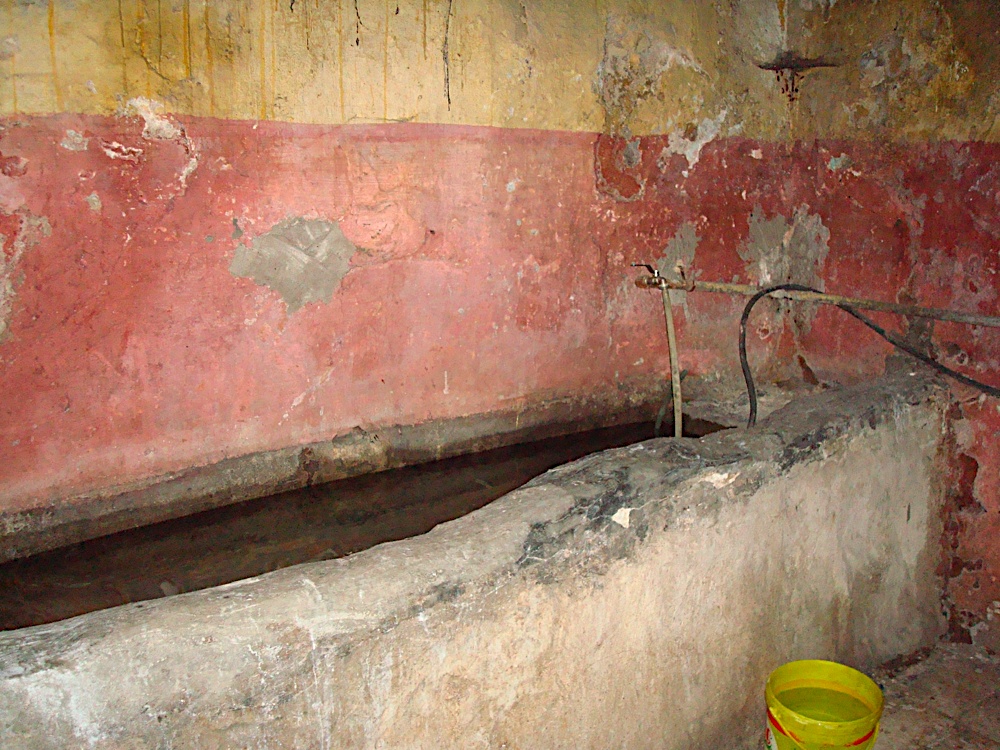


The contradiction here is that state provision of a centralized amenity once created economies of scale and business synergies that created greater human use values than ”freeing individuals to self-provision”.The Wahi Zabaleen-Bean-cooker-Bath system was an Industrial Ecology system that predated the recent Industrial Ecology Movement by a century. It demanded coordination from different stakeholder groups, public and private investment, and participation by civil society. And yet it provided human use values to a greater proportion of the population than is seen today.
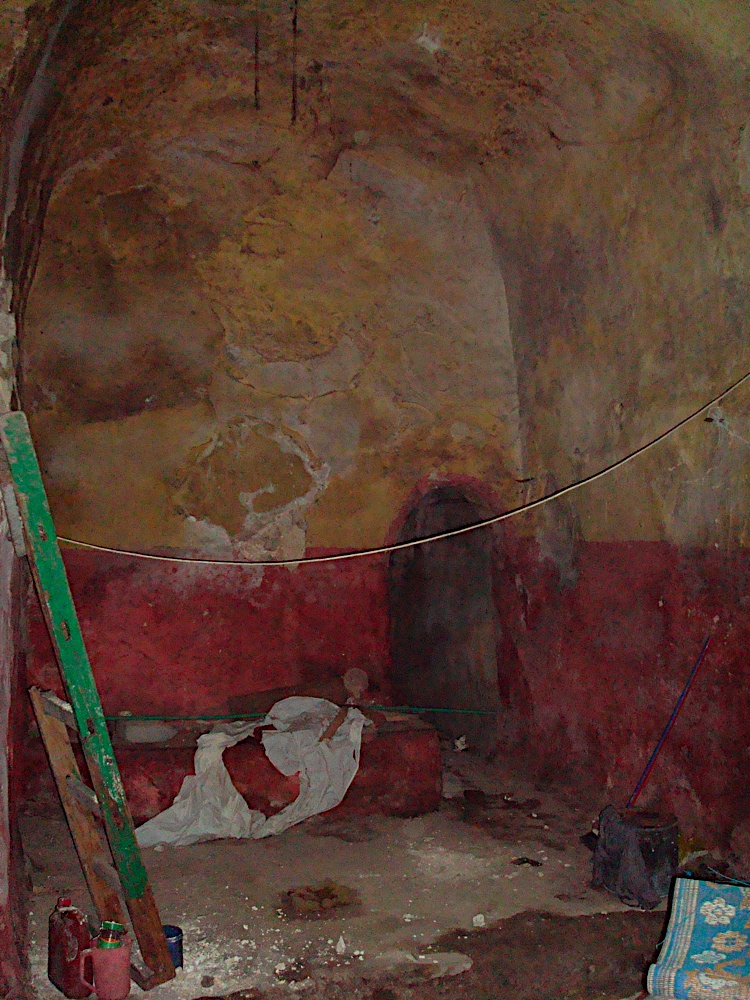
 The once beautiful, joyously painted baths have fallen into disrepair because they cannot afford to meet running costs. Solar energy could help solve this problem and revive this glorious ancient tradition.


”Unlike the grassroots environmentalism movements of the West, Egypt’s environmental initiative originated with the state, following some prodding from the international community,” writes Salwa Sharawi Gomaa.  This explains why an attempt to re-introduce industrial ecology concepts may actually rely on the international community now getting involved in a refocus of Egyptian environmentalism so that it reflects a sustainable development ethic in sync with the needs of the burgeoning urban poor, rather than an attempt to mirror the bourgeois environmentalism of the Western well-to-do.

In her analysis of the interactions between the Egyptian government, Environmental Non-Government Organizations (ENGOs), the Green Party and foreign donors, and the development of Egyptian Environmental Policy,  Gomaa lists the top environmental concerns in her country: Air  pollution, caused in large part by an absence of comprehensive zoning laws, Water Pollution, caused by
oil discharge, agricultural chemical runoff, and large volumes of untreated waste water, and raw solid waste.

She suggests that in reality agricultural drainage water and other forms of waste water ”is a
problem that can easily be turned into an advantage if the water is properly treated and utilized instead
of discharged”, and illustrates how many of Egypt’s environmental problems are a result of sloppy
thinking, bad policy and lack of implementation rather than hopeless consequences of rising population. But one area where she is in agreement with more recent urban planners, who adress population, like Abdallah Abdel Aziz Attia, professor of architecture and urban planning at Ain Shams University, a strong advocate of decentralization, is in the need to return to the 1979 Master Plan.

”Finally, Egypt is faced with the problem of land degradation due to urban encroachment. The volume of rural-urban migration in Egypt is currently at a disturbing annual growth rate of 3 percent. Given Egypt’s limited resources, such a high level of urbanization poses an environmental problem of enormous proportions, which is reflected in the huge number of shantytowns that are rising in major cities and in the development of slum areas within the towns and cities themselves. Notwithstanding these concerns, the environment has only recently developed into a policy issue encompassing legislative measures and a complex and diverse network of political actitivities both within and outside the government.” 
(preface from Environmental policy making in Egypt By  Salwa Sharawi Gomaa University Press of
Florida, 1997.)


Unfortunately, current environmental laws, rather than encouraging out of the box thinking, have actually, in this particular case, inhibited the synergies between the activities of the two communities
that once provided hot water options to the area. Particularly damaging have been regulations limiting
co-generation and dooming the public baths.
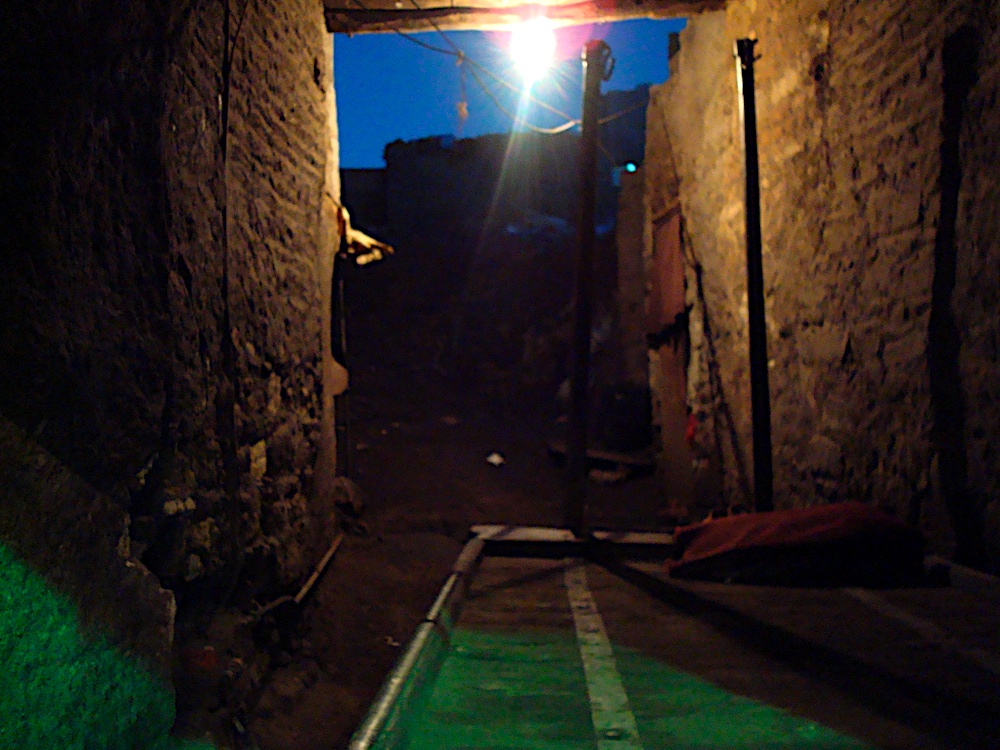
 The alley behind the bath where the beans used to be cooked using recycled waste paper.

But there is a way that these environmental laws can be used to revive the baths.  If Cairo is serious about its clean air legislation, and if Egypt wants to participate in combatting climate change (in fact they have set up a climate change ministry to do so) then one way to create a win-win would be to use Clean Development funds and Carbon Trading monies and redirection of utility and energy subsidies to do as Tunisia has done and launch a massive solar hot water initiative.  The emblem for this could be the revived Public Baths.  Since co-generation through waste paper burning (once the cheapest way to provide heated water) is unfeasible, another form of waste heat -- or rather "wasted heat" could be used -- the heat of the sun.

Since Cairo has one of the highest rates of solar insolation in the world, the running costs of the public bath would be almost nil.  On the few cold cloudy winter days that Cairo experiences, the heat could be supplemented by the burning of biogas (produced from city garbage, as they do in Pune and in Kerala state in India), which would be carbon neutral (and in fact preferable to the current practice of letting it rot in the streets, turning into the more potent greenhouse gas, methane).  The Zabaleen could once again supply the bath with the organic waste used to generate the biogas, completing the historic circle. And the gathering of the waste to feed the biodigestor would create a financial incentive for keeping the streets clean.
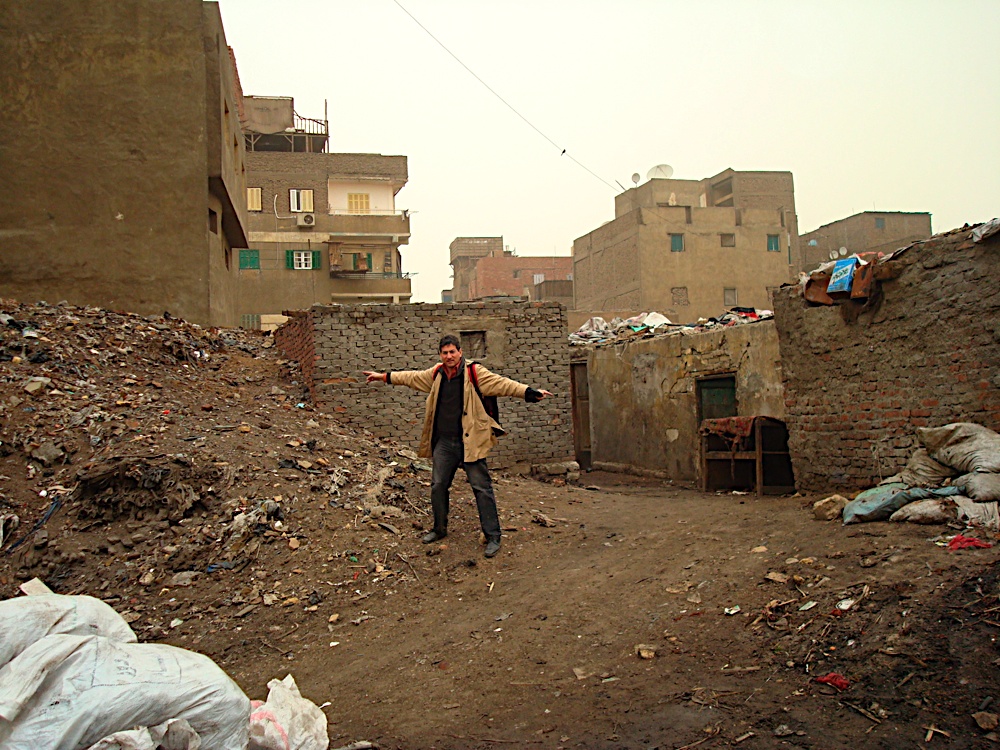
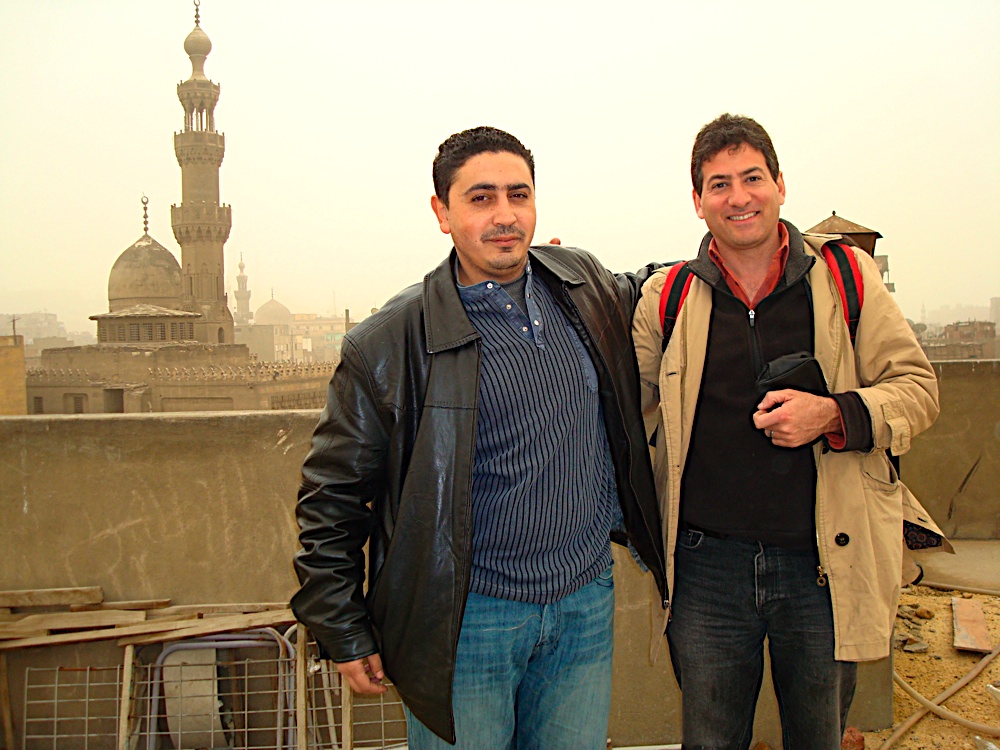
Thomas Taha Rassam Culhane demonstrates the spot, in front of the old 2000 liter water tank, where the solar hot water panels could be mounted.
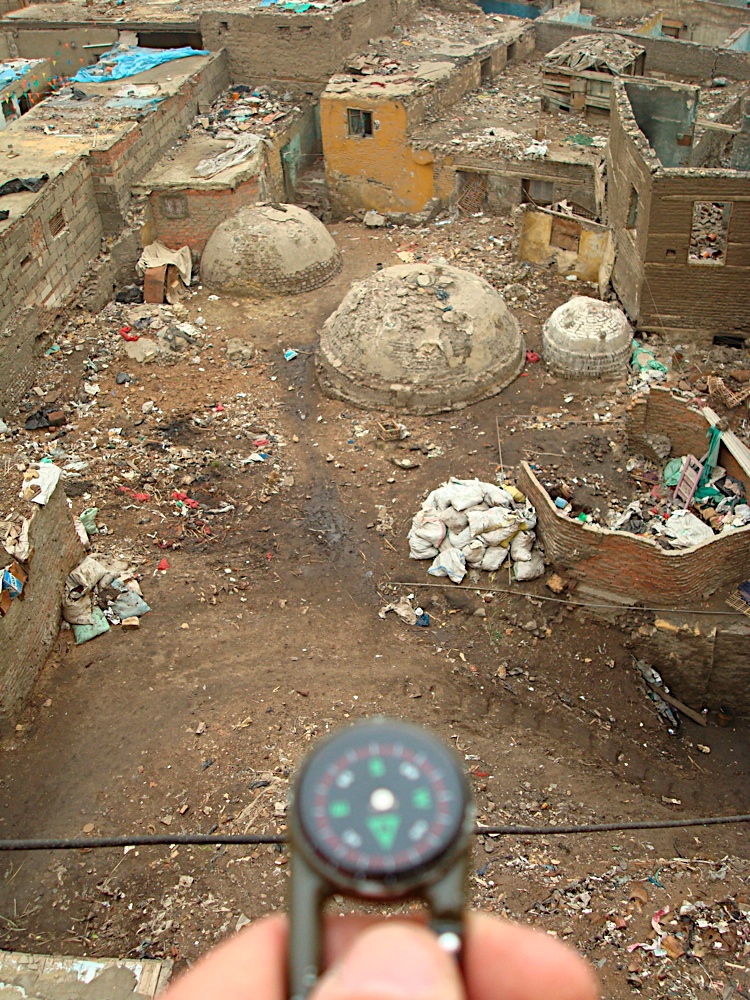
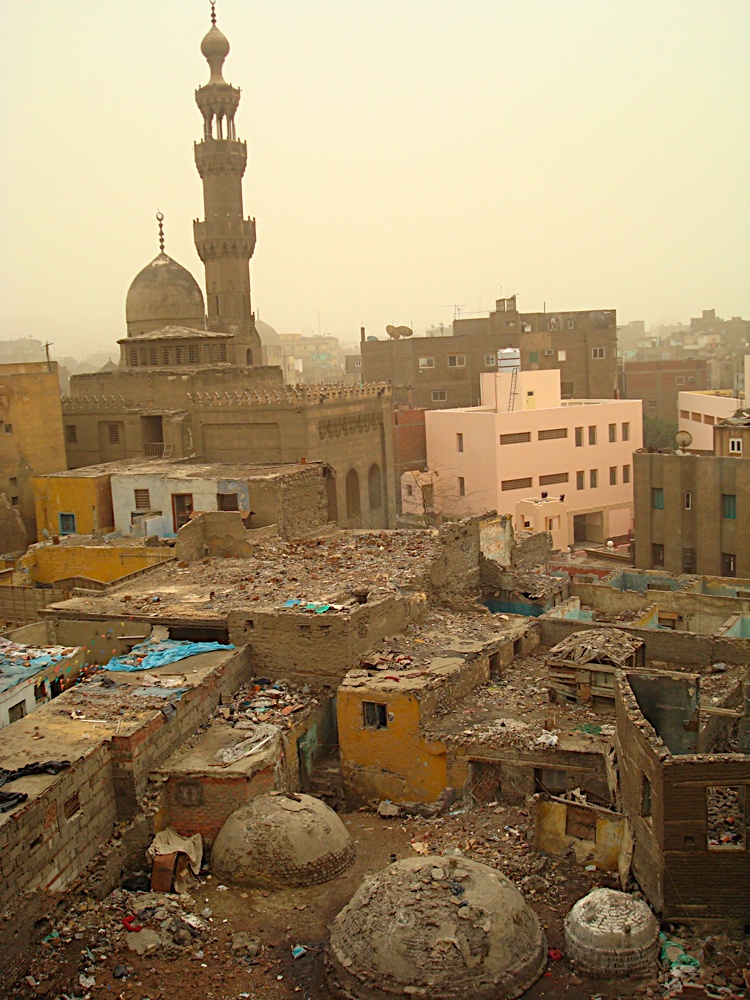
Ironically, as if Allah had intended it (yes, we believe He did!) , the open space in front of the water tank that is ideal for placing the solar panels turns out to face both the Abu Hurayba mosque AND DUE SOUTH.  Nothing could be more perfect -- the area behind the bath, built up over a mountain of garbage, is perfectly situated for solar energy.


With minimal investment capital (estimated to be at around $10,000 U.S.) a new industrial ecology system could be created that could improve the environment and the health and hygiene of the community, as well as create a place of dignified relaxation and socialization to bring people together as in days of old.


This textile business owner, Ali, who lives and runs his factory in the building directly above the baths, has fond memories of his mother taking him to wash there when he was a child.  He would like to see the baths reopened, and allowed us to install a demonstration Solar CITIES hot water system on his factory roof so that community members could see for themselves how simple it is to build solar hot water heaters and how reliable they are, and lead discussions of how solar energy could be used to revive the baths.
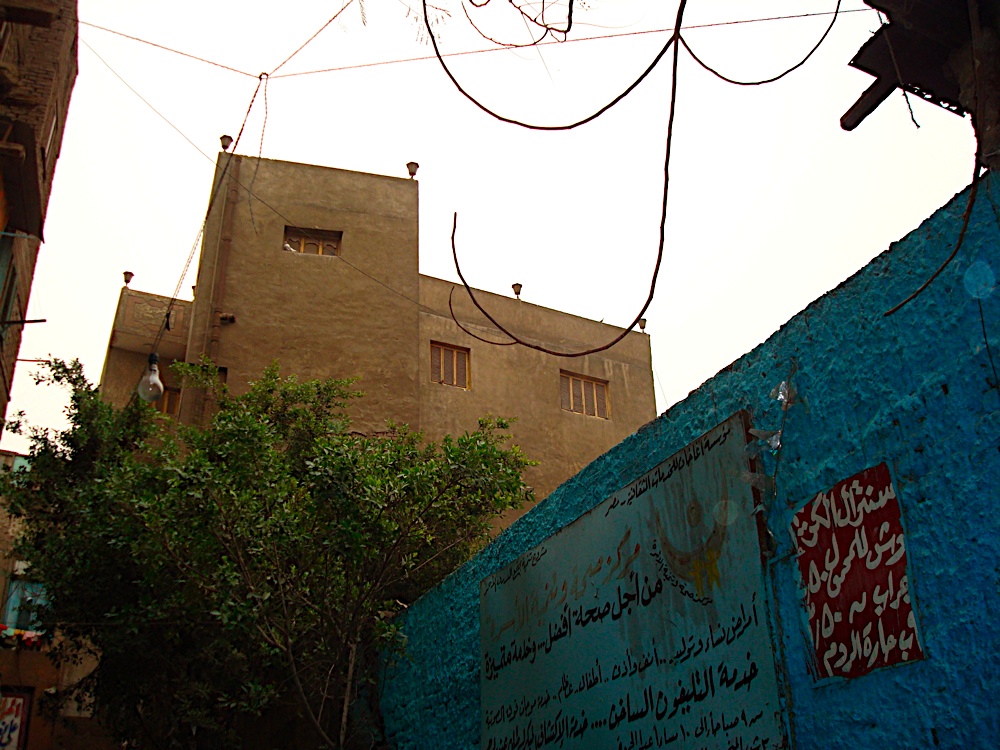

The Public Bath in blue, and the business owners factory/home above it. 
Karam, the factory owner and an employee of the bath discuss where the solar panels could be placed, and security issues to prevent them from being stolen or broken. One of the issues affecting infrastructure investments is whether or not vandalism will be a problem or not.  One of the Solar CITIES systems in Manshiyet Nasser is inoperable because children living in a taller building threw stones at the system and broke the glass. Education and public awareness must also accompany the solar effort.
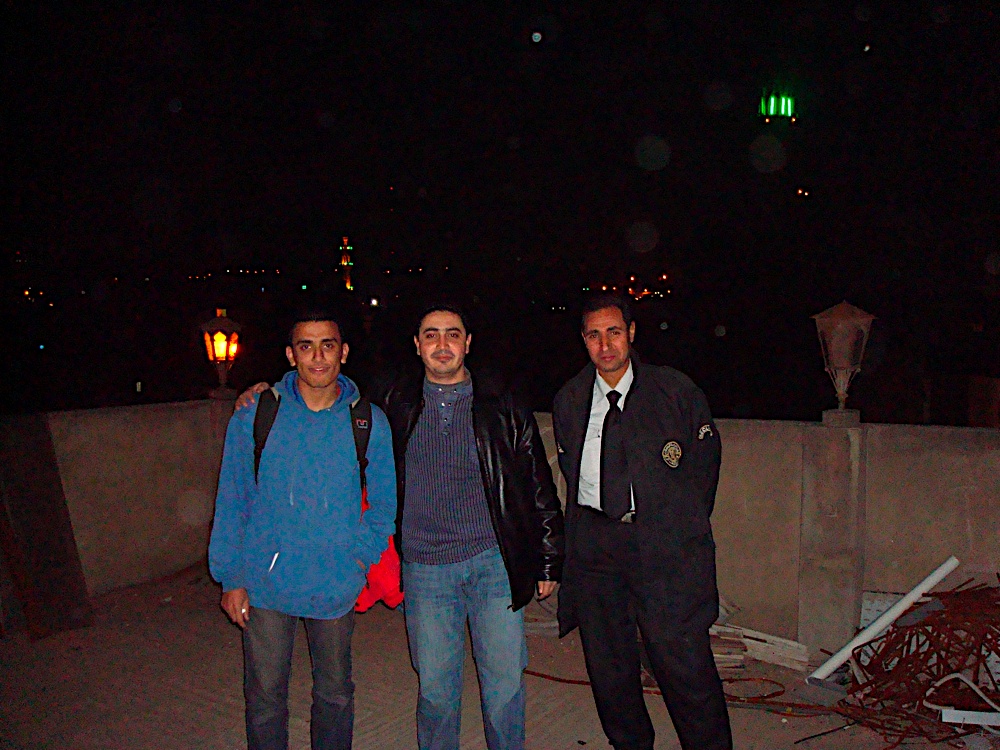
Solar CITIES associate Mahmoud Dardir of the Abu Nimrus Environmental Science Center,  who grew up in and still has family in Darb Al Ahmar, comes to an agreement with Karam and the factory owner, Ali, that they will build a demonstration system on the roof over the bath.
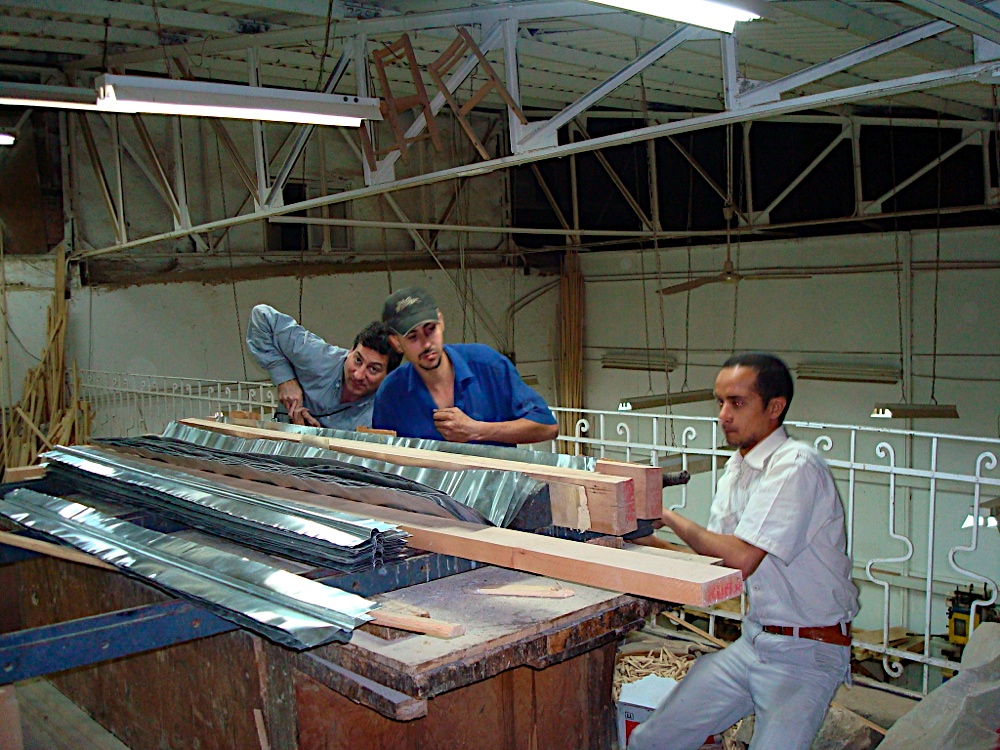
 
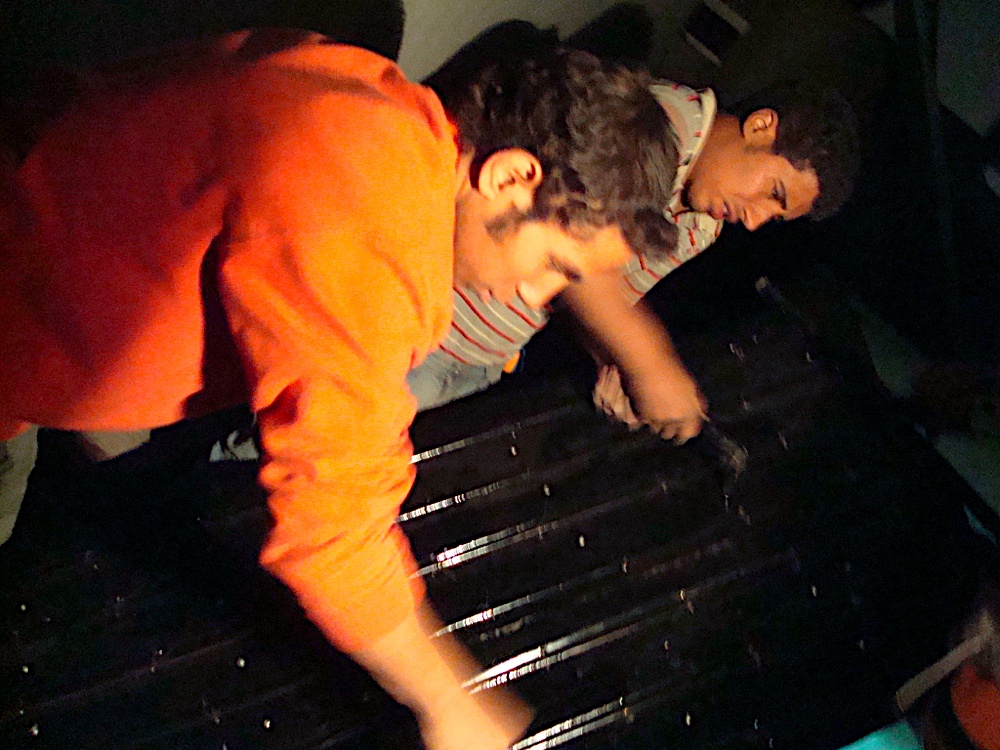
Once the agreement has been made, production work begins at the Aga Khan carpentry workshop where vocational trainer and Solar CITIES innovator Mustafa Hussein has invented a labor saving device for bending the aluminum sheets used as heat absorbers in the solar panel.  T.H. and Ayman Fathy, the brother of Solar CITIES green-collar trainer Hanna Fathy, help bend the sheets.
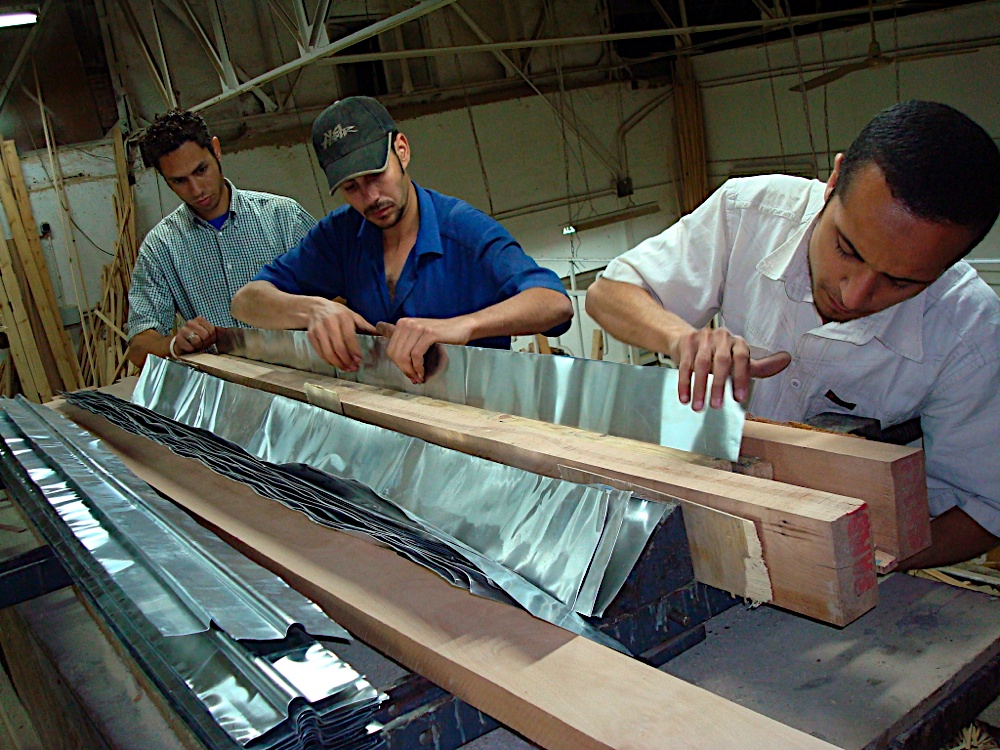
 Hanna joins in the fun.


All in the family:  Ayman, who drives a recycling truck as his day job, offers to use his truck after hours to work with Hanna to transport the iron solar tank stands that were welded in the Zabaleen community , and the aluminum, machined in Darb Al Ahmar, to the baths.  In this way the Zabaleen continue to offer their historic service to Darb Al Ahmar, but now are introducing solar energy into their portfolio of environmental industrial ecology solutions.
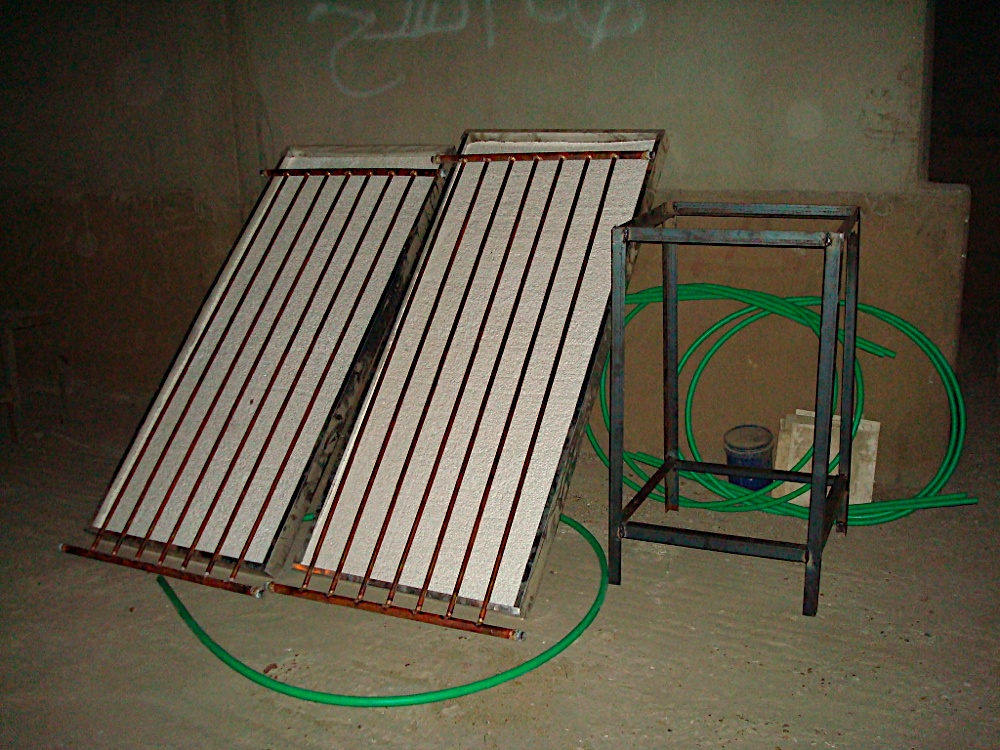

 The system starts to take shape on the roof.
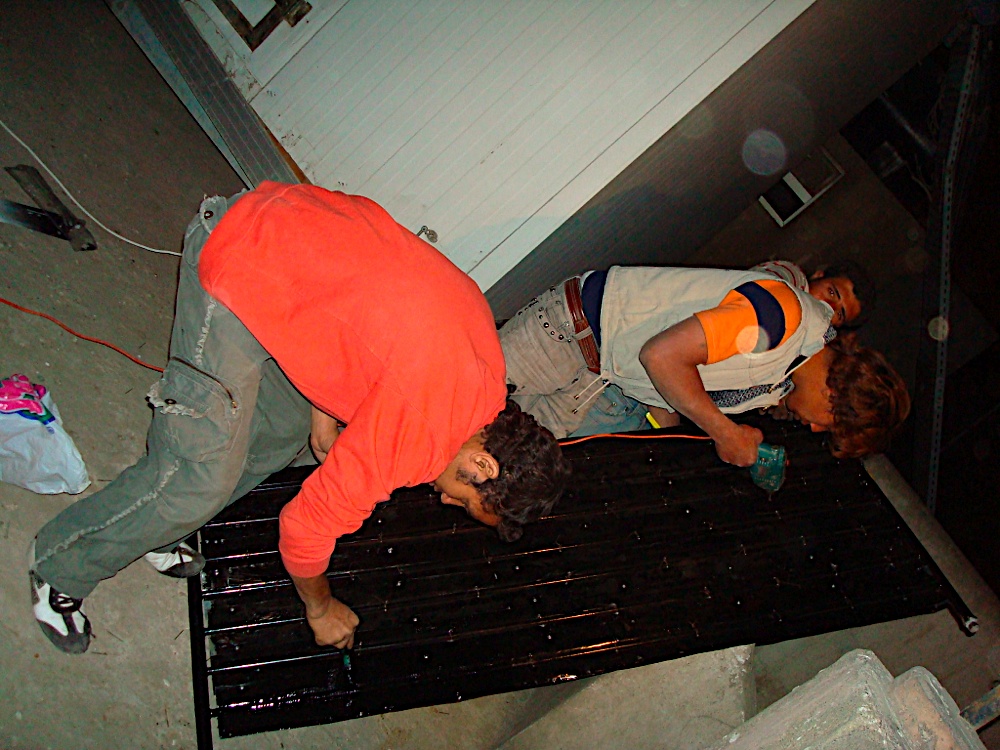


Zabaleen Recycling School Teachers and Solar CITIES engineers Adham, Nabil and Moussa work after hours in Darb Al Ahmar to paint, tie and rivet the aluminum sheets onto the copper pipes that were welded in the Zabaleen community.

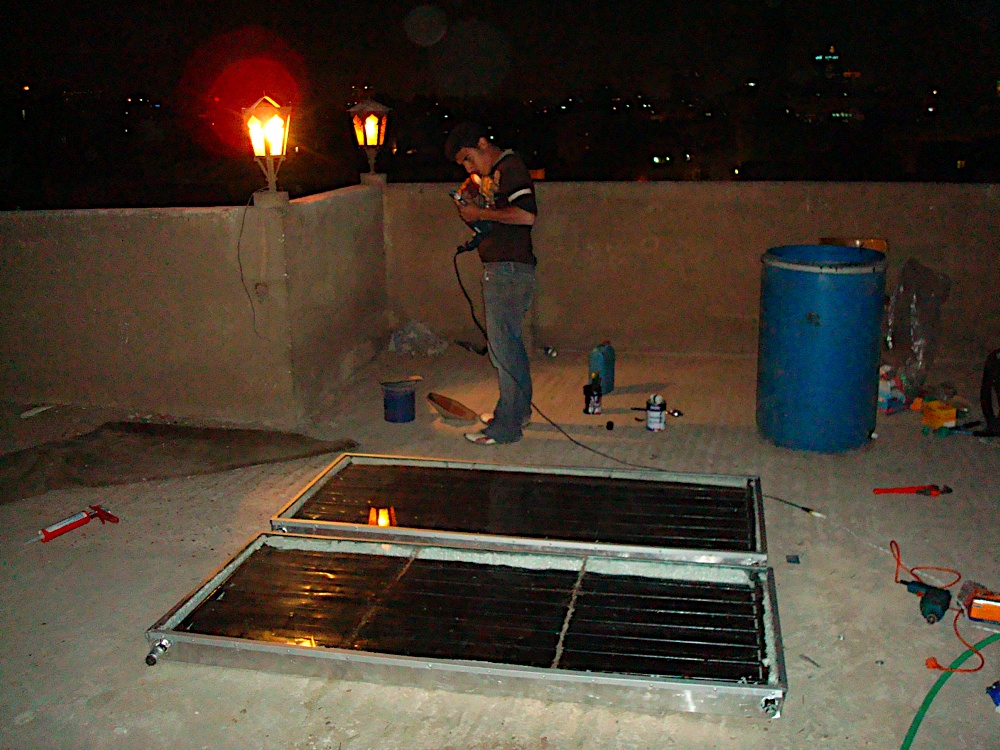
 
Zabaleen Solar Technician Mousa works late into the night building the system on the factory owner's roof in time for the visit of National Public Radio producers Liane Hansen, Davar Ardalan and Ned Wharton, who did a program on Solar CITIES work.
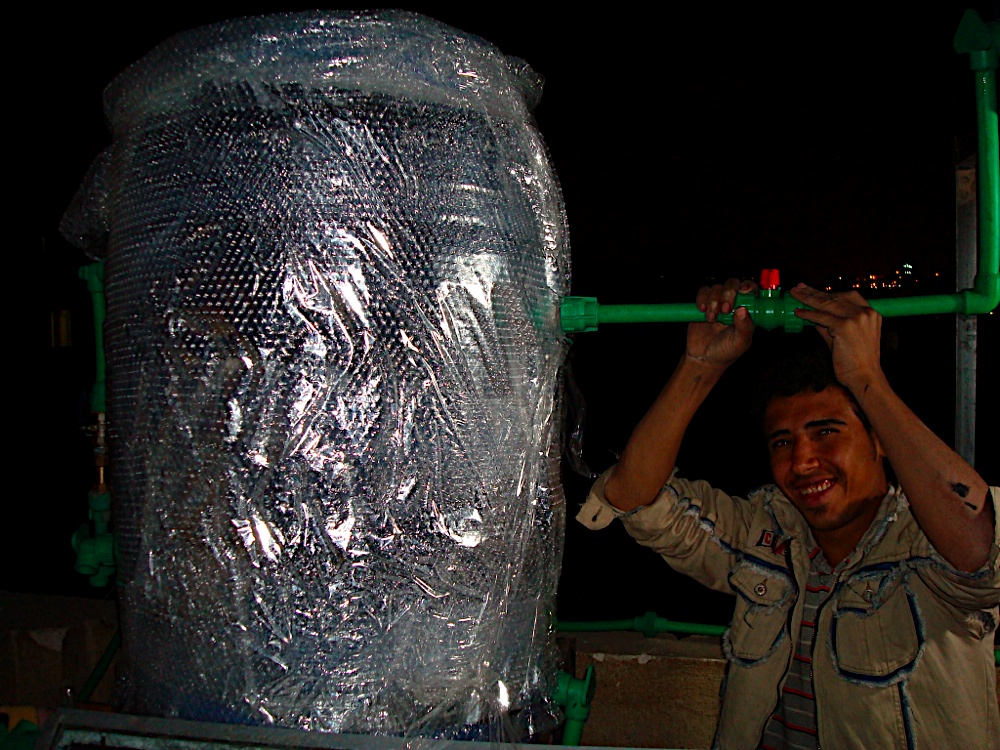
 
Mousa adds plumbing to his skillset as he connects the system to the bubble-wrapped recycled plastic water tanks that are one of Solar CITIES innovations for keeping the systems low cost.
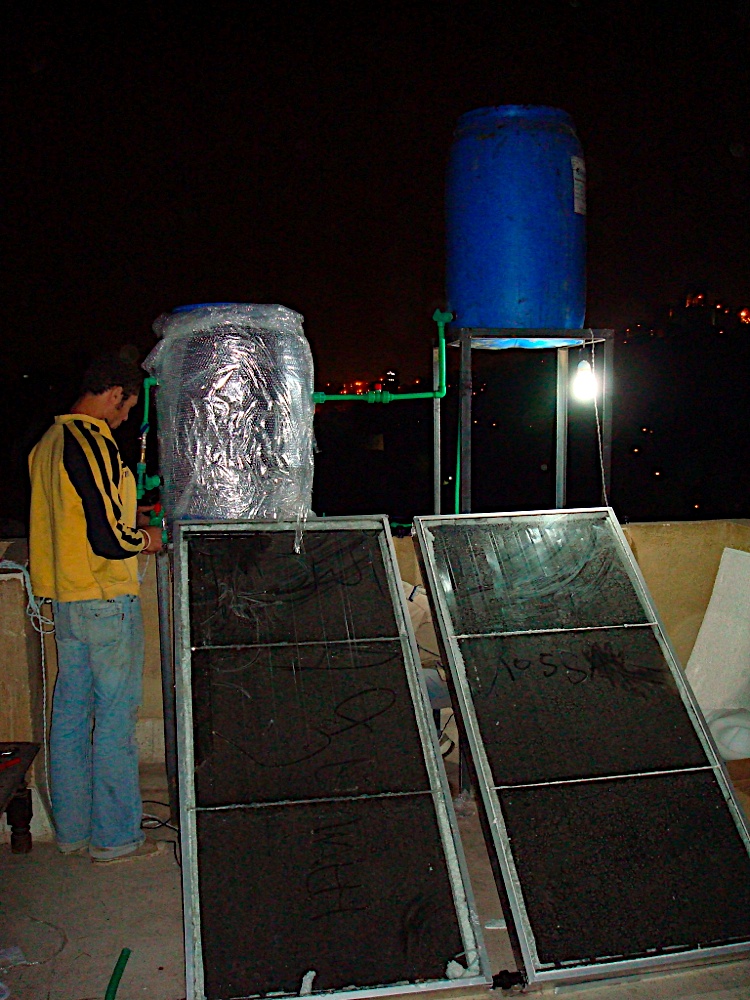
 
Hanna checks for leaks before the sun comes up and makes the water to hot to work with. 
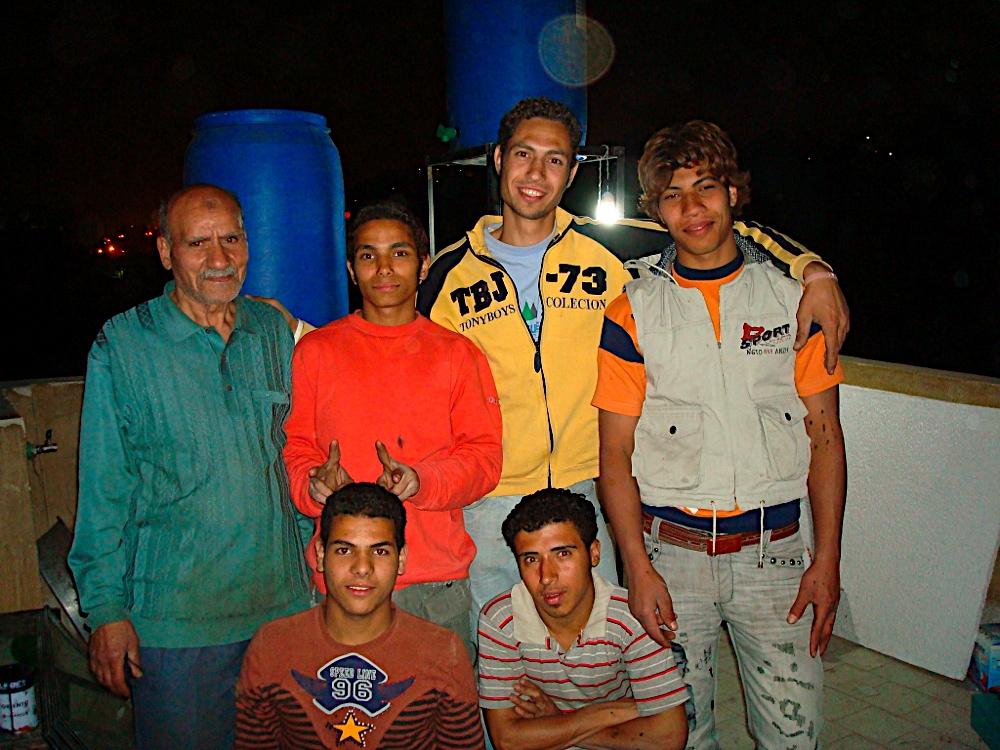
 

The Roh El Shabab NGO Solar CITIES crew, Adham, Hanna, Nabil, Abu Nob and Moussa, stand next to Darb Al Ahmar resident 'Am Hussein, on whose roof they simultaneously finished a solar hot water system, running back and forth in shifts from the bath to Am Husseins roof, so that NPR will have two satisfied families  to visit when they come to do their story.
 
An exhausted but satisfied Hanna Fathy, the Solar CITIES coordinator, inventor, and green-collar jobs trainer for this Roh El Shabab (Spirt of Youth) program, prepares to make the long walk home across the Al Azhar Park and the City of the Dead, hoping that international exposure will help raise funds to enable the team to build enough collectors to revive Cairo's historic public bath and the tradition of the Coptic Christian Zabaleen  and the Muslim Wahis of Darb Al Ahmar working together to find co-generation and cooperative solutions to solving environmental problems.

Friday, December 26, 2008

With today's technology we should have already solved yesterday's problems

On December 10th, 2008, The BBC reported a "Muted Celebration for Computing".  The headline read, ''The 40 years since the "dawn of interactive computing" represent a lost opportunity which has been hijacked by commercialism''.

I reproduce the article below, placing what I think are the most important quotes in bold, and will argue afterward that it is incumbent upon us, the technology USERS, to employ today's powerful computing technology for achieving positive social and environmental ends, or we will have nobody but ourselves to blame for the misery and suffering and loss of life and biodiversity that our folly is creating.

I will also explain how I am preparing to use the new Ipod Touch 1G that I got for Christmas in our Solar CITIES work in Cairo and India.

First, the article that inspired this blog post:

"Muted celebration for computing
By Maggie Shiels
Technology reporter, BBC News, Silicon Valley

The 40 years since the "dawn of interactive computing" represent a lost opportunity which has been hijacked by commercialism.
The claim was made at an event to celebrate the anniversary of the world debut of personal and interactive computing which took place in San Francisco on Dec 9 1968.
At what was dubbed "the mother of all demos", inventor Doug Engelbart also showed off the first computer mouse.
"There's been an explosion of technology but it hasn't reached the level of potential he envisioned in the early 1960's" Mr Engelbart's daughter Christina told the BBC.
"The vision people have for why they are building this technology is more towards commercialisation and maybe entertainment and getting documents to look nicer and crank them out faster.


"But the vision dad (Doug Engelbart) started out with was how can you make people more dramatically effective at how they work collectively to solve important problems in order to make the world a better place?"
"That vision of how do you harness the collective intellect in very powerful ways is missing from the paradigms in how things are being developed today," said Ms Englebart who is the executive director of the Engelbart Institute.
She said the kind of problems this approach would help today include things like world poverty, infectious diseases, clean technology and world hunger.

Doug Engelbart
Mr Engelbart said "the better we get, the better we get at getting better."
"It really is a race because if these problems are increasing in complexity exponentially and if we don't find exponential solutions as to how we work together to solve these problems, then we are sunk," stated Ms Engelbart.

"Innovation just stopped"
Back in 1968, Mr Engelbart's mission at the Stanford Research Institute in developing the technology was very clear. He wanted to solve humanity's most important problems by using computers to improve communication and collaboration.
At the time computing centred on mainframe machines with their punch cards, batch processing and time sharing as opposed to Mr Engelbart's notion of a personal computer and a new way of working.
At the anniversary, held at Stanford University, some of those involved in the project expressed quite vocally their own disappointment that four decades on from that seminal moment in computer history, there is not more to celebrate.
"It wasn't how are we going to sell this technology. It was about let's make the most useful thing we can possibly make," said Jeff Rulifson of the philosophy that drove the team."

Let's reiterate the key point:  Engelbart  "wanted to solve humanity's most important problems by using computers to improve communication and collaboration."  He wanted to "harness the collective intellect".  

And that is also the mission of Solar CITIES -- "Connecting Community Catalysts Integrating Technologies for Industrial Ecology Systems"

Five years ago we brought our laptop multimedia computers into the slums and informal areas of Cairo and showed photos and diagrams and quicktime movies I had taken of solar hot water production factories at work so that our colleagues, who had never had the chance to visit a solar factory, could work with us to figure out how we could build our own systems out of recycled materials.  At the time the laptop was the best, most "nomadic" technology available for "improving communication and collaboration".  Then, about 3 years ago I was able to obtain a Video Ipod (30 GB) and figured out how to use a shareware program called Floola to turn it into a portable harddrive/media player so that I could download those videos, and photos and diagrams and carry the ipod with me to our building sites and community meetings.  One thing I sorely missed, however, with the Ipod, was the inability to get on-line when we needed additional information (such as the best angle to position a solar collector in Cairo -- for that we had to hunt down a local internet cafe) or when we needed applications and tools such as spreadsheets and scientific calculators.  For that I had to rely on my HP Ipac palmtop computer, but when it's battery died and I found there was no way to replace it, and couldn't afford a new one, the party was over.

Now, with my new Christmas present -- the Ipod Touch (1st generation), I'm back in business.

The inspiration for getting this new gadget came from film-maker James Dean Conklin and nuclear biophysicist Alan Bigelow whose environmental activism rock band "Solar Punch" I will be joining in Mumbai in mid-January to do a series of U.S. State Department sponsored "musical goodwill ambassador tours" and environmental workshops throughout India with the IYCN (India Youth Climate Network).   When James and I were in California recently working on renewable energy educational materials for the Frank DiMassa Utility Consulting company, James showed me all the marvelous utilities he and Alan have loaded on to their Ipod Touch units for the goodwill tour.  Besides a host of great apps for doing measurement and translation, James and Alan even had an electric theramin and other synthesizer apps that they use in Solar Punch to create on-stage music.  For Solar Punch the Ipod Touch is not only a Star Trek like communicator, it is a bonafide musical instrument -- recharged by a small portable solar panel, of course.  Beam me up, Scotty!

Now Solar CITIES, like our brothers in Solar Punch, considers these devices an essential part of the toolkit for goodwill and welfare-enhancing sustainable development outreach.  Of course, the hardware has to be loaded with the appropriate software and accompanied by well-educated, well intentioned wetware! The choice we face is using these gadgets as toys or tools for our own personal gain, or vital communicators that enable us to boldly go where no one has gone before -- Twittering against terrorism in Mumbai, sharing how-to videos on self-help home power technologies with landless peasants and shantytown dwellers, connecting community catalysts integrating technologies for industrial ecology systems...

First, of course, I had to make my Ipod Solar CITIES ready.  This meant upgrading the firmware/software to version 2.2 (which cost 10 dollars).  And then I had to "Jailbreak" the ipod by installing QuickPwn and the Cydia Installer.  And to be able to use the Ipod Touch as an harddisk, from and to which I could drag files without using ITunes, I had to install  OpenSSH and a program called BossPrefs on the Ipod (through Cydia) and then install an open source program called MacFuse on my Macbook Pro, and a GUI to use it called MacFusion, so that I can access my Ipod through OpenSSH using a wifi connection. The best tutorial for that is found here:
http://www.hackthatphone.com/20/open_ssh.html

In order to be able to encode videos I had created on renewable energy technologies so that I can show them to my colleagues in Cairo  in the field on my Ipod touch, I had to install a video encoder called FFmpegX (along with its binaries mencoder, mpeg2enc and mplayer -- btw don't get confused by the strange garbage you get when you click on the link to the mpeg2enc binary -- right click on the link instead and do a "save as" without an extension. When you launch FFmpegX it will ask for the location of that file and you will be fine).

And finally, so that I can Skype with colleagues around the world from the Ipod Touch (from Al Azhar Park, which has free wifi, or from any Egyptian McDonalds or Quiznos!) , I had to install an application on the Ipod called "Fring" and purchase the IVoice Pro microphone and speaker. Basically what I have done is turn my Ipod Touch 1st Generation into an Iphone, without needing to buy a phone contract.  And for a sustainable development worker  like me who works with the world's poor communities, is poor himself, and has to roam around the globe but can't afford roaming rates, this is a wonderful thing indeed.  See http://lifehacker.com/378511/turn-your-ipod-touch-into-an-iphone for details.

All this took an entire day and was fairly complicated, involving a lot of tutorial reading and experimentation. The best resource was the website http://www.ipodtouchfans.com/

The result:  A jailbroken ("hacked") Ipod Touch that I can  use in the field to show videos and files about renewable energy technology, and take to anywhere that has wireless and surf the web with my colleagues for more info, or make skype calls to experts when all else fails (as if we were playing "Who wants to be a millionaire").

Solar CITIES Project 2:  Urban biogas

Already I have been able to put the following youtube videos on my Ipod using Firefox's "Video Download Helper" and the FFmpegX (yes, yes, I know, the Ipod Touch has Youtube on it, and I have bookmarked the videos I want to show, but to use that feature you have to be on line, and in the ghettoes where I work there isn't any wifi so...).


 How am I intending to show these videos to our fellow stakeholders in the slums, now that I have converted them to mp4s and put them on my Ipod Touch?  Unlike the 2nd Gen Ipod Touch, Gen 1 doesn't have a speaker.  The screen is a decent size (the ipod Nano I used to use -- which was a gift from James Dean and his newlywed wife, fellow film-maker Elisa Zazerra,  when they came to spend their honeymoon documenting our work with the Zabaleen --  made a curious sight  with crowds gathering in the streets of Manshieyet Nasser to peer down and wonder what it is we were trying to show on the tiny screen!) but still not good enough to make a demonstration to a workshop group, particular with language barriers and illiteracy standing in the way.

To solve this problem I am bringing the Hama AS-63 portable speaker system for larger gatherings; the IVoice Pro I ordered for doing Skype on the Ipod also has a small speaker as well as a microphone for more intimate presentations.  And to get the image onto a nearbye wall or screen, I'm bringing the 3M MPR0110 Handheld Projector, a portable data show no larger than the ipod itself, which uses LEDs to cast an image as large as 50 inches anywhere I shine it.

 
The beauty, of course, is that all of these devices, as Circus Guy and Solar Punch and Solar CITIES have shown on numerous goodwill tours, can be easily solar powered using our foldable Sunlinq CIGS cell solar panels.


We can also use the Solio pocket solar charger that our Solar CITIES colleague and Huffington Post writer  Andy Posner carries on his bicycle trips and President Obama uses, and the SolarStyle charger I picked up in Germany to power my cell phone.


The youtube and ipod revolution isn't going to have the impact we want it to if all we use it for is to share music videos and other "bread and circus" forms of entertainment with other privileged kids around the world, patting ourselves on the back because we can afford to use the "information superhighway" to reproduce trivia around the rich pockets of the interconnected globe.

If we want to make a real change, we must use today's mobile, nomadic computing power to get information into places where illiteracy and lack of access are still major barriers to development.

The technology is here -- it's available at "Best Buy".  Now let's put our best foot forward by taking it to "the other 90%" on the other side of the digital divide so that 40 years from now we aren't still saying, "we didn't do our best with what we bought. We could have done better."

Tuesday, November 11, 2008

"It's gonna be a new day for you!"


Up until election night I was listening with great hope to one of my favorite Basia songs called "It's gonna be a new day for you!". On November 5th our half German/half America son, who had spent a mere 19 weeks on the planet Earth by that point, arrived for the first time on the shores of his father's native America with his mother, to see that new day dawn.

Barack Hussein Obama was chosen, in a landslide victory that restores American democracy, to be the next president of the United States.

For all of us around the world who are eager to see our cities become solar cities, this is the best thing to happen in the history of world politics. Sure it is sad that we have had to wait until the end of the first decade of the 21st century to begin creating a government with both the economic and political power to embrace the hard work so many around the earth have done to create effective ways of capturing clean energy and lead the world into a sustainable future. We could have gotten there are century ago if the work being pioneered in Egypt during the coal crisis at the end of the first decade of the 20th century had been expanded. But here we are.

A new day is finally dawning.

So we can celebrate.

And then get back to work.

The hard work of kicking the oil habit.

We are like any addict who has declared he has a sickness and now truly wants to be cured -- now comes the daily challenge of meeting that commitment.

But as Obama has reminded us, "yes, we can!"

Congratulations America. Congratulations all of you in the world who have worked for, dreamed of and waited for a brighter future -- a sunlit bright future.

It's gonna be a new day for you.

Let's do it!

Thursday, October 23, 2008

Let them eat clothes?


Are we prepared to send a 21st century Marie Antoinette to Washington?

As someone who has worked with poor communities in the U.S. and abroad my entire career, I am very much hoping for an Obama presidency to recalibrate the compass of American responsibility.

How the Republicans can claim Obama wants higher spending when they steal from the public purse and give handouts, tax breaks and subsidies to the fossil fuel and nuclear industries kills me. Merely by removing those we will be able to level the playing field and make renewable energy competitive, without any additional spending. And Obama has said time and again he wants to use those wasted dollars to fund his initiatives. That's one point that seems to be lost on those who thinks he is a "tax and spend" presidential candidate.

But while we are on the topic of spending: Is it just me, or does anybody else see the similarity between Sarah Palin and Marie Antoinette with what basically amounts to a "let them eat clothes" philosophy?

Does anybody else remember Imelda Marcos adding to her extravagent shoe collection while Philippinos starved and see the connection?

I still can't get over the gall of the Republican National Committee letting a Republican VP nominee whose whole campaign is about being "a regular hockey mom like the rest of us" spend $150,000 of campaign money on clothes and makeup in two months! It especially irritates me when all our Solar CITIES organization could get from US AID was a paltry $ 25,000, 6 times less than this self-described "barracuda"'s sartorial splurge, to fund an entire year's worth of infrastructure materials to help the poor in Cairo with green collar jobs training and renewable energy facility construction.

The Republicans are supposed to be using America's wealth to make the world safe for freedom and democracy, not to fund beauty pageants. The real war on terror and the real fight against climate change come from ending deprivation and suffering and ending reliance on fossil fuels. It comes from changing hearts and minds, not clothes. The Republicans talk big about fighting on these fronts, but they don't put their money where their mouths are, and the lie of it is all the more discouraging.

The worst of it is that the Republicans justify Palin's "beauty and fashion" expenses by saying they'll give these overpriced jackets and skirts to charity!!

"It was always the intent that the clothing go to a charitable purpose after the campaign," said Tracey Schmitt of John McCain's campaign...

What? Give a handful of poor people $10,000 designer suits? How is that supposed to help impoverished communities? Are they supposed to applaud while the "lucky" recipients strut up and down the garbage strewn runway, doing a bad impression of Tina Fey doing a good impression of Sarah Palin? Is that what "charity" -- "Caritas" -- "caring" is about today?

That's much worse than "let them eat cake".... At least cake has some nutritional content from the eggs... I think Palin, the would-be queen consort of McCain, should go down in history as the newest Marie-Antoinette (1755-93), the Queen consort of Louis XVI.

And this isn't an isolated incident for the McCain/Palin ticket: McCain's wife has the same philosophy, wearing what Vanity Fair calculated to be a $300,000 outfit.


I guess the VP spending only half that amount is considered a show of good faith, except Cindy McCain is the heiress of the Budweiser fortune, so assumedly her extravagance comes from private wealth. Palin's comes from the public purse.

"I intend to give my clothes to charity when I'm done with them" says Palin, by way of defense. Hand-me downs for all the poor folk who want to try their luck making it big on Saturday Night Live or don't have any other costume for Halloween, huh Sarah? Is that what you had in mind?

I say make her eat her own words... and hope she chokes on them.

____________________________

T.H. Culhane is neither a democrat nor a republican, but an independent voter whose family comes from small town midwestern America. He is a direct descendent of Joseph Robidoux, who founded St. Joseph Missouri. He spent much of his childhood with his 16 cousins at his grandmothers house in the cornfields outside Rockford Illinois. He considers himself a "real American" with "real American values". Among them are frugality, honesty and integrity and a belief in liberty and justice FOR ALL.

Wednesday, October 15, 2008

"The Solar C3ITIES Solar Challenge" to Joe the Plumber (and Ahmed the Plumber and Mohammed the Plumber!).


(Solar C3ITIES first intern, Freiburg social sciences student Cornelia Koeck, cutting aluminum sheets in Hanna Fathy's Zabaleen apartment solar energy workshop. All Photos in this post by Connie Koeck.)

Solar C3ITIES is happy to announce that our first official intern since we became a legal German "Verein" (NGO) has returned to Germany after a successful summer in Cairo.

Ms. Cornelia "Connie" Koeck, a 25 year old student of Social Science at Albert-Ludwigs-University in Germany's premier solar city, Freiburg, spent the hot summer months working with Solar C3ITIES' Green Collar Jobs Trainer Hanna Fathy building solar hot water systems on the rooftops of buildings in Muqattam and Darb Al Ahmar in the slums and informal areas of Cairo, Egypt.

Connie's assignment was what we call "The Solar C3ITIES Solar Challenge": Learn how to build -- and then actually build ! -- a practical solar hot water system -- from scratch, out of local and recycled materials found in small mom-and-pop markets and in garbage dumps -- and install it on the home of at least one poor Cairo family. Her "aufgabe" (homework): Create a clear, illustrated manual in her native language (to be translated into English and Arabic) that could help others around the world to do the same thing.

(Connie's First Solar Hot Water System near the Darb Al Ahmar Mosque).

The Solar C3ITIES Challenge follows the modified motto "Force somebody to buy a fish and you will have fed him for today but made him poorer for tomorow ; Learn how to fish and share the knowledge with your friends and you create a skilled social network that can provide enough for all in both good and bad times."

This spring Solar C3ITIES will launch its "Urban Bountiful Biogas Challenge", as T.H. and Sybille head back to Cairo to figure out how to turn city garbage into clean cooking and heating fuel and fertilizer, servicing families who have no access to direct sunlight. But we are getting ahead of ourselves...

Beyond the "Rule of Experts"

Connie took a train from Berlin to Essen to meet with us before embarking on her trip overseas and expressed her concerns and her resolve, "I'm a social science student" she said, "and I have no practical experience with engineering, physics or with building things. But I'm willing to get in there and give it a try."

She was encouraged by the fact that T.H. Culhane, co-founder of Solar C3ITIES , and co-inventor of our signature "Plastic-Barrel Solar Hot Water System" was also a mere social science student (a Ph.D. candidate in Urban Planning, Environmental Policy and Analysis at UCLA), who also had absolutely no background or supervised experience in engineering or physics. T.H. told her, "the intelligence is in the network. We operate according to the distributed intelligence principles of "swarm" or "hive" intelligence. Somewhere in every community are nodes of specialized brilliance -- a local welder or mechanic or plumber or carpenter or waste recycler. You go in as a community catalyst, connecting other community catalysts and hooking up and organizing the social network of skilled participants toward a common goal. Then you learn from each other as you get the job done."

Based on this philosophy Solar C3ITIES created the C3ITIES acronym that serves as our mission statement: "Connecting Community Catalysts Integrating Technologies for Industrial Ecology Systems".

The Solar C3ITIES mantra is that ALL OF US can acheive domestic energy independence, regardless of our backgrounds or educational specializations. The idea behind our program has been that if normal people LIKE US can kick the addiction to fossil fuels, all you hockey moms and joe-six-packs and public policy makers and Harvard Law School graduates NOT TO MENTION ALL THE "JOE THE PLUMBERS" (who already know about water and energy infrastructure) can too -- with your own two hands (and those of your community) and without drilling one-more drop of oil, to say nothing of splitting atoms or mining coal. Once you feel the power that comes from working on the household level with friends and neighbors to solve your own energy crises, you realize that we don't really need "governments" or expensive "consultants" or "specialists" or "big businesses" to solve our problems, just the collective intelligence of human beings sharing a common purpose.

The Results:


Connie photographed Solar C3ITIES green collar jobs coordinator, Zabaleen innovator Hanna Fathy (center), who trained Connie, describing a system he built next to Al Azhar park to British-American micro-finance expert Rosalind Copisarow and an Egyptian journalist.

Connie returned to Germany a solar hot water engineering expert. She built her solar hot water system on the rooftops of Cairo and created the training manual she set out to make (which will be available soon). Below are some of the diagrams she produced, which we reproduce here so that any of you out there in the blogosphere who want to get started on your own energy independence project can do so:

Tools you'll need:


The schematics:


Figure 1 shows the water flow of our two tank system. Note that our innovation is that we use OPEN (although covered to prevent heat loss and evaporation) vertical tanks. Note that the blue arrow inside tank B, the hot water tank, is actually a polypropylene pipe carrying the cold water to the bottom of the barrel.


Figure 2 shows the critical placement of the two recycled plastic shampoo barrels that make up our system, giving maximum flow and thermosiphoning.

Figure 3 shows the critical placement of all the pipes and float valves in the system. After a year of experimentation T.H. Culhane and Hanna Fathy discovered that these were the correct dimensions for a system that uses 3/4" Zahran tank float valves to work during the winter months. We suggest, if you aren't an engineer, that you follow these measurements exactly (unless you really want to experiment and can find an improvement).


(Note: We use the less expensive 1/2" Zahran float valve (picture left) for the cold water tank because we aren't concerned about flow rate filling the tank with cold water, which only occurs when the neighborhood has water pressure anyway (the soap suds in the picture are because we use recycled shampoo barrels that always have residue of shampoo in them. It is safer than using barrels that contained chemicals, and you don't have to wash them out. For the first few days you also don't have to use shampoo!) For the hot water tank (picture right) we use the larger 3/4" float valve between the cold water inlet and the hot water tank (note the green 3/4" polypropylene pipe descending to the bottom of the tank) so that water flows in as fast as it flows out through the 1/2" outlet to the household shower. We found that due to the long drop to the household the water would drain faster than it was being replaced if both were 1/2". The disadvantage, though, is that the 3/4" float is very large and takes up space that could be used for hot water. We sacrifice about 25 liters because of this. A better solution would be to find a way to use the float from the 1/2" valve with the mechanism from the 3/4" system, but they do not work together. Inventor Magdy Zahran tells us that a redesign would require expensive retooling and the market for do-it-yourself solar systems is of course too small. So it appears we are stuck with this compromise!)

Figure 4 shows the Zahran plastic tank nipple and the photographs show the Zahran float valves, 1/2" for the cold water tank and 3/4" for the hot water tank. We used to use metal nipples with rubber gaskets and steel pressure plates, but they tend to rust and the metal wears away at the plastic of the barrel, eventually leaking if too much stress is placed at the join. Figure 5 shows how we insulate the hot water barrel (which is otherwise identical to the cold water barrel) by creating a styrofoam box and filling it with waste bits of styrofoam and fiberglass, wool, scraps of paper etc. to kill airflow. Note that we first wrap the tank with shiny mylar or aluminum foil, then bubble wrap, tehn another layer of mylar, to keep heat internally reflecting.


Figure 6 shows the construction of the solar collector itself. This is fairly standard: a box made of 1 mm aluminum sheets (1 x 2 meter, bent into a box) filled with styrofoam sheet insulation on the back and the sides, with welded copper pipe attached to guttered aluminum strips painted black, covered with glass, with special sauce on a sesame seed bun. We've also made the collector box out of wood and recycled pressed plastic sheets, but aluminum is the quickest, easiest and lightest. We make our absorber plates out of aluminum strips (preferred) but we've also made them out of recycled butter tins, soda cans and other thin scrap metal. When all is said and done, we find it simplest to buy 1 mm 1x2 aluminum sheeting for the box and .5 mm aluminum sheeting for the absorber fins to save on labor and for durability.


Figure 7 shows how we connect the panels in series, using screw couplings, allowing the system to expand with additional family members (we recommend a two panel system for a family of 4, with an additional panel for every additional 2 family members; each panel puts out approximately 100 liters of bath temperature water in the summer, 75 liters in the winter)


Figure 8 Shows the placement of the valves in the system. It is critical that one put a one-way valve before the cold water tank inlet (not shown) to keep water from backflowing when there is no water pressure (a daily occurence in inner-city Cairo). Another one-way valve is needed somewhere along the hot water outlet pipe to the house to prevent water cold water from backflowing into the hot water tank if the plumbing in the household isn't properly done (as is often the case). Too often, in a country with bad materials like Cairo, a family's faucet mixer will break and the cold water will go up the hot water pipe and flood the roof if there is no one way valve. We recommend AGAINST placing the valve as shown in the picture, so close to the tank because their isn't sufficent pressure to open it. A better placement is actually IN the bathroom, where it can easily be serviced, or at least at the lowest accesible point on the roof before the hot water pipe goes down to the household.


Many old people in the community risk their lives boiling water for bathing on kerosene and gas stoves. Accidents from explosions and scalds from spilled hot water send hundreds of children and elderly residents to the hospital every year. Now this old gentleman (above right) never has to worry about his safety, or the increasing struggle to carry buckets of hot water to the bathroom again. Furthermore, and very imporant to an old pensioner with no income, he never has to pay to heat his water again!


Hanna Fathy, green collar trainer of trainers, shows Connie step by step how to build a Solar C3ITIES system.

Trainer of Trainers

Our successful Solar C3ITIES intern, Cornelia Koeck, is now a Solar C3ITIES expert and can now become a trainer of trainers. We certainly don't expect her or anyone to spend their lives on slum rooftops building solar hot water systems. Our green collar jobs training program assumes that some folks on our "Planet of Slums" will decide to create lucrative businesses out of domestic renewable energy programs. This is particularly appropriate for JOE THE PLUMBER in the U.S., and AHMED THE PLUMBER in Muqattam and MOHAMMED THE PLUMBER in Darb Al Ahmar with whom we built our solar hot water systems in Cairo.  But we know your average hockey mom or Joe-six-pack or Harvard Law School Grad or Social Science or Urban Planning student will have other priorities. Still, we believe that once you have built a working, practical, inflation-resistent (let us say these days "FINANCIAL CRISIS RESISTENT") energy independence system, you still have one more duty as a concerned Solar Citizen:

Pay it forward!

Pass the knowledge on, help a friend or neighbor or somebody less fortunate than you elsewhere in the world to become energy independent (all of us who are addicted to oil are less fortunate than those who aren't, n'est-ce pas?). Then move on to other challenges (like the Solar C3ITIES urban bountiful biogas challenge!) and keep moving forward, step by step, community by community, until the threats of wars for foreign oil, the despoiling and degradation of our environments and the destructive potential of climate change become merely scary bedtime stories we will tell our children of the way we were when we were young and naive, back when silly people thought humanity could simply drill our way out of our messes.

-- T.H. Culhane


(Solar C3ITIES co-founder T.H. Culhane demonstrating solar and fuel-cell technology in Syria on September 11, 2002,on a U.S. State Department tour, meets anti-war protesters and suggests Damascus become a solar city and that the Middle East end its own addiction to fossil fuels and interests in nuclear power as a way to prevent war.)

Sunday, September 14, 2008

Mother Courage to Mother Earth:"Global Warming is not a problem..."

Global warming is not a problem.

So says Mother Courage to Mother Earth and all her "worthy" citizens.

Neither are rockslides, hurricanes, earthquakes, sea-level changes, tsunamis, brush fires, epidemic diseases, shortages of clean water, fuel, or food.  Ditto for radiation and toxic waste.

None of these "environmental" problems are anything to worry about. Not if you are worthy. If you are part of the chosen, elect few. The blessed but anything but meek.  The elite.

Global warming is not a problem.

Not if you have Airforce One at your disposal, like George Bush.  Not if you have so many homes in secure and beautiful parts of the world that you can't even remember how many you can take refuge in, like John McCain.  Not if you are wealthy enough to be able to "go with the flow" and move on to "higher ground" and "greener pastures" when one area "goes bad" or "gets used up".  Ask any swarm of locusts (or the invading aliens in "Independence Day").   As Ronald Reagan famously said when asked if the destruction of our environment was anything to worry about, "h-we-y-ll,  the scientists tell me, man will adapt...".

Yeah Ron.  "THE MAN" will adapt. If you've got money and connections there's plenty of pleasant resorts to go to when disaster strikes. It's the rest of us John Does and Jane Does out here who have nowhere to run.  But I guess we can't expect the filthy rich to understand our plight, can we?

When I am following the words of Jesus Christ, our Savior, I can not really blame the greedy, callous "ruling crass" for being callously indifferent to the plight of others.  Christ even asked God to "forgive them... for they know not what they do."  So I am hardly in a position to judge.

On a good day.

When I am feeling generous.

Today I'm feeling pissed.

Another tragedy has struck America in the form of Hurricane Ike.  With global warming we can expect ever more of these disasters.  People have sustained enormous material and financial and emotional losses, some are injured and  dead, vast numbers are without electricity.  What does our commander in chief do?  He uses the opportunity to suspend EPA rules that we put in place to prohibit the import of dirty gasoline from foreign countries.  He doesn't ask other parts of the state to deliver fuel to the hardest hit areas.  He doesn't  tap into our strategic reserves, pledging to get us through the crisis and then restock them when the Texas refineries are operating again.


He certainly doesn't prepare to send in solar gen-sets (like the solar cubes now being sent to Iraq)  that can get lights and power up and running within a few hours and depend on no shipping of filthy and dangerous fuels.   Instead he pledges to send in a whole bunch of gasoline and diesel powered generators and uses the crisis to set a precedent for dismantling the few protections we have against being flooded not by storm waters but  by health hazardous cheap gasoline.

See Bush talk about his plan here:
 http://news.bbc.co.uk/1/hi/world/americas/7615424.stm 

Why?  Could this be how he plans to bring about a sudden "reduction" in the price of gasoline at the pump to make it look as though his administration can solve the domestic problems facing the nation?
At the very least,  if it can't bring the price down, his policy destructive act looks like a desperate bid to keep the price from going up again while our refineries are putting themselves back together, so that people don't suddenly realize that the current Republican-party policy of keeping us addicted to oil lurks behind both the causes of these alarmingly frequent extreme whether events AND the terrible symptoms caused when the storms knock out our refineries. We should have weaned ourselves off of dependence on oil refineries long long ago.  Certainly after Katrina we should have started building a diverse portfolio of renewables so aggressively that the return of electricity to the Texas coast would have merely awaited the passing of the clouds (hell, with T. Boone Pickens plan, we wouldn't even wait for the sun to come out again -- the strong winds after the hurricane would bring us a good dose of windpower!)

No, Bush's response to the crisis is opportunistic.

Another surge in oil prices caused by the greenhouse effect  and our dependency on vulnerable oil infrastructure might just tip voters toward candidates who truly intend to break our addiction to fossil fuels.

So what does our commander in chief do?  He gives the green light for more dependency on foreign oil -- and this time he allows in the filthy kind that makes the air of places like Cairo, Egypt unbreathable and causes over 10,000 deaths every year there from respiratory illness while causing an average IQ drop of 4 points because of lead (yes, Cairo still uses leaded gasoline! And so might you again with the EPA rules broken!)

And all in the name of "helping the victims".  Yeah, right.  Sounds suspiciously like the argument some Egyptian government authorities are using to drive the poor out of the valuable real estate in "rockslide prone" Muqattam hills (see last post), sounds like the argument some American government authorities used after Hurricane Katrina to get poor people (mostly of color) out of prime waterfront realestate in New Orleans where they intend to build floating casinos and hotels.

We've seen this kind of behavior often enough.  Bertolt Brecht created a famous character in one of his plays who epitomizes such opportunistic behavior:  Mother Courage.


Mother Courage, if you remember the play, is an opportunist who, during the long periods of perpetual war, shuttles back and forth from one side of the front to the other, selling things to the soldiers and victims on both sides of the conflict.  She makes herself out to be a philathropist.  She constantly laments the loss of life, the suffering and the horrible costs of war to everybody who will listen, but deep inside is glad every time there is a tragedy, for that is when she makes her big business profits.

And so it is with an American business community and its government stooges who have figured out ways to benefit from every crisis.

Ask yourself why some of the wealthiest companies and politicians continue to deny the dangers of climate change, or of nuclear power and proliferation.

I tender to you that it is because for such wealthy, powerful opportunists there is very little danger.

For the filthy rich and the greedy rich Golbal Warming is not a problem and human suffering often proves to be a great business opportunity (er... not all rich people are like this, I hasten to point out;  I don't want to  alienate all of my wealthy philanthropist friends and neighbors and benefactors and patrons; you know who you are!) 

The attitude of those whom we can call "filthy" rich and "greedy" rich  is like that of George C. Scott as General Buck Turgidson in Stanley Kubrick's Dr. Strangelove (or "How I stopped worrying and learned to love the Bomb":) "I'm not saying we won't get our hair mussed up, [but what are we going to lose], 10-20 million [people] tops, depending on the breaks."

  That quote sums up the feeling quite well -- for those who have comfortable ranches on Texas high ground, or  have more houses than they can remember, disasters are merely a bad hair day.  And when they start combing it out, they find incredible opportunities -- a chance to instantly reverse important and hard won government regulations (the Hurricane Ike prompted dismantling of the EPA restrictions on dirty fuels) , a chance to rally the nation into an unnecessary war (the strange linking of Sept. 11th tragedies to control over Iraqi oil and a chance to test new weapons there), the chance to get the poor out of prime real estate (Hurrican Katrina's displacement of people of color and the proposed displacement of the Cairo poor after the rockslide).


I don't know about you, but when I went to see the Biosphere II experiment built by oil tycoon Ed Bass in the Arizona desert (created as an experiment to see if we could survive on the harsh surface of Mars),  and we passed all the posh golf-courses and lush gated communities springing up in the desert along the way, I got a strange feeling:

I began to think that for those with lots of money and power there could never be any  environmental problem worth worrying about.   The earth be damned, I thought, if you can get a rich Arizona presidential candidate into the White House and you can afford to build a bunch of 100 million dollar Biosphere II modules with all the luxuries and comforts you need, sealed off from the threat of Hurricanes, fires, and floods and safe from radioactive fallout, why worry about the rest of the people and creatures out here in Biosphere I?   In fact, if you take your James Bond movies seriously, the real rich supervillains always wanted to destroy the world so they could save it, and start a new Eden.  But of course, you'd have to be some kind of Bible literalist to think that scheme would work.  Scientists know that for a host of reasons (having to do with ecosystem interdynamics and the extinction rates caused by the "island effect" -- see MacArthur and Wilson's classic studies)  Biosphere II experiments will always ultimately fail.  Only religious fanatics who don't understand or believe in evolution would take the risk of letting our planet's ecology get out of control.

And there's no chance of them getting control of the White House, now is there?

So what's to worry about? No problem.